Life and Health Sciences Research Institute (ICVS), School of Medicine, University of Minho, Braga, Portugal.
ICVS/3B's - PT Government Associate Laboratory, Braga, Portugal.
Sci Rep. 2019 Mar 12;9(1):4187. doi: 10.1038/s41598-019-40695-3.
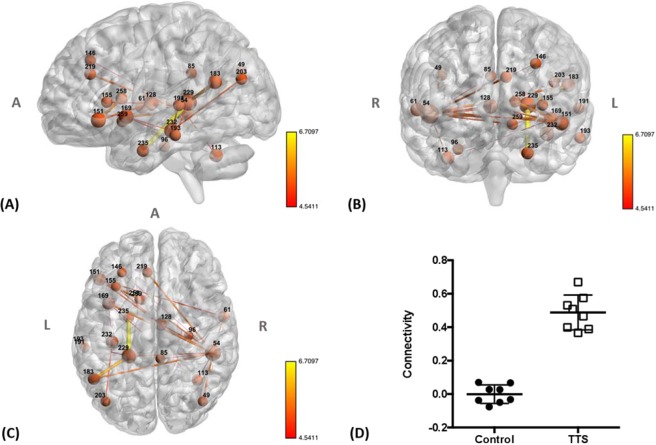
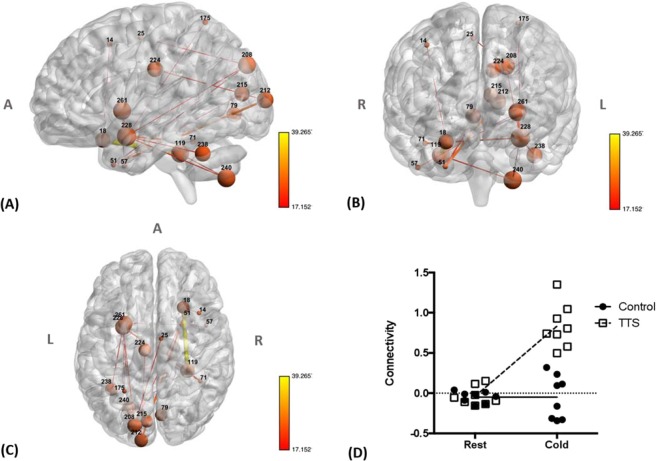
Takotsubo syndrome (TTS) is an acute, reversible cardiomyopathy. The central autonomic nervous system (ANS) is believed to play a role in this disease. The aim of the present study was to investigate the patterns of brain functional connectivity in a sample of patients who had experienced a previous episode of TTS. Brain functional connectivity, both at rest and in response to the stressful stimulus of topical cold stimulation, was explored using functional magnetic resonance imaging (fMRI), network-based statistics (NBS) and graph theory analysis (GTA) in a population consisting of eight patients with a previous episode of TTS and eight sex- and age-matched controls. At rest, a network characterized by increased connectivity in the TTS group compared to controls and comprising elements of the central ANS was identified. GTA revealed increased local efficiency, clustering and strength in regions of the bilateral hippocampus in subjects with a previous episode of TTS. When stressed by local exposure to cold, the TTS group differed significantly from both a pre-stress baseline interval and from the control group, showing increased connectivity in a network that included the left amygdala and the right insula. Based on the results, patients with TTS display a reorganization of cortical and subcortical networks, including areas associated with the emotional response and autonomic regulation. The findings tend to support the hypothesis that a deregulation of autonomic control at the central level plays a significant role in this syndrome.
心尖球形综合征(TTS)是一种急性、可逆性心肌病。人们认为中枢自主神经系统(ANS)在这种疾病中起作用。本研究的目的是在经历过先前 TTS 发作的患者样本中研究脑功能连接的模式。使用功能磁共振成像(fMRI)、基于网络的统计学(NBS)和图论分析(GTA),在由 8 名经历过先前 TTS 发作的患者和 8 名性别和年龄匹配的对照组组成的人群中,研究了静息状态下和对局部冷刺激应激刺激下的脑功能连接。在静息状态下,与对照组相比,TTS 组的网络特征是连接性增加,包括中枢 ANS 的元素。GTA 显示,TTS 组双侧海马区的局部效率、聚类和强度增加。当受到局部冷暴露的压力时,TTS 组与应激前基线间隔和对照组相比差异显著,显示出包括左杏仁核和右岛叶在内的网络连接性增加。基于这些结果,TTS 患者显示出皮质和皮质下网络的重组,包括与情绪反应和自主调节相关的区域。这些发现倾向于支持这样一种假设,即中枢自主控制的失调在这种综合征中起着重要作用。