Sugawara Kikuchi Yuka, Shimizu Tetsuo
Department of Neuropsychiatry, Akita University Graduate School of Medicine, Akita 010-8543, Japan,
Neuropsychiatr Dis Treat. 2019 Feb 22;15:543-547. doi: 10.2147/NDT.S189050. eCollection 2019.
The core features of dementia with Lewy bodies (DLB) are cognitive fluctuations, visual hallucinations, and parkinsonian symptoms. Although there have been several reports on the efficacy of treatments for psychotic symptoms in patients with DLB, little is known regarding the treatment effects of aripiprazole. The aim of this study was to evaluate the efficacy and safety of aripiprazole for the treatment of psychotic symptoms in patients with DLB.
We employed a 10-week, open-label study design with 11 patients who met the criteria for DLB. The patients had previously experienced persistent or intermittent delusions, hallucinations, or both for at least 1 month. Aripiprazole was initiated at a low dose (3 or 6 mg/day) and titrated to higher doses at 2-week intervals or more rapidly, as needed. The Neuropsychiatric Inventory (NPI), Brief Psychiatric Rating Scale (BPRS), and Clinical Global Impression-Severity (CGI-S) were administered at baseline and 1, 2, 4, 8, and 10 weeks later. The Simpson-Angus Scale (SAS), Clinical Dementia Rating (CDR), and Mini-Mental State Examination (MMSE) Scale were evaluated at baseline and at week 10. The NPI, CGI-S, and BPRS scores were compared between the baseline and each assessment point and between each assessment point and the one before assessment point. The SAS, CDR, and MMSE scores were compared between the baseline and the end point.
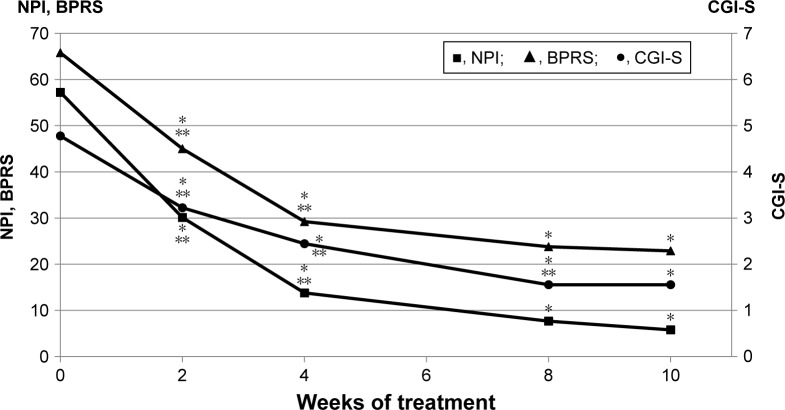
The mean NPI and BPRS scores improved until the fourth week; they significantly decreased at each assessment point compared to the previous one. Afterward, improvements slowed and continued without significant decrease. The median SAS scores significantly decreased at the end point compared to the baseline (<0.05). The median MMSE score was higher at the end point than at the baseline (<0.05).
This study showed that aripiprazole may be effective and well tolerated for the treatment of psychotic symptoms in patients with DLB.
路易体痴呆(DLB)的核心特征是认知波动、视幻觉和帕金森症状。尽管已有多篇关于DLB患者精神病性症状治疗疗效的报道,但对于阿立哌唑的治疗效果知之甚少。本研究的目的是评估阿立哌唑治疗DLB患者精神病性症状的疗效和安全性。
我们采用了一项为期10周的开放标签研究设计,纳入了11例符合DLB标准的患者。这些患者此前至少1个月持续或间歇性出现妄想、幻觉或两者皆有。阿立哌唑起始剂量较低(3或6毫克/天),并根据需要每2周或更快速地滴定至更高剂量。在基线以及1、2、4、8和10周后进行神经精神科问卷(NPI)、简明精神病评定量表(BPRS)和临床总体印象严重程度(CGI-S)评估。在基线和第10周评估辛普森-安格斯量表(SAS)、临床痴呆评定量表(CDR)和简易精神状态检查表(MMSE)。比较基线与每个评估点之间以及每个评估点与前一个评估点之间的NPI、CGI-S和BPRS评分。比较基线与终点之间的SAS、CDR和MMSE评分。
平均NPI和BPRS评分在第4周前有所改善;与前一个评估点相比,每个评估点均显著下降。此后,改善速度放缓并持续但无显著下降。与基线相比,终点时SAS评分中位数显著下降(<0.05)。终点时MMSE评分中位数高于基线(<0.05)。
本研究表明,阿立哌唑治疗DLB患者的精神病性症状可能有效且耐受性良好。