Hartshorn Stuart, Dissmann Patrick, Coffey Frank, Lomax Mark
Emergency Department, Birmingham Children's Hospital, Birmingham, UK,
Academic Department of Emergency Medicine, James Cook University Hospital, Middlesbrough, UK.
J Pain Res. 2019 Feb 15;12:689-700. doi: 10.2147/JPR.S188675. eCollection 2019.
The undertreatment of acute pain presents a significant challenge in the Emergency Department. This post hoc subgroup analysis of a previously reported randomized controlled UK study reports the efficacy and safety of low-dose methoxyflurane analgesia in treating adolescent patients with moderate-to-severe trauma pain.
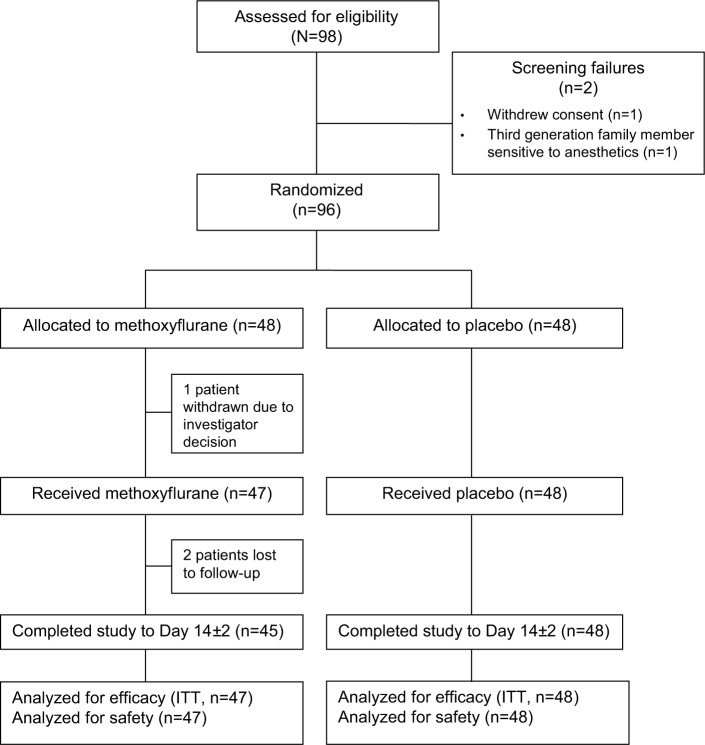
Three hundred patients (96 in the adolescent subgroup) aged ≥12 years requiring analgesia for acute trauma pain (pain score of 4-7 on the Numerical Rating Scale) at triage were randomized 1:1 to methoxyflurane (up to 6 mL) or placebo (normal saline), both administered using a Penthrox inhaler. The patient could request rescue medication (paracetamol/opioids) at any time. The primary endpoint was the change from baseline in visual analog scale (VAS) pain intensity.
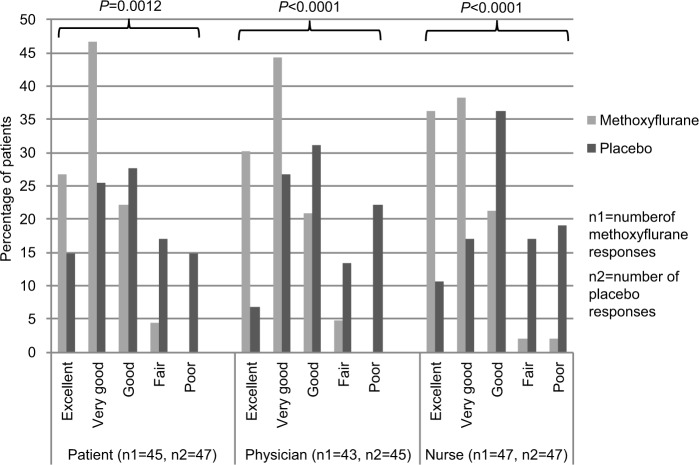
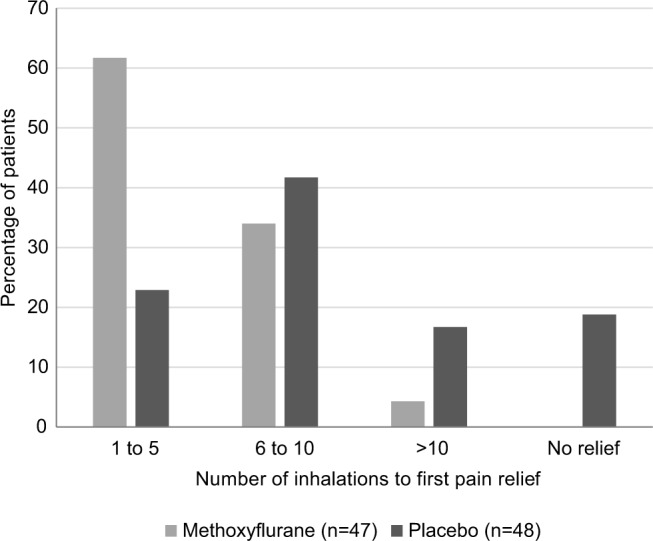
Mean VAS pain score for the adolescent subgroup at baseline was ~ 61 mm. Adjusted mean change in VAS pain intensity from baseline to 5, 10, 15, and 20 minutes was -24.5, -28.1, -31.6, and -31.7 mm for methoxyflurane and -14.6, -18.8, -19.2, and -23.7 mm for placebo, with a statistically significant treatment effect in favor of methoxyflurane overall across all four time points (-9.9 mm; 95% CI: -17.4, -2.4 mm; =0.0104). Median time to first pain relief was significantly shorter with methoxyflurane (1 minute) than placebo (3 minutes, <0.0001). Pain relief was reported within 1-10 inhalations in 95.7% of methoxyflurane-treated patients and 64.6% of placebo-treated patients. Rescue medication was requested by two (4.3%) methoxyflurane-treated patients and three (6.3%) placebo-treated patients. Over 95% of patients, physicians, and nurses rated methoxyflurane treatment as "Excellent", "Very Good" or "Good" compared with between 64% and 68% for placebo. The incidence of adverse events was higher with methoxyflurane (51%) than placebo (42%), mostly comprising mild/transient dizziness and headache.
This subgroup analysis shows that low-dose inhaled methoxyflurane is a rapid-acting and effective analgesic in adolescent patients presenting with moderate-to-severe trauma pain.
Clinicaltrials.gov identifier: NCT01420159, EudraCT number: 2011-000338-12.
急性疼痛治疗不足是急诊科面临的一项重大挑战。本项对先前报道的一项英国随机对照研究进行的事后亚组分析,报告了低剂量甲氧氟烷镇痛治疗中度至重度创伤疼痛青少年患者的疗效和安全性。
300例年龄≥12岁、因急性创伤疼痛(分诊时数字评分量表疼痛评分为4 - 7分)需要镇痛的患者被1:1随机分为甲氧氟烷组(最多6 mL)或安慰剂组(生理盐水),均使用喷他佐辛吸入器给药。患者可随时要求使用解救药物(对乙酰氨基酚/阿片类药物)。主要终点是视觉模拟量表(VAS)疼痛强度相对于基线的变化。
青少年亚组基线时的平均VAS疼痛评分为~61 mm。从基线到5、10、15和20分钟,甲氧氟烷组VAS疼痛强度的调整后平均变化分别为-24.5、-28.1、-31.6和-31.7 mm,安慰剂组分别为-14.6、-18.8、-19.2和-23.7 mm,在所有四个时间点上,总体治疗效果在统计学上显著有利于甲氧氟烷(-9.9 mm;95%置信区间:-17.4,-2.4 mm;P = 0.0104)。甲氧氟烷组首次疼痛缓解的中位时间(1分钟)显著短于安慰剂组(3分钟,P<0.0001)。95.7%接受甲氧氟烷治疗的患者和64.6%接受安慰剂治疗的患者在1 - 10次吸入内报告疼痛缓解。2例(4.3%)接受甲氧氟烷治疗的患者和3例(6.3%)接受安慰剂治疗的患者要求使用解救药物。超过95%的患者、医生和护士将甲氧氟烷治疗评为“优秀”、“非常好”或“好”,而安慰剂组的这一比例为64%至68%。甲氧氟烷组不良事件的发生率(51%)高于安慰剂组(42%),主要包括轻度/短暂的头晕和头痛。
该亚组分析表明,低剂量吸入甲氧氟烷对出现中度至重度创伤疼痛的青少年患者是一种起效迅速且有效的镇痛药。
Clinicaltrials.gov标识符:NCT01420159,欧洲临床试验数据库编号:2011-000338-12。