Zhai Jian, Li Ke
School of Mathematical Science, Zhejiang University, Hangzhou, China.
Front Hum Neurosci. 2019 Feb 26;13:62. doi: 10.3389/fnhum.2019.00062. eCollection 2019.
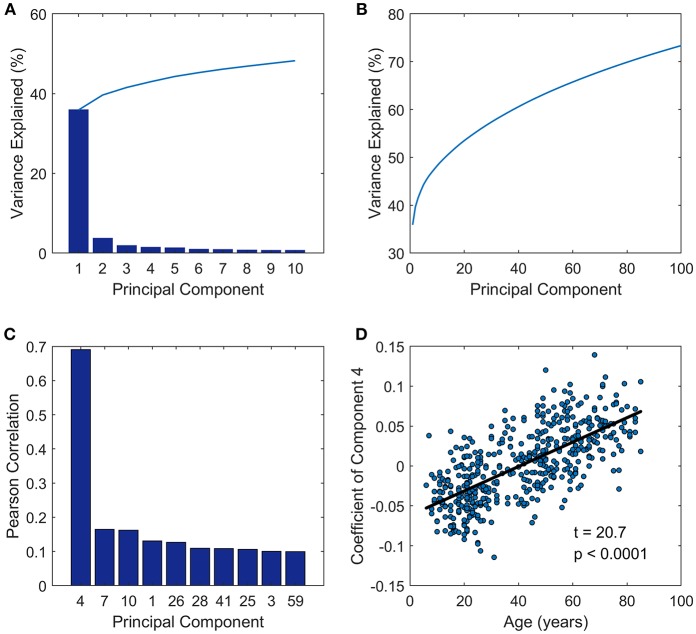
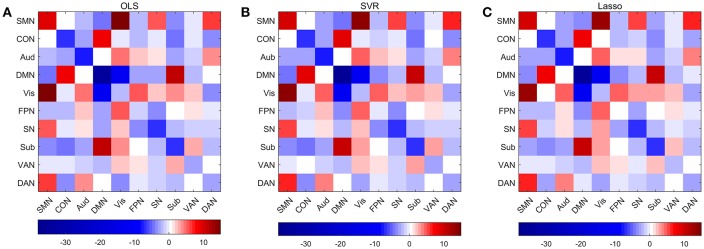
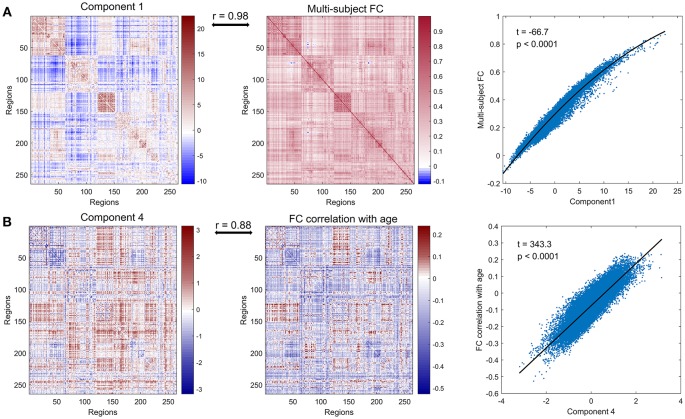
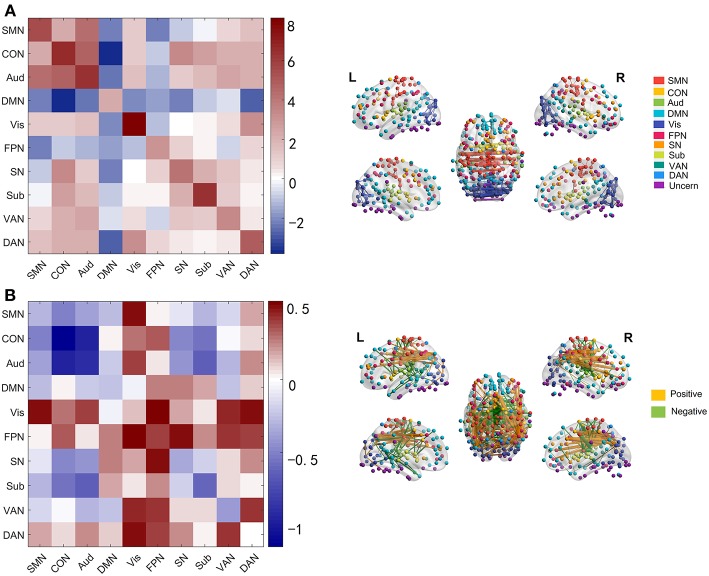
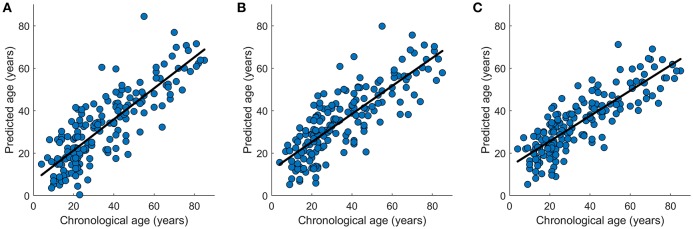
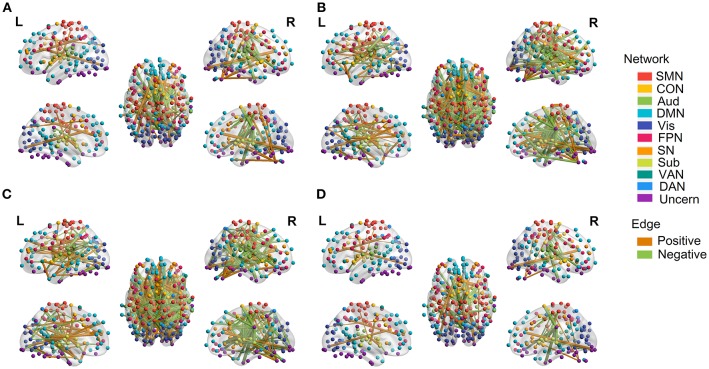
The organization of human brain networks can be measured by capturing correlated brain activity with functional MRI data. There have been a variety of studies showing that human functional connectivities undergo an age-related change over development. In the present study, we employed resting-state functional MRI data to construct functional network models. Principal component analysis was performed on the FC matrices across all the subjects to explore meaningful components especially correlated with age. Coefficients across the components, edge features after a newly proposed feature reduction method as well as temporal features based on fALFF, were extracted as predictor variables and three different regression models were learned to make prediction of brain age. We observed that individual's functional network architecture was shaped by intrinsic component, age-related component and other components and the predictive models extracted sufficient information to provide comparatively accurate predictions of brain age.
人类大脑网络的组织可以通过利用功能磁共振成像(fMRI)数据捕捉相关的大脑活动来进行测量。已有多项研究表明,人类的功能连接在发育过程中会经历与年龄相关的变化。在本研究中,我们使用静息态功能磁共振成像数据构建功能网络模型。对所有受试者的功能连接(FC)矩阵进行主成分分析,以探索与年龄特别相关的有意义成分。提取各成分的系数、一种新提出的特征约简方法后的边特征以及基于低频振幅分数(fALFF)的时间特征作为预测变量,并学习三种不同的回归模型来预测脑龄。我们观察到,个体的功能网络结构由内在成分、与年龄相关的成分和其他成分塑造,并且预测模型提取了足够的信息来提供相对准确的脑龄预测。