Conte Maria, Martucci Morena, Sandri Marco, Franceschi Claudio, Salvioli Stefano
Department of Experimental, Diagnostic and Specialty Medicine (DIMES), University of Bologna, Bologna, Italy.
Interdepartmental Centre "L. Galvani" (CIG), University of Bologna, Bologna, Italy.
Front Endocrinol (Lausanne). 2019 Feb 26;10:114. doi: 10.3389/fendo.2019.00114. eCollection 2019.
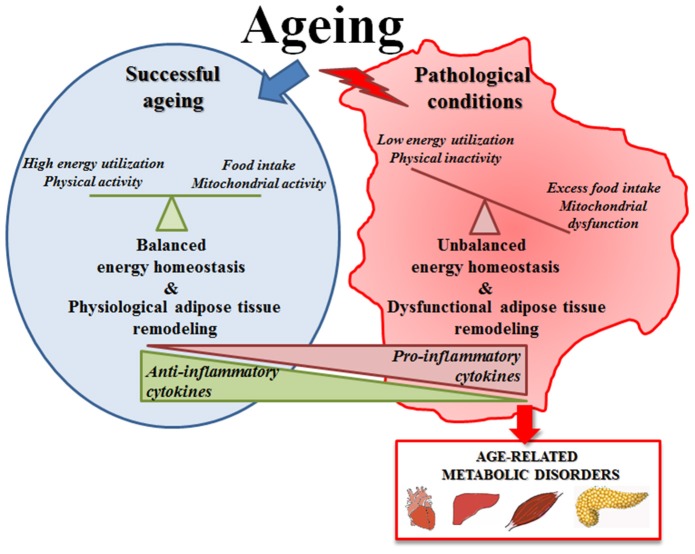
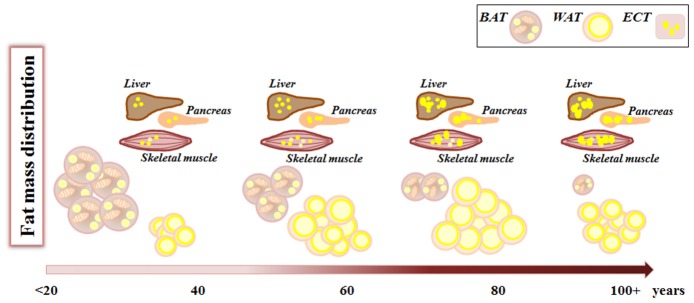
Human aging is characterized by dramatic changes in body mass composition that include a general increase of the total fat mass. Within the fat mass, a change in the proportions of adipose tissues also occurs with aging, affecting body metabolism, and playing a central role in many chronic diseases, including insulin resistance, obesity, cardiovascular diseases, and type II diabetes. In mammals, fat accumulates as white (WAT) and brown (BAT) adipose tissue, which differ both in morphology and function. While WAT is involved in lipid storage and immuno-endocrine responses, BAT is aimed at generating heat. With advancing age BAT declines, while WAT increases reaching the maximum peak by early old age and changes its distribution toward a higher proportion of visceral WAT. However, lipids tend to accumulate also within lipid droplets (LDs) in non-adipose tissues, including muscle, liver, and heart. The excess of such ectopic lipid deposition and the alteration of LD homeostasis contribute to the pathogenesis of the above-mentioned age-related diseases. It is not clear why age-associated tissue remodeling seems to lean toward lipid deposition as a "default program." However, it can be noted that such remodeling is not inevitably detrimental. In fact, such a programmed redistribution of fat throughout life could be considered physiological and even protective, in particular at extreme old age. In this regard, it has to be considered that an excessive decrease of subcutaneous peripheral fat is associated with a pro-inflammatory status, and a decrease of LD is associated with lipotoxicity leading to an increased risk of insulin resistance, type II diabetes and cardiovascular diseases. At variance, a balanced rate of fat content and distribution has beneficial effects for health and metabolic homeostasis, positively affecting longevity. In this review, we will summarize the present knowledge on the mechanisms of the age-related changes in lipid distribution and we will discuss how fat mass negatively or positively impacts on human health and longevity.
人类衰老的特征是身体质量组成发生显著变化,包括总体脂肪量普遍增加。在脂肪量中,脂肪组织的比例也会随着衰老而发生变化,影响身体代谢,并在许多慢性疾病中起核心作用,包括胰岛素抵抗、肥胖症、心血管疾病和II型糖尿病。在哺乳动物中,脂肪以白色(WAT)和棕色(BAT)脂肪组织的形式积累,它们在形态和功能上都有所不同。虽然WAT参与脂质储存和免疫内分泌反应,但BAT的作用是产热。随着年龄的增长,BAT减少,而WAT增加,在老年早期达到最高峰,并将其分布向更高比例的内脏WAT转变。然而,脂质也倾向于在非脂肪组织(包括肌肉、肝脏和心脏)的脂滴(LDs)中积累。这种异位脂质沉积的过量以及LD稳态的改变促成了上述与年龄相关疾病的发病机制。目前尚不清楚为什么与年龄相关的组织重塑似乎倾向于将脂质沉积作为一种“默认程序”。然而,可以注意到这种重塑并非不可避免地有害。事实上,这种一生中脂肪的程序性重新分布可以被认为是生理的,甚至是保护性的,特别是在高龄时。在这方面,必须考虑到皮下外周脂肪的过度减少与促炎状态相关,而LD的减少与脂毒性相关,导致胰岛素抵抗、II型糖尿病和心血管疾病的风险增加。相反,脂肪含量和分布的平衡速率对健康和代谢稳态具有有益影响,对寿命有积极影响。在这篇综述中,我们将总结目前关于脂质分布与年龄相关变化机制的知识,并讨论脂肪量如何对人类健康和寿命产生负面或正面影响。