Department of Health Policy and Management, University of Arkansas for Medical Sciences, 4301 W. Markham, Slot 820, Little Rock, AR, 72205, USA.
Division of Pharmaceutical Evaluation and Policy, University of Arkansas for Medical Sciences, Little Rock, AR, USA.
Pharmacoeconomics. 2019 Apr;37(4):609-620. doi: 10.1007/s40273-019-00789-2.
Healthcare interventions that improve the health of children with autism spectrum disorder (ASD) have the potential to affect the health of caregivers. This study compares the three-level EuroQoL-5 Dimension (EQ-5D-3L) and the Short Form-6 Dimension (SF-6D) in their ability to value such spillover effects in caregivers.
Clinical data collected from two Autism Treatment Network (ATN) sites was combined with survey data of caregivers of children diagnosed with ASD. Caregivers completed instruments by proxy describing child health and completed the EQ-5D-3L and SF-6D preference-weighted instruments to describe their own health.
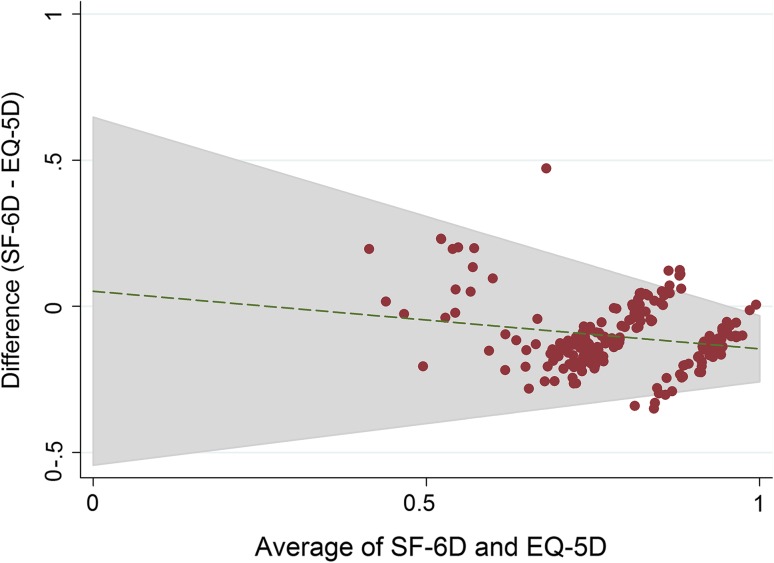
There was a strong correlation between the health utility scores of the two preference-weighted instruments (ρ = 0.6172, p < 0.001) measuring caregiver health-related quality of life. There was a similar correlation between both the SF-6D and EQ-5D-3L scores with a previously validated care-related quality of life measure (Care-related Quality of Life instrument [CarerQol-7D]) (ρ = 0.569, p < 0.001 and ρ = 0.541, p < 0.001, respectively). The mean SF-6D scores for caregivers differed significantly in relation to four of the five child health or behavior measures whereas the EQ-5D-3L differed for only two of them.
Health utility values of caregivers for children with ASD vary by the health characteristics of the child, suggesting significant potential for spillover effects. The comparison of the EQ-5D-3L and SF-6D demonstrated that both instruments can be used to estimate spillover effects of interventions to improve child health, but the SF-6D exhibited greater sensitivity to child health among children with ASD.
改善自闭症谱系障碍(ASD)儿童健康的医疗干预措施有可能影响照顾者的健康。本研究比较了三级欧洲五维健康量表(EQ-5D-3L)和六维健康量表简表(SF-6D)在评估此类溢出效应方面的能力。
将来自两个自闭症治疗网络(ATN)站点的临床数据与 ASD 儿童照顾者的调查数据相结合。照顾者通过代理完成描述儿童健康的工具,并完成 EQ-5D-3L 和 SF-6D 偏好加权工具来描述自己的健康状况。
两种偏好加权工具(ρ=0.6172,p<0.001)测量照顾者健康相关生活质量的健康效用评分之间存在很强的相关性。SF-6D 和 EQ-5D-3L 评分与之前验证的与照顾相关的生活质量测量(照顾者生活质量工具[CarerQol-7D])之间也存在类似的相关性(ρ=0.569,p<0.001 和 ρ=0.541,p<0.001)。 caregiver 的平均 SF-6D 评分与儿童健康或行为的五个指标中的四个显著相关,而 EQ-5D-3L 仅与其中两个相关。
ASD 儿童照顾者的健康效用值因儿童的健康特征而异,表明溢出效应存在重大潜力。EQ-5D-3L 和 SF-6D 的比较表明,两种工具都可用于估计改善儿童健康的干预措施的溢出效应,但 SF-6D 对 ASD 儿童的健康更敏感。