Department of Child and Family Studies, University of Tennessee, Knoxville, Tennessee, United States of America.
Department of Psychology, University of Warwick, Coventry, United Kingdom.
PLoS One. 2019 Mar 13;14(3):e0212789. doi: 10.1371/journal.pone.0212789. eCollection 2019.
Very preterm (<32 weeks gestation; VP) and/or very low birth weight (<1500g; VLBW) children often have cognitive and mathematic difficulties. It is unknown whether VP/VLBW children's frequent mathematic problems significantly add to the burden of negative life-course consequences over and above effects of more general cognitive deficits. Our aim was to determine whether negative consequences of VP/VLBW versus healthy term birth on adult wealth are mediated by mathematic abilities in childhood, or rather explained by more general cognitive abilities.
193 VP/VLBW and 217 healthy term comparison participants were studied prospectively from birth to adulthood as part of a geographically defined study in Bavaria (South Germany). Mathematic and general cognitive abilities were assessed at 8 years with standardized tests; wealth information was assessed at 26 years with a structured interview and summarized into a comprehensive index score. All scores were z-standardized.
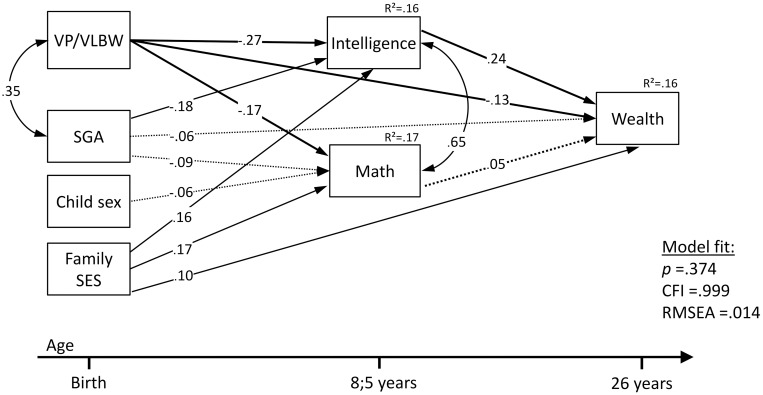
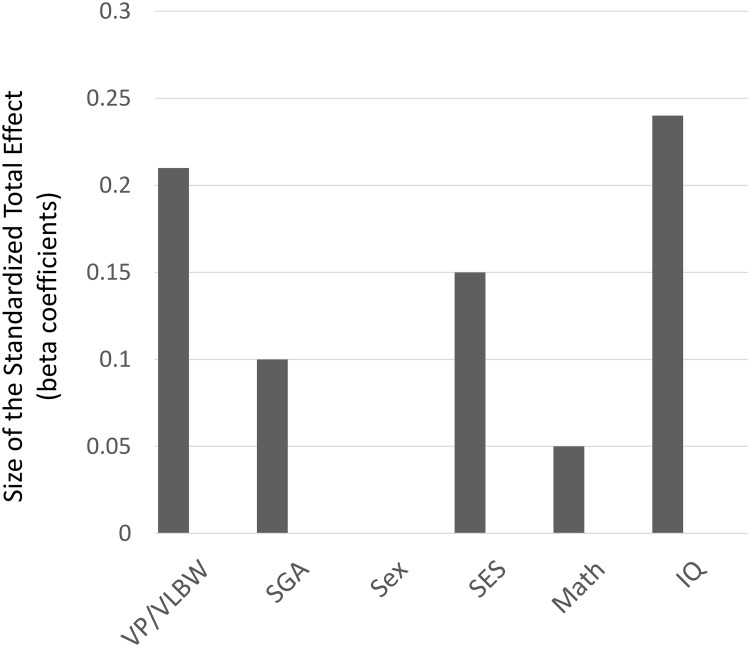
At 8 years, VP/VLBW (n = 193, 52.3% male) had lower mathematic and general cognitive abilities than healthy term comparison children (n = 217, 47.0% male). At 26 years, VP/VLBW had accumulated significantly lower overall wealth than term born comparison adults (-0.57 (1.08) versus -0.01 (1.00), mean difference 0.56 [0.36-0.77], p < .001). Structural equation modeling confirmed that VP/VLBW birth (β = -.13, p = .022) and childhood IQ (β = .24, p < .001) both directly predicted adult wealth, but math did not (β = .05, p = .413). Analyses were controlled for small-for-gestational-age (SGA) birth, child sex, and family socioeconomic status.
This longitudinal study from birth to adulthood shows that VP/VLBW survivors' general cognitive rather than specific mathematic problems explain their diminished life-course success. These findings are important in order to design effective interventions at school age that reduce the burden of prematurity for those individuals who were born at highest neonatal risk.
极早产儿(<32 孕周;VP)和/或极低出生体重儿(<1500g;VLBW)常存在认知和数学困难。目前尚不清楚 VP/VLBW 患儿频繁出现的数学问题是否会加重生活轨迹不良后果的负担,超出一般认知缺陷的影响。我们的目的是确定 VP/VLBW 与健康足月出生对成人财富的负面影响是否通过儿童时期的数学能力来介导,或者是否通过更一般的认知能力来解释。
193 名 VP/VLBW 和 217 名健康足月对照组参与者作为巴伐利亚(德国南部)一个地理位置明确研究的一部分,从出生到成年进行前瞻性研究。8 岁时使用标准化测试评估数学和一般认知能力;26 岁时使用结构化访谈评估财富信息,并总结为综合指数得分。所有分数均进行 z 标准化。
8 岁时,VP/VLBW(n=193,52.3%男性)的数学和一般认知能力低于健康足月对照组儿童(n=217,47.0%男性)。26 岁时,VP/VLBW 组的总财富明显低于足月出生对照组成年人(-0.57(1.08)与-0.01(1.00),平均差异 0.56 [0.36-0.77],p<.001)。结构方程模型证实,VP/VLBW 出生(β=-0.13,p=0.022)和儿童期智商(β=0.24,p<.001)均直接预测成年财富,但数学没有(β=0.05,p=0.413)。分析控制了小于胎龄儿(SGA)出生、儿童性别和家庭社会经济地位。
这项从出生到成年的纵向研究表明,VP/VLBW 幸存者的一般认知问题,而不是特定的数学问题,解释了他们生活轨迹的失败。这些发现对于设计有效的干预措施非常重要,这些干预措施可以减少那些处于最高新生儿风险的个体的早产负担。