Jin Pei-Ying, Zheng Zi-Hui, Lu Hong-Jie, Yan Jing, Zheng Gui-Hong, Zheng Yuan-Lin, Wu Dong-Mei, Lu Jun
1Key Laboratory for Biotechnology on Medicinal Plants of Jiangsu Province, School of Life Science, Jiangsu Normal University, No. 101, Shanghai Road, Tongshan District, Xuzhou, 221116 Jiangsu People's Republic of China.
2State Key Laboratory Cultivation Base For TCM Quality and Efficacy, School of Medicine and Life Science, Nanjing University of Chinese Medicine, Nanjing, 210023 People's Republic of China.
Cancer Cell Int. 2019 Feb 28;19:48. doi: 10.1186/s12935-019-0764-7. eCollection 2019.
Nasopharyngeal carcinoma (NPC) is a common malignant tumor of the head and neck region with poorly understood progression and prognosis. The present study aims at exploring whether the expression of β-catenin, TCF-4, and survivin affects clinicopathological features and prognostic significance in NPC.
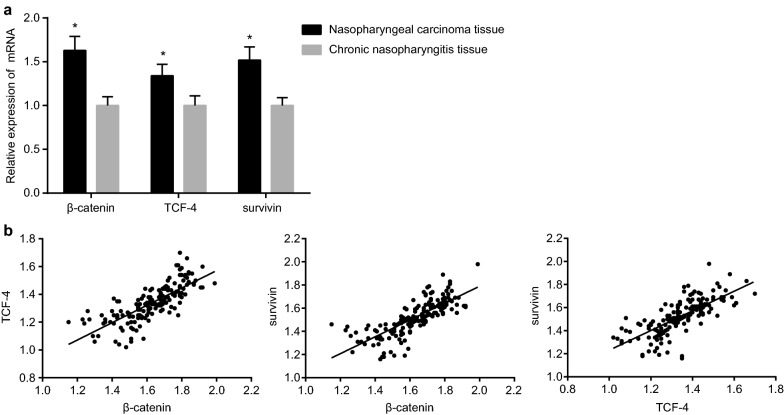
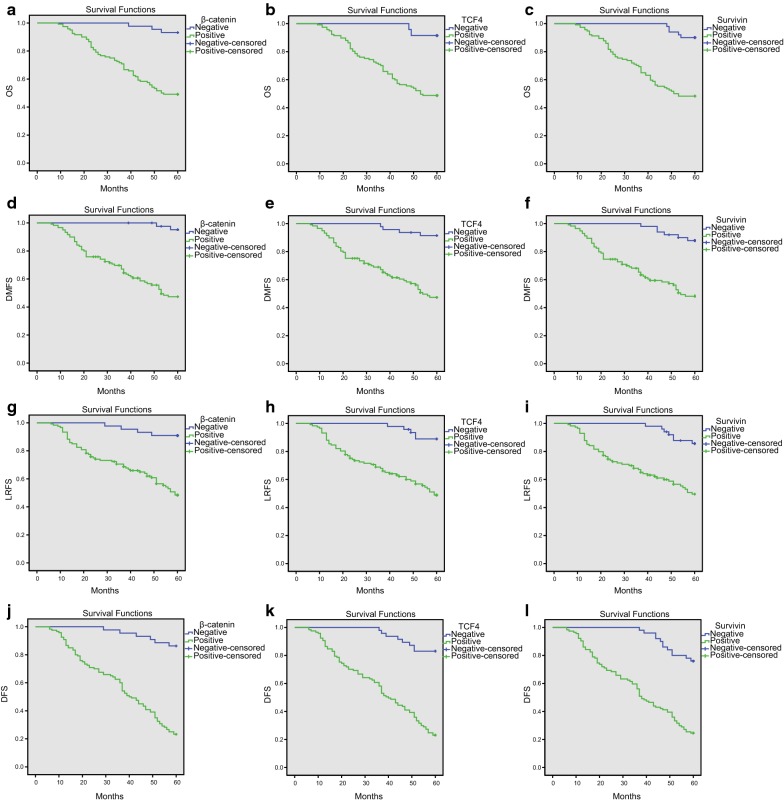
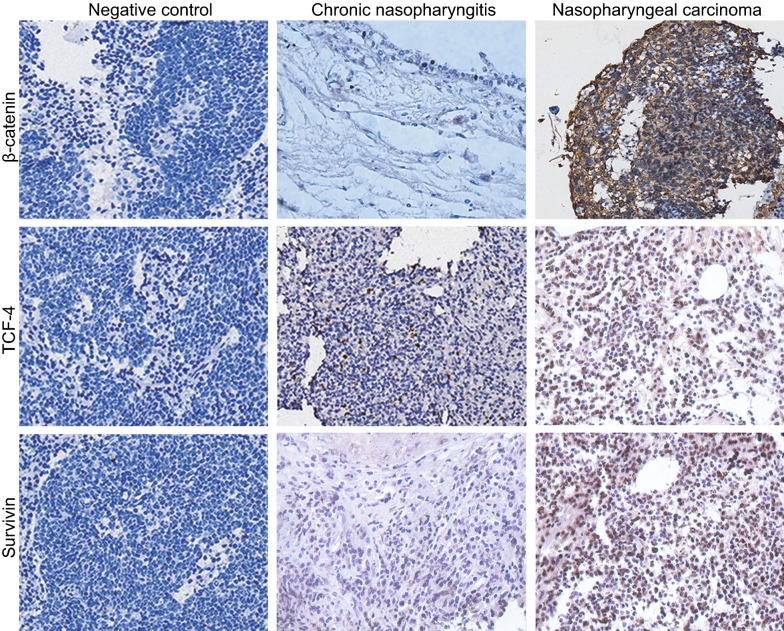
We enrolled 164 patients with NPC and 70 patients with chronic nasopharyngitis (CNP) in this study. Reverse transcription quantitative polymerase chain reaction (RT-qPCR) and immunohistochemistry (IHC) were conducted to evaluate the expression of β-catenin, TCF-4, and survivin. Spearman's rank correlation analysis and Pearson correlation analysis were used to measure the correlation of β-catenin, TCF-4, and survivin. Risk factors for prognosis and survival conditions of NPC patients were analyzed by Cox proportional hazards model and Kaplan-Meier curves.
The results obtained revealed that mRNA and protein expression of β-catenin, TCF-4, and survivin was higher in NPC tissues than in CNP tissues. Positive correlations amongst β-catenin, TCF-4, and survivin were identified by Spearman's rank correlation analysis and Pearson correlation analysis. There was a significant correlation in expression of β-catenin, TCF-4, and survivin with EBV DNA, EBV-VCA-IgA, EBV-EA-IgA, T stage, N stage, and clinicopathological stages. Lower overall survival (OS), distant metastasis-free survival (DMFS), local recurrence-free survival (LRFS), and disease-free survival (DFS) rates were detected in NPC patients with positive expression of β-catenin, TCF-4, and survivin, in contrast to those with negative expression. Cox proportional hazards model demonstrated that β-catenin, TCF-4, and survivin protein positive expression were independent risk factors for OS and DFS of NPC prognosis; there was an evident correlation between clinicopathological stages, TCF-4, and EBV-EA-IgA and OS, DMFS, LRFS, and DFS of NPC.
The aforementioned results indicate that β-catenin, TCF-4, and survivin proteins are highly expressed in NPC, which can be used as factors to predict the malignancy of NPC. In addition, positive expression of β-catenin, TCF-4, and survivin are potential risk factors that lead to an unfavorable prognosis of OS and DFS in NPC patients.
鼻咽癌(NPC)是头颈部常见的恶性肿瘤,其进展和预后尚不清楚。本研究旨在探讨β-连环蛋白、TCF-4和生存素的表达是否影响鼻咽癌的临床病理特征及预后意义。
本研究纳入164例鼻咽癌患者和70例慢性鼻咽炎(CNP)患者。采用逆转录定量聚合酶链反应(RT-qPCR)和免疫组织化学(IHC)检测β-连环蛋白、TCF-4和生存素的表达。采用Spearman等级相关分析和Pearson相关分析来衡量β-连环蛋白、TCF-4和生存素之间的相关性。通过Cox比例风险模型和Kaplan-Meier曲线分析鼻咽癌患者的预后危险因素和生存情况。
结果显示,鼻咽癌组织中β-连环蛋白、TCF-4和生存素的mRNA和蛋白表达高于慢性鼻咽炎组织。Spearman等级相关分析和Pearson相关分析确定了β-连环蛋白、TCF-4和生存素之间存在正相关。β-连环蛋白、TCF-4和生存素的表达与EBV DNA、EBV-VCA-IgA、EBV-EA-IgA、T分期、N分期及临床病理分期存在显著相关性。与β-连环蛋白、TCF-4和生存素表达阴性的鼻咽癌患者相比,阳性患者的总生存期(OS)、无远处转移生存期(DMFS)、无局部复发生存期(LRFS)和无病生存期(DFS)较低。Cox比例风险模型显示,β-连环蛋白、TCF-4和生存素蛋白阳性表达是鼻咽癌预后OS和DFS的独立危险因素;临床病理分期、TCF-4和EBV-EA-IgA与鼻咽癌的OS、DMFS、LRFS和DFS之间存在明显相关性。
上述结果表明,β-连环蛋白、TCF-4和生存素蛋白在鼻咽癌中高表达,可作为预测鼻咽癌恶性程度的因素。此外,β-连环蛋白、TCF-4和生存素的阳性表达是导致鼻咽癌患者OS和DFS预后不良的潜在危险因素。