1College House, University of Exeter Medical School, University of Exeter, Exeter, EX1 2LU UK.
2UCL Research Department of Clinical, Educational and Health Psychology, Gower Street, London, WC1E 6BT UK.
Mol Autism. 2019 Mar 1;10:9. doi: 10.1186/s13229-019-0260-x. eCollection 2019.
Current global estimates suggest the proportion of the population with autism spectrum disorder (ASD) who have intellectual disability (ID) is approximately 50%. Our objective was to ascertain the existence of selection bias due to under-inclusion of populations with ID across all fields of autism research. A sub-goal was to evaluate inconsistencies in reporting of findings.
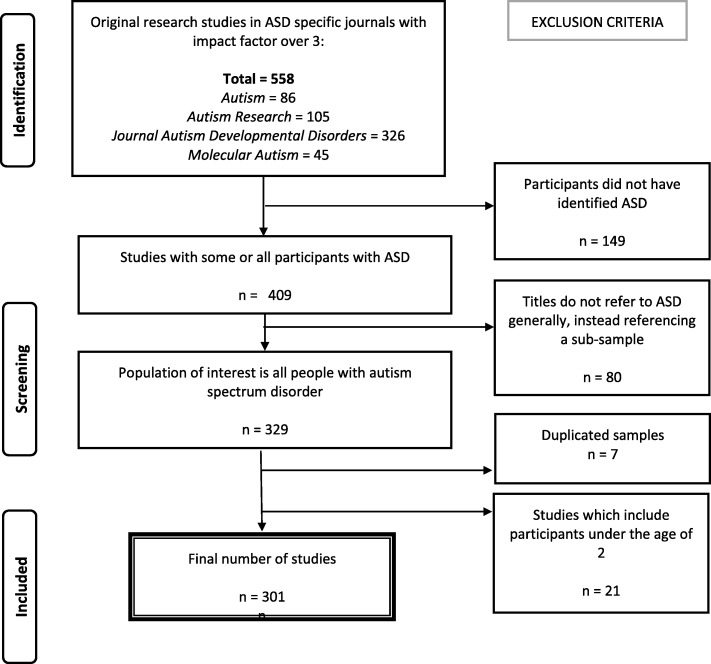
This review covers all original research published in 2016 in autism-specific journals with an impact factor greater than 3. Across 301 included studies, 100,245 participants had ASD. A random effects meta-analysis was used to estimate the proportion of participants without ID. Selection bias was defined as where more than 75% of participants did not have ID.
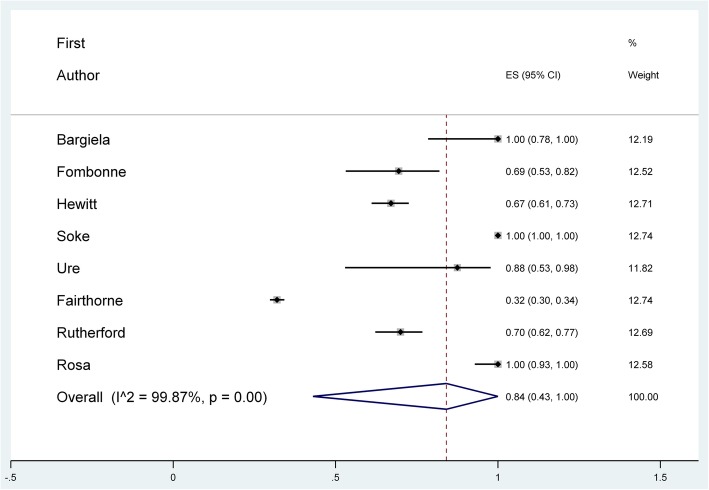
Meta-analysis estimated 94% of all participants identified as being on the autism spectrum in the studies reviewed did not have ID (95% CI 0.91-0.97). Eight out of ten studies demonstrated selection bias against participants with ID. The reporting of participant characteristics was generally poor: information about participants' intellectual ability was absent in 38% of studies ( = 114). Where there was selection bias on ID, only 31% of studies mentioned lack of generalisability as a limitation.
We found selection bias against ID throughout all fields of autism research. We recommend transparent reporting about ID and strategies for inclusion for this much marginalised group.
目前全球估计患有自闭症谱系障碍(ASD)的人群中有智力残疾(ID)的比例约为 50%。我们的目的是确定在所有自闭症研究领域中,由于 ID 人群的纳入不足而导致选择偏差的存在。次要目标是评估发现报告的不一致性。
本综述涵盖了 2016 年在自闭症特定期刊上发表的所有原始研究,这些期刊的影响因子大于 3。在 301 项纳入的研究中,有 100245 名参与者患有 ASD。使用随机效应荟萃分析来估计无 ID 参与者的比例。选择偏差定义为超过 75%的参与者没有 ID。
荟萃分析估计,在所审查的研究中,所有被确定为自闭症谱系的参与者中,有 94%(95%CI 0.91-0.97)没有 ID。十分之八的研究显示出对 ID 参与者的选择偏差。参与者特征的报告通常很差:有 38%的研究(= 114)缺乏关于参与者智力能力的信息。在存在 ID 选择偏差的情况下,只有 31%的研究提到缺乏普遍性是一个局限性。
我们发现自闭症研究的所有领域都存在对 ID 的选择偏差。我们建议对 ID 进行透明报告,并为这个边缘化的群体制定纳入策略。