Gilead Biosciences, Foster City, CA 94404, USA.
Regeneron Pharmaceuticals Inc., Terrytown, NY 10591, USA.
Int J Mol Sci. 2019 Mar 12;20(5):1237. doi: 10.3390/ijms20051237.
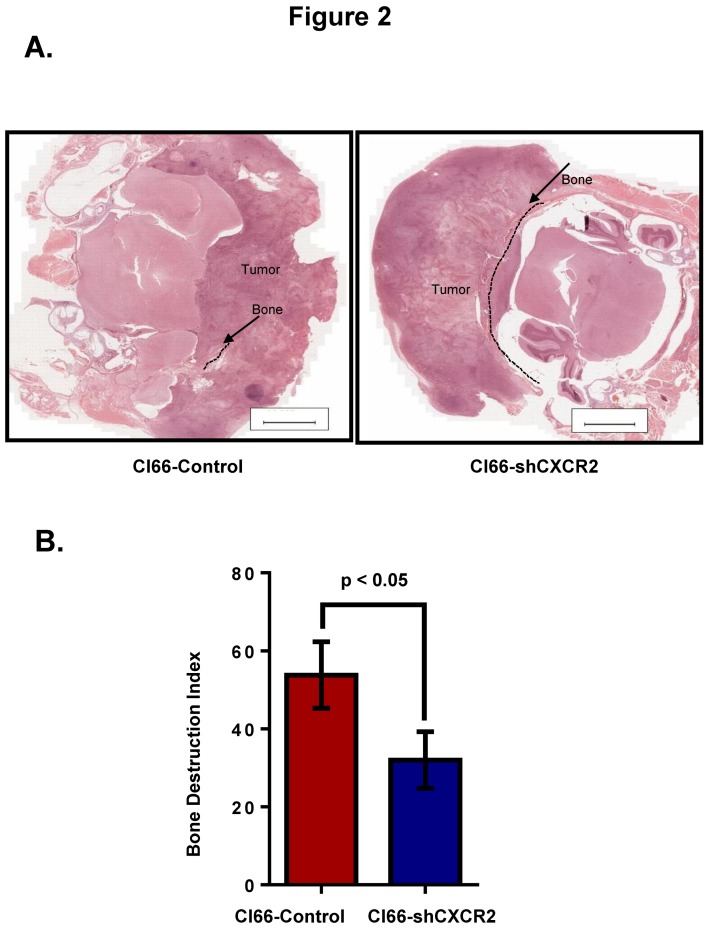
Most breast cancer patients die due to bone metastasis. Although metastasis accounts for 5% of the breast cancer cases, it is responsible for most of the deaths. Sometimes even before the detection of a primary tumor, most of the patients have bone and lymph node metastasis. Moreover, at the time of death, breast cancer patients have the bulk of the tumor burden in their bones. Therapy options are available for the treatment of primary tumors, but there are minimal options for treating breast cancer patients who have bone metastasis. C-X-C motif chemokine receptor type 2 (CXCR2) receptor-mediated signaling has been shown to play a critical role during bone-related inflammations and its ligands C-X-C motif chemokine ligand 6 (CXCL6) and 8 (CXCL8) aid in the resorption of bone during bone metastasis. In this study, we tested the hypothesis that CXCR2 contributes to mammary tumor-induced osteolysis and bone metastasis. In the present study, we examined the role of both tumor cell-derived and host-derived CXCR2 in influencing mammary tumor cell bone metastasis. For understanding the role of tumor cell-derived CXCR2, we utilized Cl66 CXCR2 knockdown (Cl66-shCXCR2) and Cl66-Control cells (Cl66-Control) and observed a significant decrease in tumor growth and tumor-induced osteolysis in Cl66-shCXCR2 cells in comparison with the Cl66-Control cells. Next, for understanding the role of host-derived CXCR2, we utilized mice with genomic knockdown of CXCR2 (Cxcr2) and injected Cl66-Luciferase (Cl66-Luc) or 4T1-Luciferase (4T1-Luc) cells. We observed decreased bone destruction and metastasis in the bone of Cxcr2 mice. Our data suggest the importance of both tumor cell- and host-derived CXCR2 signaling in the bone metastasis of breast cancer cells.
大多数乳腺癌患者死于骨转移。尽管转移占乳腺癌病例的 5%,但它是导致大多数死亡的原因。有时甚至在检测到原发性肿瘤之前,大多数患者就已经有骨和淋巴结转移。此外,在死亡时,乳腺癌患者的大部分肿瘤负担都在骨骼中。虽然有治疗原发性肿瘤的方法,但对于患有骨转移的乳腺癌患者,治疗方法很少。C-X-C 基序趋化因子受体 2(CXCR2)受体介导的信号在与骨相关的炎症中起着关键作用,其配体 C-X-C 基序趋化因子配体 6(CXCL6)和 8(CXCL8)有助于骨转移过程中骨的吸收。在这项研究中,我们检验了 CXCR2 有助于乳腺癌诱导的溶骨性骨转移的假设。在本研究中,我们研究了肿瘤细胞来源和宿主来源的 CXCR2 在影响乳腺癌细胞骨转移中的作用。为了了解肿瘤细胞衍生的 CXCR2 的作用,我们利用 Cl66 CXCR2 敲低(Cl66-shCXCR2)和 Cl66-Control 细胞(Cl66-Control),并观察到与 Cl66-Control 细胞相比,Cl66-shCXCR2 细胞中的肿瘤生长和肿瘤诱导的溶骨性骨破坏明显减少。接下来,为了了解宿主来源的 CXCR2 的作用,我们利用基因组敲低 CXCR2 的小鼠(Cxcr2)并注射 Cl66-Luciferase(Cl66-Luc)或 4T1-Luciferase(4T1-Luc)细胞。我们观察到 Cxcr2 小鼠的骨破坏和转移减少。我们的数据表明,肿瘤细胞和宿主来源的 CXCR2 信号在乳腺癌细胞的骨转移中都很重要。