Tizaoui Kalthoum, Kim Seon Hui, Jeong Gwang Hun, Kronbichler Andreas, Lee Kwang Seob, Lee Keum Hwa, Shin Jae Il
Department of Basic Sciences, Division of Histology and Immunology, Faculty of Medicine Tunis, Tunis El Manar University, Tunis 1068, Tunisia.
School of Medicine, Kyungpook National University, Daegu 41944, Korea.
J Clin Med. 2019 Mar 12;8(3):347. doi: 10.3390/jcm8030347.
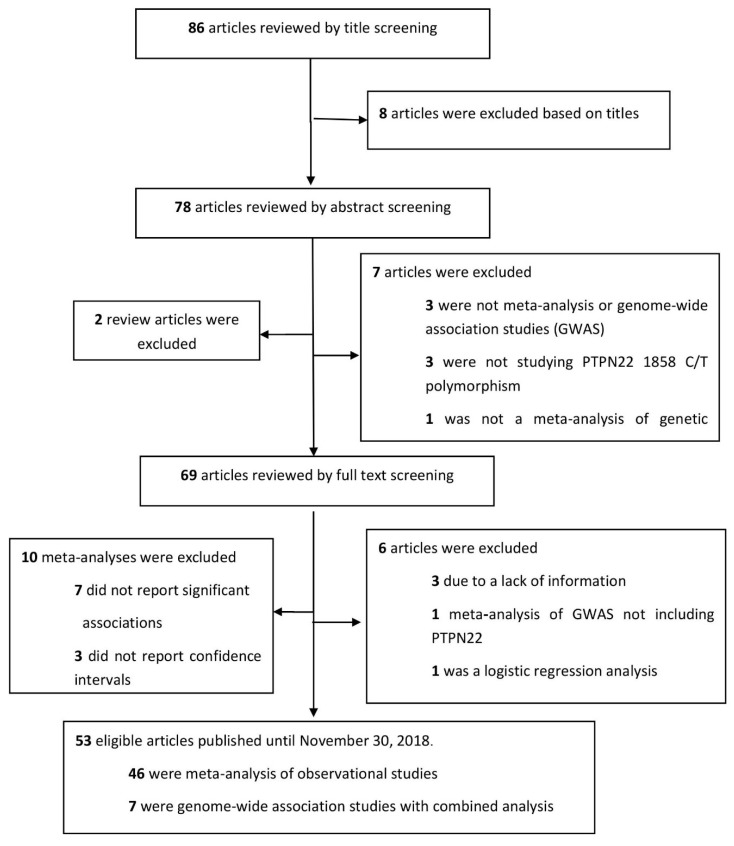
The 1858T allele in the protein tyrosine phosphatase non-receptor type 22 (PTPN22) locus shows one of the strongest and most consistent genetic associations with autoimmune diseases. We synthesized all meta-analyses reporting a genetic association of the PTPN22 1858T C/T polymorphism with autoimmune diseases. This work examined their validity to discover false positive results under Bayesian methods. We conducted a PubMed search to identify relevant publications and extracted the respective results, published until 30 November 2018. In observational studies, the associations of 1858 C/T genetic variant were noteworthy for 12 autoimmune or autoimmunity-related diseases (rheumatoid arthritis, systemic lupus erythematosus, type 1 diabetes mellitus, juvenile idiopathic arthritis, Crohn's disease, anti-neutrophil cytoplasmic antibody (ANCA)-associated vasculitis, vitiligo, Graves' disease, myasthenia gravis, Addison's disease, giant cell arteritis, and endometriosis). In contrast, we could not confirm the noteworthiness for eight diseases (systemic sclerosis, psoriasis, Behçet's disease, autoimmune thyroid disease, alopecia areata, Sjögren's syndrome, inflammatory bowel disease, and ankylosing spondylitis). From the meta-analysis of genome-wide association studies (GWAS) with a -value < 5 × 10, findings verified noteworthiness for all autoimmune diseases (psoriatic arthritis, myasthenia gravis, juvenile idiopathic arthritis and rheumatoid arthritis). The results from meta-analysis of GWAS showing a -value ranging between 0.05 and 5 × 10 were noteworthy under both Bayesian approaches (ANCA-associated vasculitis, type 1 diabetes mellitus, giant cell arteritis and juvenile idiopathic arthritis). Re-analysis of observational studies and GWAS by Bayesian approaches revealed the noteworthiness of all significant associations observed by GWAS, but noteworthiness could not be confirmed for all associations found in observational studies.
蛋白酪氨酸磷酸酶非受体22型(PTPN22)基因座中的1858T等位基因显示出与自身免疫性疾病最强且最一致的遗传关联之一。我们综合了所有报告PTPN22 1858T C/T多态性与自身免疫性疾病遗传关联的荟萃分析。这项工作在贝叶斯方法下检验了它们发现假阳性结果的有效性。我们进行了PubMed检索以识别相关出版物,并提取截至2018年11月30日发表的各自结果。在观察性研究中,1858 C/T基因变异与12种自身免疫性或自身免疫相关疾病(类风湿关节炎、系统性红斑狼疮、1型糖尿病、青少年特发性关节炎、克罗恩病、抗中性粒细胞胞浆抗体(ANCA)相关血管炎、白癜风、格雷夫斯病、重症肌无力、艾迪生病、巨细胞动脉炎和子宫内膜异位症)的关联值得关注。相比之下,我们无法证实8种疾病(系统性硬化症、银屑病、白塞病、自身免疫性甲状腺疾病、斑秃、干燥综合征、炎症性肠病和强直性脊柱炎)的相关性值得关注。从全基因组关联研究(GWAS)的荟萃分析(P值<5×10)来看,研究结果证实了所有自身免疫性疾病(银屑病关节炎、重症肌无力、青少年特发性关节炎和类风湿关节炎)的相关性值得关注。GWAS荟萃分析结果显示P值在0.05至5×10之间,在两种贝叶斯方法下均值得关注(ANCA相关血管炎、1型糖尿病、巨细胞动脉炎和青少年特发性关节炎)。通过贝叶斯方法对观察性研究和GWAS进行重新分析,揭示了GWAS观察到的所有显著关联的相关性值得关注,但观察性研究中发现的所有关联的相关性无法得到证实。