Park Hye-Min, Kwon Yu-Jin, Kim Hyoung-Sik, Lee Yong-Jae
Department of Family Medicine, Yonsei University College of Medicine, 211 Eonju-ro, Gangnam-gu, Seoul 06273, Korea.
Department of Medicine, Graduate School, Yonsei University, 50-1 Yonsei-ro, Seodaemoon-gu, Seoul 03722, Korea.
J Clin Med. 2019 Mar 13;8(3):356. doi: 10.3390/jcm8030356.
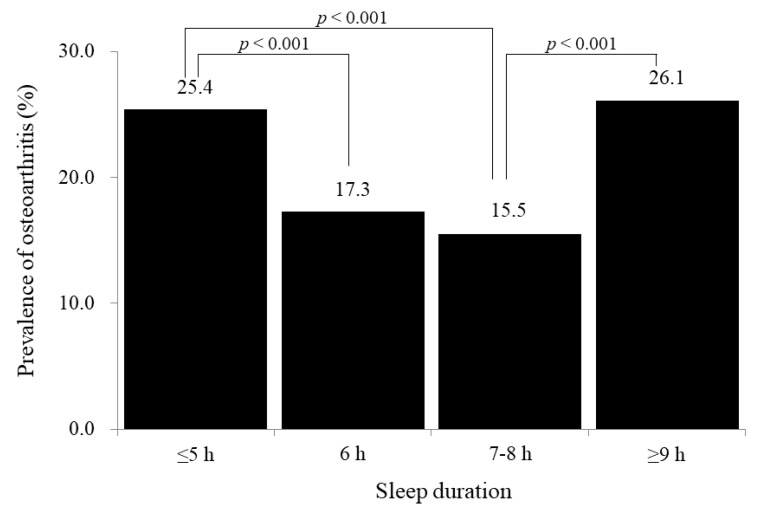
(1) Background: Both long and short sleep durations have been associated with negative health outcomes, particularly in middle-aged and older adults. To date, there has been little research on the association between sleep and osteoarthritis. This study aimed to evaluate the relationship between sleep duration and radiographically confirmed osteoarthritis in middle-aged and older women. (2) Methods: This study included 5268 women aged ≥50 years from the Korea National Health and Nutrition Examination Survey. Sleep duration was categorized into four groups (≤5 h, 6 h, 7⁻8 h, and ≥9 h) using responses from a self-reported questionnaire, and 7⁻8 h was set as an appropriate sleep duration. Osteoarthritis was defined as Kellgren⁻Lawrence grade ≥2 in the knee or hip area in radiographic images with knee or hip joint pain. The odds ratios (ORs) and 95% confidence intervals (CIs) of osteoarthritis according to sleep duration were calculated using multiple logistic regression analyses. (3) Results: The prevalence of osteoarthritis according to sleep duration showed a U-shaped curve, with the nadir in the appropriate sleep category (7⁻8 h). Compared with the 7⁻8 h sleep duration, the ORs (95% CIs) of osteoarthritis in the short sleep duration (≤5 h/day) and long sleep duration (≥9 h/day) were 1.343 (1.072⁻1.682) and 1.388 (1.020⁻1.889), respectively, after adjusting for age, body mass index, current smoking, alcohol consumption, regular exercise, occupation, residential area, hypertension, type 2 diabetes, cardiovascular disease, and stroke. (4) Conclusions: Short and long sleep duration were positively associated with osteoarthritis in middle-aged and older women.
(1)背景:睡眠时间过长或过短均与不良健康后果相关,尤其是在中老年人中。迄今为止,关于睡眠与骨关节炎之间关联的研究甚少。本研究旨在评估睡眠时间与经影像学证实的中老年女性骨关节炎之间的关系。(2)方法:本研究纳入了韩国国家健康与营养检查调查中5268名年龄≥50岁的女性。根据一份自我报告问卷的回答,将睡眠时间分为四组(≤5小时、6小时、7 - 8小时和≥9小时),并将7 - 8小时设定为适宜睡眠时间。骨关节炎的定义为在膝关节或髋关节疼痛的影像学图像中,膝关节或髋关节区域的凯尔格伦 - 劳伦斯分级≥2级。使用多元逻辑回归分析计算根据睡眠时间划分的骨关节炎的比值比(OR)和95%置信区间(CI)。(3)结果:根据睡眠时间划分的骨关节炎患病率呈U形曲线,在适宜睡眠类别(7 - 8小时)中最低。在调整年龄、体重指数、当前吸烟状况、饮酒量、规律运动、职业、居住地区、高血压、2型糖尿病、心血管疾病和中风后,与7 - 8小时睡眠时间相比,短睡眠时间(≤5小时/天)和长睡眠时间(≥9小时/天)的骨关节炎的OR(95%CI)分别为1.343(1.072 - 1.682)和1.388(1.020 - 1.889)。(4)结论:中老年女性的短睡眠时间和长睡眠时间均与骨关节炎呈正相关。