Center for Life Nano science @ Sapienza, Isituto Italiano di Tecnologia, Viale Regina Elena, 291, I-00161, Roma, Italy.
CNR NANOTEC Institute of Nanotechnology, Via Monteroni, 73100, Lecce, Italy.
Sci Rep. 2019 Mar 14;9(1):4591. doi: 10.1038/s41598-019-40997-6.
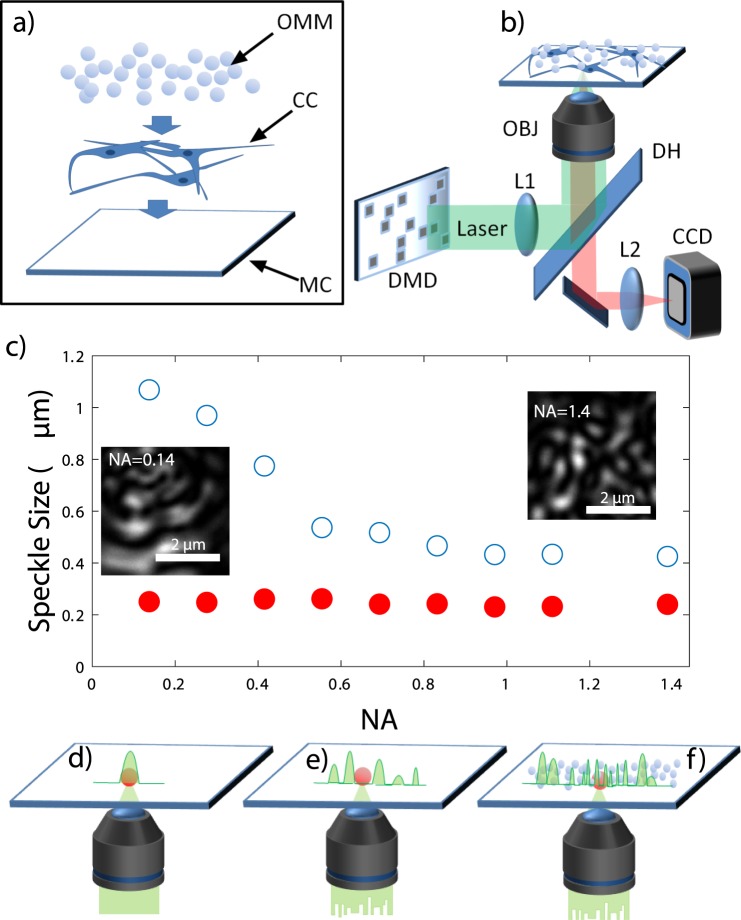
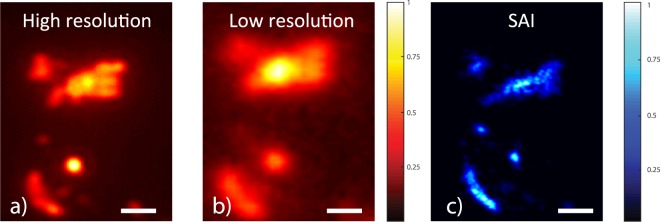
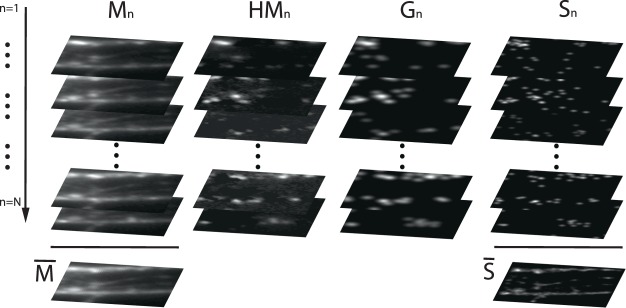
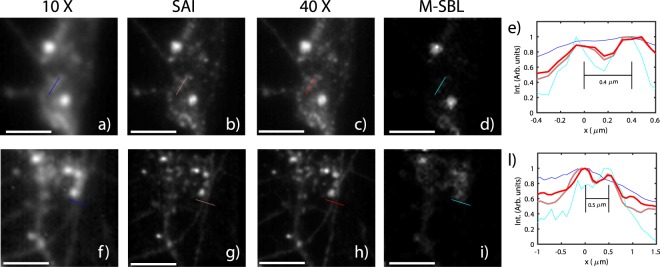
Standard imaging systems provide a spatial resolution that is ultimately dictated by the numerical aperture (NA) of the illumination and collection optics. In biological tissues, the resolution is strongly affected by scattering, which limits the penetration depth to a few tenths of microns. Here, we exploit the properties of speckle patterns embedded into a strongly scattering matrix to illuminate the sample at high spatial frequency content. Combining adaptive optics with a custom deconvolution algorithm, we obtain an increase in the transverse spatial resolution by a factor of 2.5 with respect to the natural diffraction limit. Our Scattering Assisted Imaging (SAI) provides an effective solution to increase the resolution when long working distance optics are needed, potentially paving the way to bulk imaging in turbid tissues.
标准成像系统提供的空间分辨率最终由照明和收集光学器件的数值孔径(NA)决定。在生物组织中,分辨率受到强烈散射的影响,这限制了穿透深度只有几十分之一微米。在这里,我们利用嵌入强散射矩阵的散斑图案的特性,以高空间频率内容对样品进行照明。通过自适应光学与定制的反卷积算法相结合,我们相对于自然衍射极限将横向空间分辨率提高了 2.5 倍。我们的散射辅助成像(SAI)提供了一种有效的解决方案,可以在需要长工作距离光学器件时提高分辨率,有可能为混浊组织中的整体成像铺平道路。