van den Elsen Lieke W J, Garssen Johan, Burcelin Remy, Verhasselt Valerie
School of Molecular Sciences, University of Western Australia, Perth, WA, Australia.
Division of Pharmacology, Faculty of Science, Utrecht Institute of Pharmaceutical Sciences, Utrecht University, Utrecht, Netherlands.
Front Pediatr. 2019 Feb 27;7:47. doi: 10.3389/fped.2019.00047. eCollection 2019.
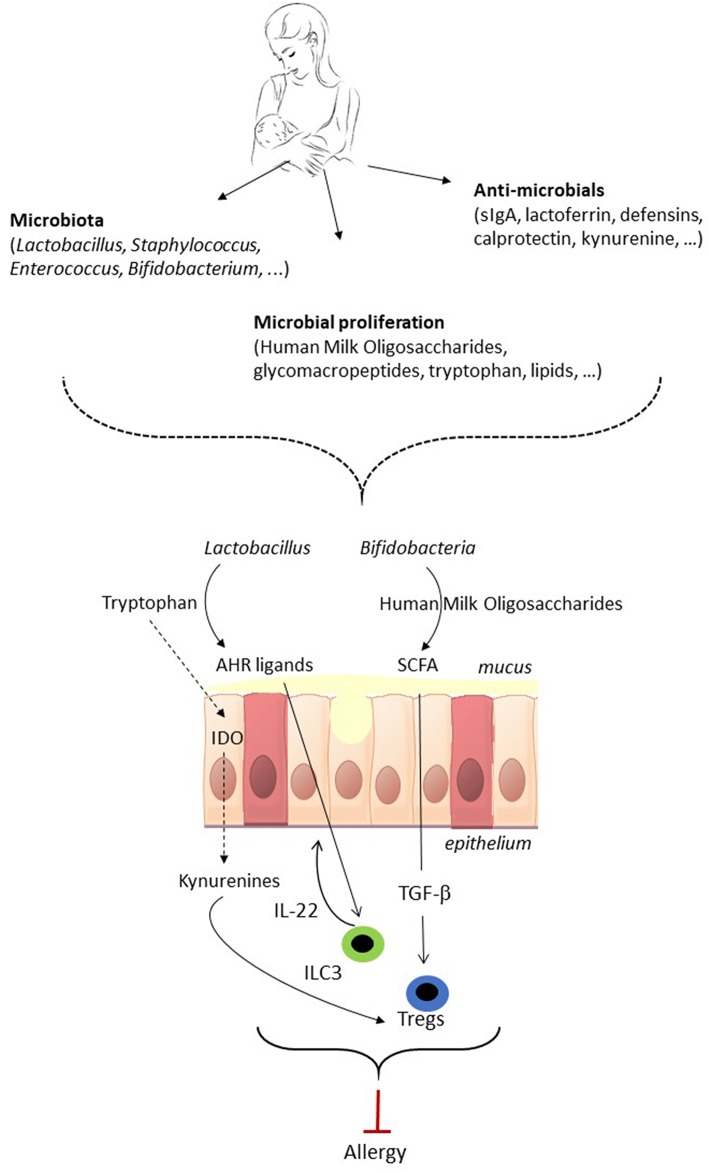
Evidence is accumulating that demonstrates the importance of the gut microbiota in health and diseases such as allergy. Recent studies emphasize the importance of the "window of opportunity" in early life, during which interventions altering the gut microbiota induce long-term effects. The neonate's gut microbiota composition and metabolism could therefore play an essential role in allergic disease risk. Breastfeeding shapes the gut microbiota in early life, both directly by exposure of the neonate to the milk microbiota and indirectly, via maternal milk factors that affect bacterial growth and metabolism such as human milk oligosaccharides, secretory IgA, and anti-microbial factors. The potential of breastmilk to modulate the offspring's early gut microbiota is a promising tool for allergy prevention. Here, we will review the existing evidence demonstrating the impact of breastfeeding on shaping the neonate's gut microbiota and highlight the potential of this strategy for allergy prevention.
越来越多的证据表明肠道微生物群在健康和诸如过敏等疾病中具有重要性。最近的研究强调了生命早期“机遇之窗”的重要性,在此期间改变肠道微生物群的干预措施会产生长期影响。因此,新生儿的肠道微生物群组成和代谢可能在过敏性疾病风险中发挥重要作用。母乳喂养在生命早期塑造肠道微生物群,既通过让新生儿接触乳汁中的微生物群直接起作用,也通过母乳中的影响细菌生长和代谢的因素间接起作用,如人乳寡糖、分泌型IgA和抗菌因子。母乳调节后代早期肠道微生物群的潜力是预防过敏的一个有前景的工具。在此,我们将综述现有的证据,证明母乳喂养对塑造新生儿肠道微生物群的影响,并强调这一策略在预防过敏方面的潜力。