Department of Medicine, University of Chicago, Chicago, Illinois, USA.
Department of Anesthesiology, University of Maryland Baltimore School of Medicine, Baltimore, Maryland, USA.
Compr Physiol. 2019 Mar 15;9(2):873-904. doi: 10.1002/cphy.c180020.
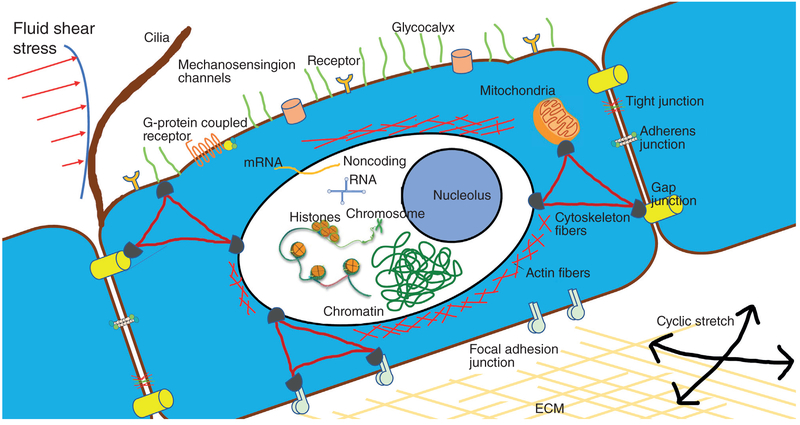
Vascular endothelial cells (ECs) form a semiselective barrier for macromolecules and cell elements regulated by dynamic interactions between cytoskeletal elements and cell adhesion complexes. ECs also participate in many other vital processes including innate immune reactions, vascular repair, secretion, and metabolism of bioactive molecules. Moreover, vascular ECs represent a unique cell type exposed to continuous, time-dependent mechanical forces: different patterns of shear stress imposed by blood flow in macrovasculature and by rolling blood cells in the microvasculature; circumferential cyclic stretch experienced by the arterial vascular bed caused by heart propulsions; mechanical stretch of lung microvascular endothelium at different magnitudes due to spontaneous respiration or mechanical ventilation in critically ill patients. Accumulating evidence suggests that vascular ECs contain mechanosensory complexes, which rapidly react to changes in mechanical loading, process the signal, and develop context-specific adaptive responses to rebalance the cell homeostatic state. The significance of the interactions between specific mechanical forces in the EC microenvironment together with circulating bioactive molecules in the progression and resolution of vascular pathologies including vascular injury, atherosclerosis, pulmonary edema, and acute respiratory distress syndrome has been only recently recognized. This review will summarize the current understanding of EC mechanosensory mechanisms, modulation of EC responses to humoral factors by surrounding mechanical forces (particularly the cyclic stretch), and discuss recent findings of magnitude-specific regulation of EC functions by transcriptional, posttranscriptional and epigenetic mechanisms using -omics approaches. We also discuss ongoing challenges and future opportunities in developing new therapies targeting dysregulated mechanosensing mechanisms to treat vascular diseases. © 2019 American Physiological Society. Compr Physiol 9:873-904, 2019.
血管内皮细胞 (ECs) 形成了一种半选择性的大分子和细胞元素屏障,这种屏障受到细胞骨架元素和细胞黏附复合物之间的动态相互作用的调节。ECs 还参与许多其他重要过程,包括先天免疫反应、血管修复、生物活性分子的分泌和代谢。此外,血管 ECs 代表了一种独特的细胞类型,其暴露于持续的、随时间变化的机械力中:宏观血管中血流引起的不同剪切应力模式和微血管中滚动血细胞引起的剪切应力模式;心脏推动引起的动脉血管床所经历的圆周循环拉伸;由于重症患者的自发性呼吸或机械通气,肺微血管内皮细胞受到不同程度的机械拉伸。越来越多的证据表明,血管内皮细胞含有机械感受器复合物,这些复合物能迅速对机械负荷的变化做出反应,处理信号,并针对特定的环境适应性反应来重新平衡细胞的内稳态。特定机械力在 EC 微环境中的相互作用以及循环生物活性分子在血管病变(包括血管损伤、动脉粥样硬化、肺水肿和急性呼吸窘迫综合征)的进展和解决中的作用,最近才得到认识。这篇综述将总结目前对 EC 机械感受器机制的理解,以及周围机械力对 EC 对体液因子反应的调节(特别是循环拉伸),并讨论利用组学方法研究 EC 功能的转录后、转录后和表观遗传调控的最新发现。我们还讨论了在开发针对失调的机械传感机制的新疗法以治疗血管疾病方面的当前挑战和未来机遇。 版权所有 © 2019 美国生理学会。综合生理学 9:873-904, 2019。