Toxicology Department, Cinvestav, Mexico City, MX.
Pharmacy Department, University of Guanajuato, Guanajuato, MX.
Ann Glob Health. 2018 Jul 27;84(2):212-224. doi: 10.29024/aogh.909.
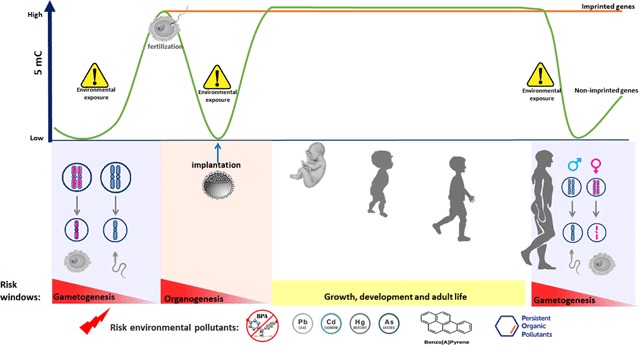
Children are susceptible to environmental contaminants and are at risk of developing diseases, more so if the exposure begins at an early age. Epidemiological studies have postulated the hypothesis of the fetal origin of disease, which is mediated by epigenetic changes. Epigenetic marks are inheritable; they modulate the gene expression and can affect human health due to the presence of environmental factors.
This review focuses on DNA-methylation and its association with environmental-related diseases in children.
A search for studies related to DNA-methylation in children by pre- or post-natal environmental exposures was conducted, and those studies with appropriate designs and statistical analyses and evaluations of the exposure were selected.
Prenatal and early life environmental factors, from diet to exposure to pollutants, have been associated with epigenetic changes, specifically DNA-methylation. Thus, maternal nutrition and smoking and exposure to air particulate matter, polycyclic aromatic hydrocarbons, arsenic, heavy metals, persistent organic pollutants, and some endocrine disrupters during pregnancy have been associated with genomic and gene-specific newborns' DNA-methylation changes that have shown in some cases sex-specific patterns. In addition, these maternal factors may deregulate the placental DNA-methylation balance and could induce a fetal reprogramming and later-in-life diseases.
Exposure to environmental pollutants during prenatal and early life can trigger epigenetic imbalances and eventually the development of diseases in children. The integration of epigenetic data should be considered in future risk assessments.
儿童易受环境污染物影响,患病风险较高,尤其是在早期暴露的情况下。流行病学研究提出了疾病的胎儿起源假说,这是由表观遗传变化介导的。表观遗传标记是可遗传的;它们可以调节基因表达,并由于环境因素的存在而影响人类健康。
本综述重点关注儿童 DNA 甲基化及其与环境相关疾病的关系。
通过产前或产后环境暴露搜索与儿童 DNA 甲基化相关的研究,并选择具有适当设计和统计分析以及暴露评估的研究。
从饮食到暴露于污染物等产前和生命早期环境因素与表观遗传变化,特别是 DNA 甲基化有关。因此,母亲的营养和吸烟以及怀孕期间暴露于空气颗粒物、多环芳烃、砷、重金属、持久性有机污染物和一些内分泌干扰物与新生儿基因组和基因特异性的 DNA 甲基化变化有关,在某些情况下表现出性别特异性模式。此外,这些母体因素可能会破坏胎盘 DNA 甲基化平衡,并可能诱导胎儿重编程和以后的生活疾病。
产前和生命早期暴露于环境污染物会引发表观遗传失衡,并最终导致儿童疾病的发生。在未来的风险评估中应考虑整合表观遗传数据。