Lin Xinyi, Lim Ives Yubin, Wu Yonghui, Teh Ai Ling, Chen Li, Aris Izzuddin M, Soh Shu E, Tint Mya Thway, MacIsaac Julia L, Morin Alexander M, Yap Fabian, Tan Kok Hian, Saw Seang Mei, Kobor Michael S, Meaney Michael J, Godfrey Keith M, Chong Yap Seng, Holbrook Joanna D, Lee Yung Seng, Gluckman Peter D, Karnani Neerja
Singapore Institute for Clinical Sciences, A*STAR, 30 Medical Drive, Singapore, 117609, Singapore.
Department of Obstetrics and Gynaecology, Yong Loo Lin School of Medicine, National University of Singapore, Singapore, 119228, Singapore.
BMC Med. 2017 Mar 7;15(1):50. doi: 10.1186/s12916-017-0800-1.
Obesity is an escalating health problem worldwide, and hence the causes underlying its development are of primary importance to public health. There is growing evidence that suboptimal intrauterine environment can perturb the metabolic programing of the growing fetus, thereby increasing the risk of developing obesity in later life. However, the link between early exposures in the womb, genetic susceptibility, and perturbed epigenome on metabolic health is not well understood. In this study, we shed more light on this aspect by performing a comprehensive analysis on the effects of variation in prenatal environment, neonatal methylome, and genotype on birth weight and adiposity in early childhood.
In a prospective mother-offspring cohort (N = 987), we interrogated the effects of 30 variables that influence the prenatal environment, umbilical cord DNA methylation, and genotype on offspring weight and adiposity, over the period from birth to 48 months. This is an interim analysis on an ongoing cohort study.
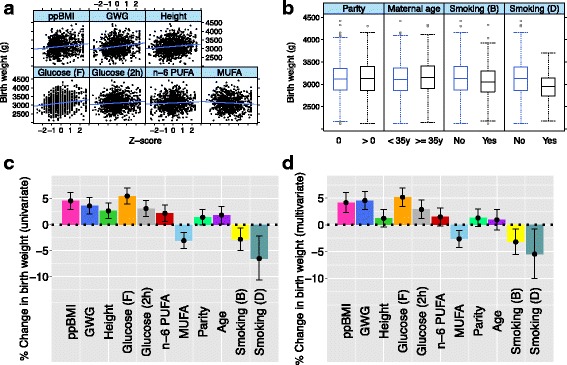
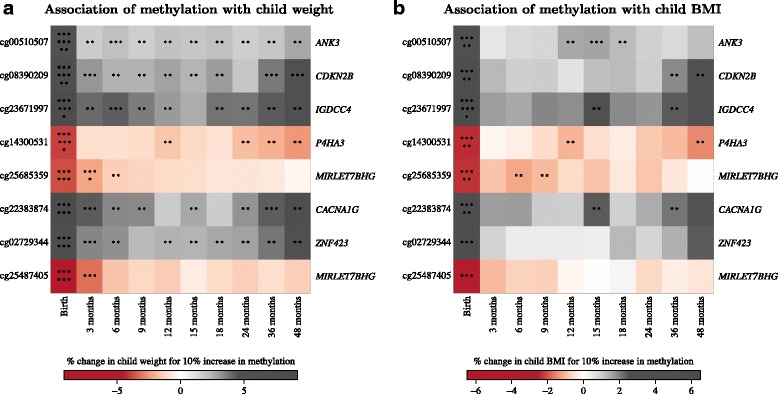
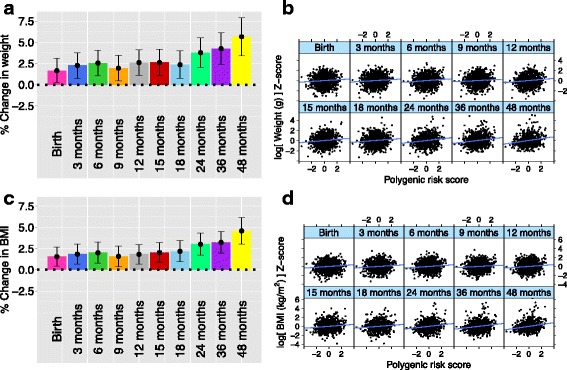
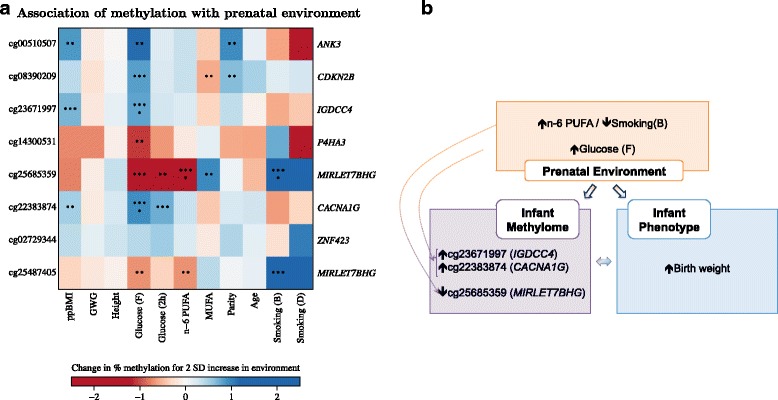
Eleven of 30 prenatal environments, including maternal adiposity, smoking, blood glucose and plasma unsaturated fatty acid levels, were associated with birth weight. Polygenic risk scores derived from genetic association studies on adult adiposity were also associated with birth weight and child adiposity, indicating an overlap between the genetic pathways influencing metabolic health in early and later life. Neonatal methylation markers from seven gene loci (ANK3, CDKN2B, CACNA1G, IGDCC4, P4HA3, ZNF423 and MIRLET7BHG) were significantly associated with birth weight, with a subset of these in genes previously implicated in metabolic pathways in humans and in animal models. Methylation levels at three of seven birth weight-linked loci showed significant association with prenatal environment, but none were affected by polygenic risk score. Six of these birth weight-linked loci continued to show a longitudinal association with offspring size and/or adiposity in early childhood.
This study provides further evidence that developmental pathways to adiposity begin before birth and are influenced by environmental, genetic and epigenetic factors. These pathways can have a lasting effect on offspring size, adiposity and future metabolic outcomes, and offer new opportunities for risk stratification and prevention of obesity.
This birth cohort is a prospective observational study, designed to study the developmental origins of health and disease, and was retrospectively registered on 1 July 2010 under the identifier NCT01174875 .
肥胖是全球范围内日益严重的健康问题,因此其发生的潜在原因对公共卫生至关重要。越来越多的证据表明,子宫内环境欠佳会扰乱胎儿生长过程中的代谢编程,从而增加其日后患肥胖症的风险。然而,子宫内早期暴露、遗传易感性和表观基因组紊乱与代谢健康之间的联系尚未完全明确。在本研究中,我们通过对产前环境、新生儿甲基化组和基因型变异对出生体重及幼儿期肥胖的影响进行全面分析,进一步阐明了这一方面的问题。
在一个前瞻性母婴队列研究(N = 987)中,我们探究了30个影响产前环境、脐带血DNA甲基化和基因型的变量在出生至48个月期间对后代体重和肥胖的影响。这是一项正在进行的队列研究的中期分析。
30种产前环境中的11种,包括母亲肥胖、吸烟、血糖和血浆不饱和脂肪酸水平,与出生体重有关。来自成人肥胖症遗传关联研究的多基因风险评分也与出生体重和儿童肥胖有关,这表明影响早期和晚期代谢健康的遗传途径存在重叠。来自7个基因位点(ANK3、CDKN2B、CACNA1G、IGDCC4、P4HA3、ZNF423和MIRLET7BHG)的新生儿甲基化标记与出生体重显著相关,其中一部分基因先前在人类和动物模型的代谢途径中已有涉及。7个与出生体重相关的位点中有3个的甲基化水平与产前环境显著相关,但均不受多基因风险评分的影响。这些与出生体重相关的位点中有6个在幼儿期继续与后代的体型和/或肥胖呈现纵向关联。
本研究进一步证明,肥胖的发育途径在出生前就已开始,并受到环境、遗传和表观遗传因素的影响。这些途径可能对后代的体型、肥胖及未来的代谢结局产生持久影响,并为肥胖的风险分层和预防提供新的机会。
这个出生队列是一项前瞻性观察性研究,旨在研究健康与疾病的发育起源,于2010年7月1日进行回顾性注册,标识符为NCT01174875。