Infectious Diseases Institute, Makerere University College of Health Sciences, Kampala, UG.
Division of Infectious Diseases, Department of Medicine, Johns Hopkins University School of Medicine, Baltimore, Maryland, US.
Ann Glob Health. 2018 Apr 30;84(1):170-175. doi: 10.29024/aogh.25.
High quality PhD training in sub-Saharan Africa is important to strengthen research evidence to advance development and health. Training a critical mass of independent investigators capable of original scientific research requires strong mentorship, research environments, and international networks. We sought to iteratively improve a PhD training model in Uganda through systems capacity building.
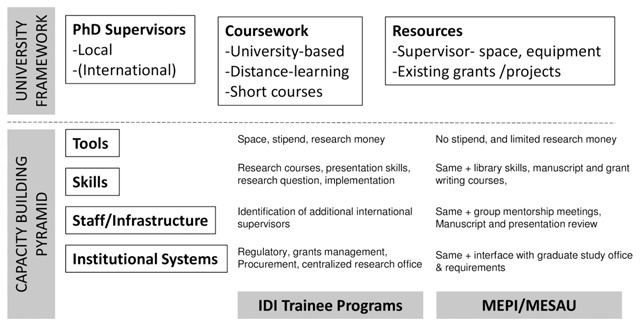
PhD students were selected through a rigorous competitive application and selection process, which included a written proposal and a face-to-face panel interview. The program provided administrative support, paid tuition fees, tools (space, equipment, research money), skills (short research courses on study design, biostatistics, manuscript and grant writing), and infrastructure (finance, grants management support, and lab infrastructure). Guidance to identify local and international mentorship was also provided in addition to two to three group meetings per year where data was presented and progress assessed by the program leaders in addition to available local mentors.
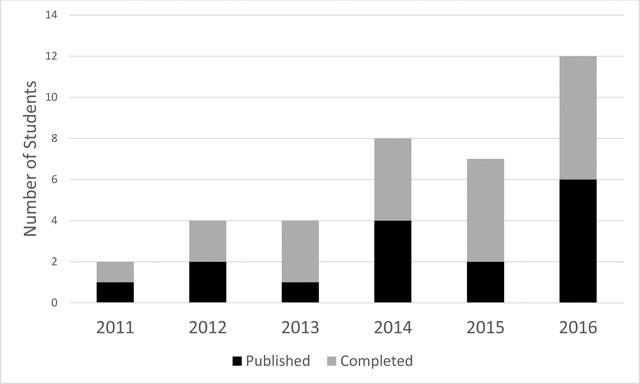
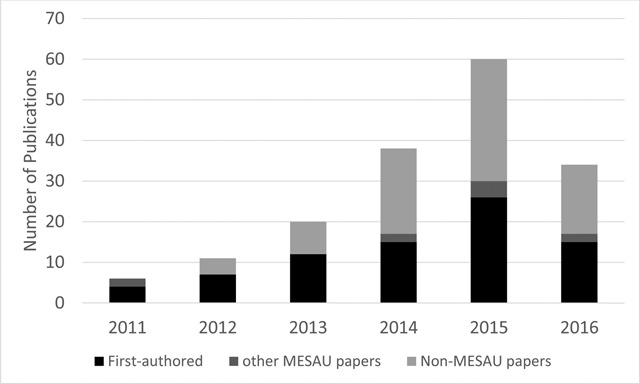
Seventeen PhD students were selected, and fifteen will complete training through the MEPI-MESAU program. To date, 60% have completed, including 2 students who started 2 years into the program. So far, 169 publications have been published in the peer-reviewed literature. Our PhD students have supervised and mentored 65 Master's students, which illustrates the cascade effect of PhD training on the academic medical school environment.
The systems capacity building approach to PhD training is an efficient and productive training model that allowed strong outputs at lower cost and with relatively few additional mentors to rapidly achieve a critical mass of independent scientists able to conduct original research and mentor others.
在撒哈拉以南非洲地区提供高质量的博士培训对于加强研究证据以促进发展和健康非常重要。培养一大批能够进行原创科学研究的独立研究人员需要强大的指导、研究环境和国际网络。我们试图通过系统能力建设来逐步改进乌干达的博士培训模式。
博士生通过严格的竞争申请和选拔过程进行选拔,包括书面提案和面对面小组面试。该计划提供行政支持、支付学费、工具(空间、设备、研究资金)、技能(研究设计、生物统计学、手稿和资助写作方面的短期研究课程)和基础设施(财务、资助管理支持和实验室基础设施)。此外,还提供了寻找本地和国际导师的指导,以及每年两到三次小组会议,在这些会议上,计划负责人以及可用的本地导师会对数据进行介绍并评估进展情况。
共选拔了 17 名博士生,其中 15 名将通过 MEPI-MESAU 计划完成培训。迄今为止,已有 60%的人完成了培训,其中包括 2 名在计划进行 2 年后开始的学生。迄今为止,已有 169 篇论文在同行评议文献中发表。我们的博士生已经指导和指导了 65 名硕士研究生,这说明了博士培训对学术医学院环境的级联效应。
博士培训的系统能力建设方法是一种高效、富有成效的培训模式,它以较低的成本和相对较少的额外导师实现了强大的产出,迅速培养了一大批能够进行原创研究和指导他人的独立科学家。