Institute of Pharmacy and Molecular Biotechnology, Heidelberg University, Im Neuenheimer Feld 364, 69120, Heidelberg, Germany.
Sci Rep. 2019 Mar 15;9(1):4616. doi: 10.1038/s41598-019-40851-9.
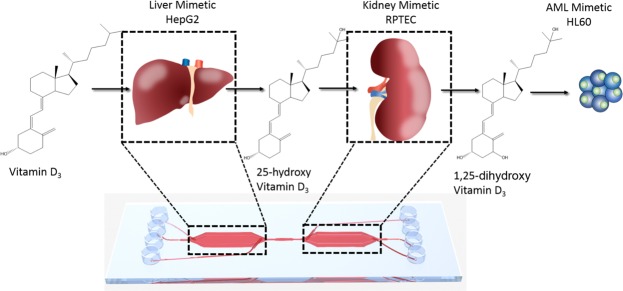
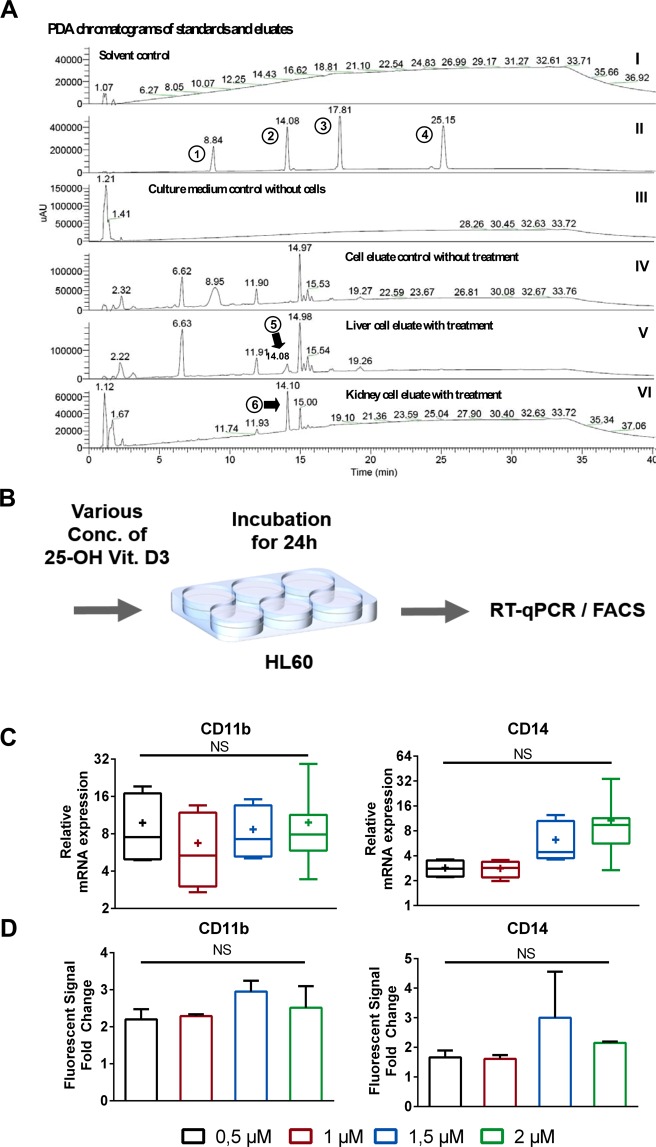
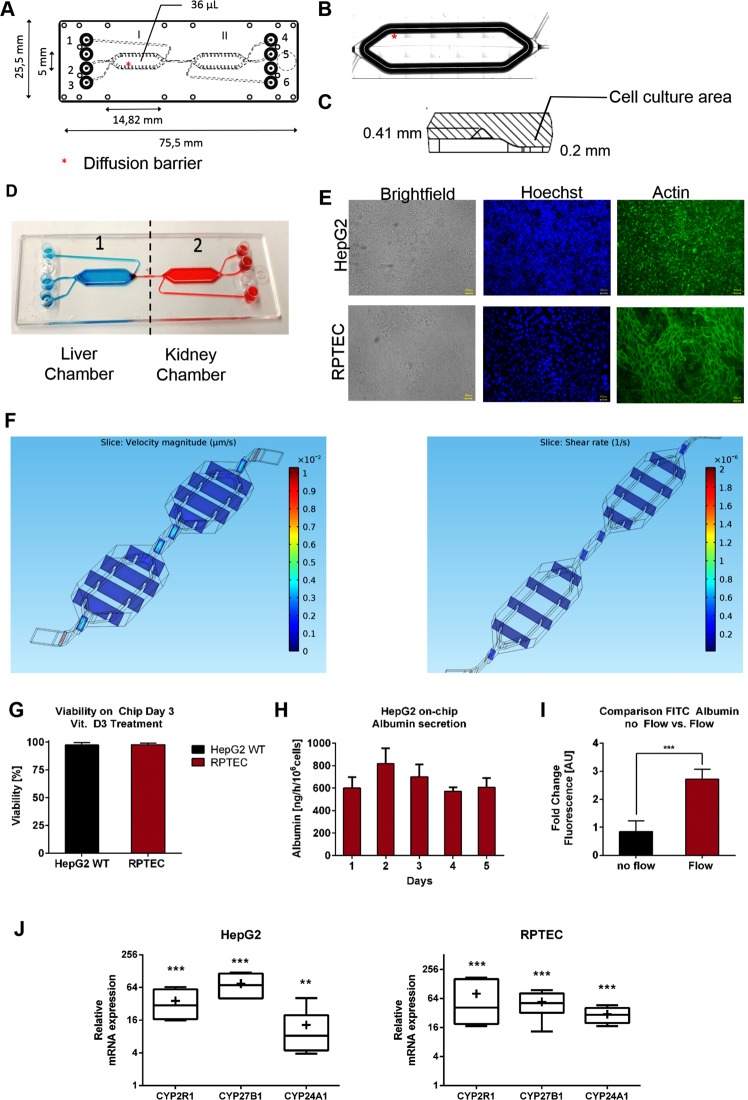
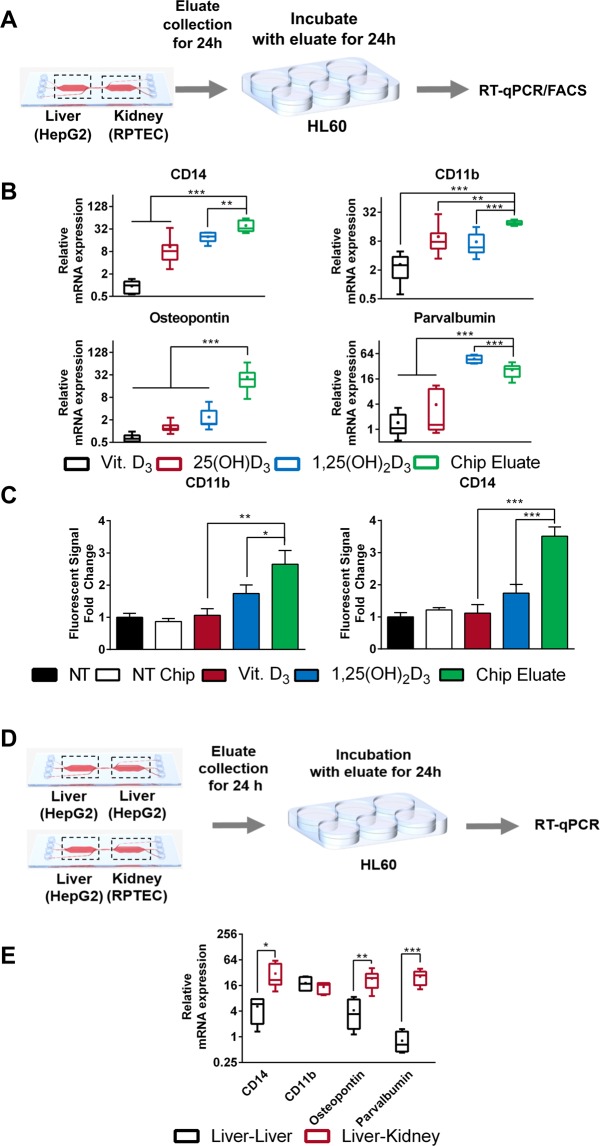
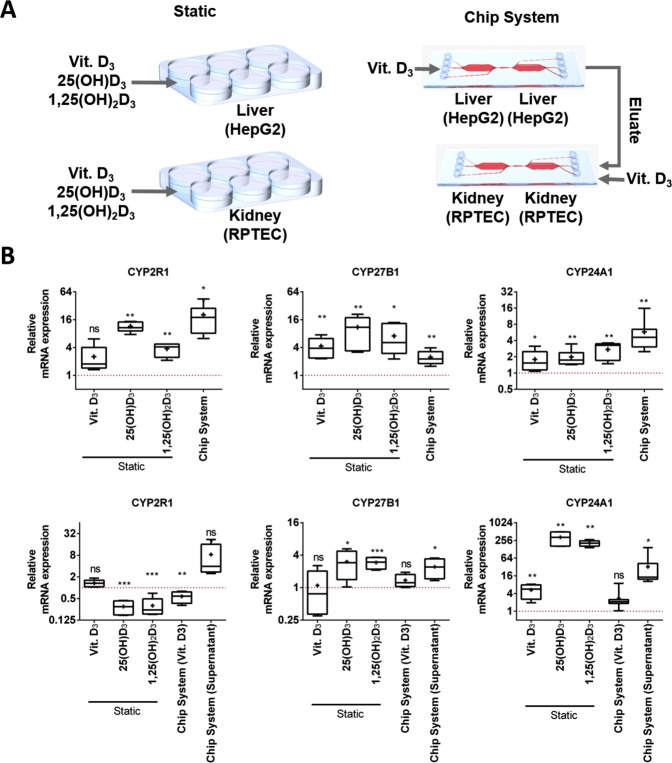
Organ-on-chip platforms provide models that allow the representation of human physiological processes in cell-based miniaturized systems. Potential pre-clinical applications include drug testing and toxicity studies. Here we describe the use of a multi-compartment micro-fluidic chip to recapitulate hepatic vitamin D metabolism (vitamin D to 25-hydroxyvitamin D) and renal bio-activation (25-hydroxyvitamin D to 1,25-dihydroxyvitamin D) in humans. In contrast to cultivation in conventional tissue culture settings, on-chip cultivation of HepG2 and RPTEC cells in interconnected chambers, used to mimic the liver and kidneys, respectively, resulted in the enhanced expression of vitamin D metabolizing enzymes (CYP2R1, CYP27B1 and CYP24A1). Pump-driven flow of vitamin D3-containing medium through the microfluidic chip produced eluate containing vitamin D3 metabolites. LC-MSMS showed a strong accumulation of 25-hydroxyvitamin D. The chip eluate induced the expression of differentiation markers in HL-60 (acute myeloid leukemia) cells, assessed by qPCR and FACS analysis, in a manner similar to treatment with reference standards indicating the presence of fully activated 1,25 dihydroxyvitamin D, although the latter was not detected in the eluate by LC-MSMS. Interestingly, 25-hydroxyvitamin D by itself led to weak activation of HL-60 cells suggesting that 25-hydroxyvitamin D is also an active metabolite. Our experiments demonstrate that complex metabolic interactions can be reconstructed outside the human body using dedicated organ-on-chip platforms. We therefore propose that such systems may be used to mimic the in vivo metabolism of various micronutrients and xenobiotics.
器官芯片平台提供了模型,允许在基于细胞的小型化系统中再现人体生理过程。潜在的临床前应用包括药物测试和毒性研究。在这里,我们描述了使用多腔室微流控芯片在人类中重新构建肝维生素 D 代谢(维生素 D 至 25-羟维生素 D)和肾生物活化(25-羟维生素 D 至 1,25-二羟维生素 D)。与传统组织培养环境中的培养相比,在相互连接的腔室中培养 HepG2 和 RPTEC 细胞的芯片培养分别模拟肝脏和肾脏,导致维生素 D 代谢酶(CYP2R1、CYP27B1 和 CYP24A1)的表达增强。通过微流控芯片泵驱动含维生素 D3 的培养基流动产生含有维生素 D3 代谢物的洗脱液。LC-MSMS 显示 25-羟维生素 D 大量积累。芯片洗脱液通过 qPCR 和 FACS 分析诱导 HL-60(急性髓细胞白血病)细胞表达分化标志物,其方式类似于用参比标准处理,表明存在完全激活的 1,25 二羟维生素 D,尽管后者在洗脱液中未通过 LC-MSMS 检测到。有趣的是,25-羟维生素 D 本身导致 HL-60 细胞的弱激活,表明 25-羟维生素 D 也是一种活性代谢物。我们的实验表明,复杂的代谢相互作用可以使用专用的器官芯片平台在体外重建。因此,我们建议此类系统可用于模拟各种微量营养素和外源性物质的体内代谢。