Modi Prerna Suchitan, Singh Abhishek, Chaturvedi Awyang, Agarwal Shailly, Dutta Raghav, Nayak Ranu, Singh Alok Kumar
Amity Institute of Biotechnology, Amity University Uttar Pradesh, Noida, Uttar Pradesh, India.
Amity Institute of Nanotechnology, Amity University Uttar Pradesh, Noida, Uttar Pradesh, India.
Synth Syst Biotechnol. 2024 Aug 30;10(1):86-101. doi: 10.1016/j.synbio.2024.08.007. eCollection 2025.
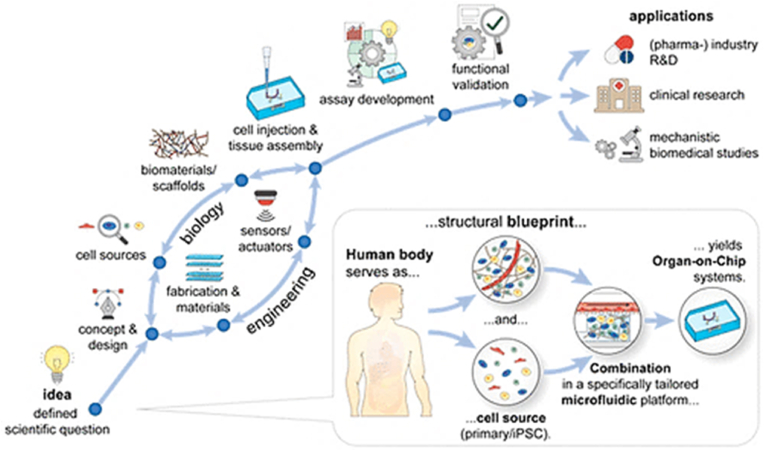
Tissue on a chip or organ-on-chip (OOC) is a technology that's dignified to form a transformation in drug discovery through the use of advanced platforms. These are 3D in cell culture models that mimic micro-environment of human organs or tissues on artificial microstructures built on a portable microfluidic chip without involving sacrificial humans or animals. This review article aims to offer readers a thorough and insightful understanding of technology. It begins with an in-depth understanding of chip design and instrumentation, underlining its pivotal role and the imperative need for its development in the modern scientific landscape. The review article explores into the myriad applications of OOC technology, showcasing its transformative impact on fields such as radiobiology, drug discovery and screening, and its pioneering use in space research. In addition to highlighting these diverse applications, the article provides a critical analysis of the current challenges that OOC technology faces. It examines both the biological and technical limitations that hinder its progress and efficacy and discusses the potential advancements and innovations that could drive the OOC technology forward. Through this comprehensive review, readers will gain a deep appreciation of the significance, capabilities, and evolving landscape of OOC technology.
芯片上的组织或器官芯片(OOC)是一项通过使用先进平台有望在药物发现领域引发变革的技术。这些是3D细胞培养模型,可在便携式微流控芯片上构建的人工微结构上模拟人体器官或组织的微环境,而无需使用人类或动物作为实验对象。这篇综述文章旨在让读者全面、深入地了解该技术。文章首先深入介绍芯片设计和仪器设备,强调其关键作用以及在现代科学领域发展的迫切需求。该综述文章探讨了器官芯片技术的众多应用,展示了其对放射生物学、药物发现与筛选等领域的变革性影响,以及在空间研究中的开创性应用。除了强调这些多样的应用,文章还对器官芯片技术目前面临的挑战进行了批判性分析。它审视了阻碍其发展和功效的生物学及技术限制,并讨论了可能推动器官芯片技术前进的潜在进展和创新。通过这一全面的综述,读者将深刻认识到器官芯片技术的重要性、能力以及不断发展的前景。