Graduate Field of Biochemistry, Molecular and Cellular Biology, Cornell University, Ithaca, NY, 14853, USA.
Division of Nutritional Sciences, Cornell University, 127 Savage Hall, Ithaca, NY, 14853, USA.
DNA Repair (Amst). 2019 May;77:36-44. doi: 10.1016/j.dnarep.2019.02.014. Epub 2019 Feb 27.
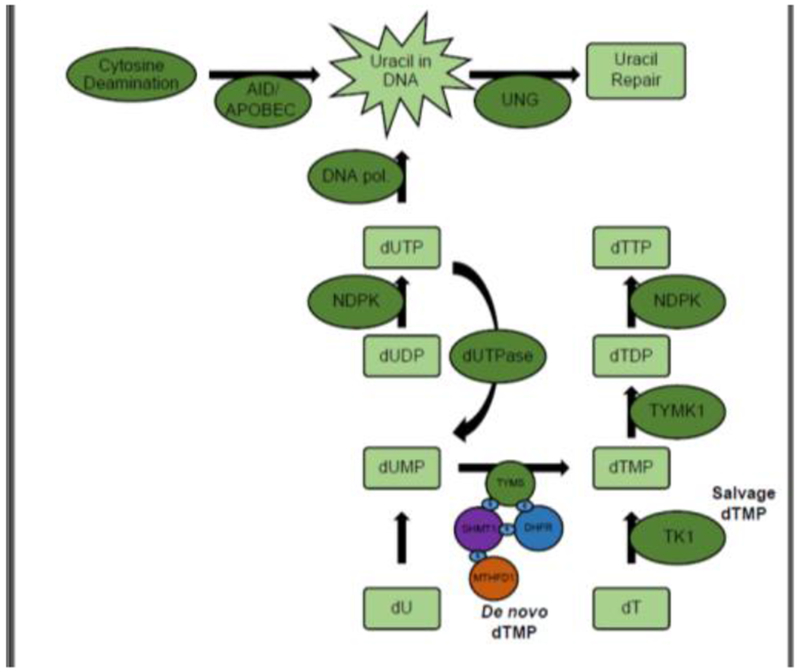
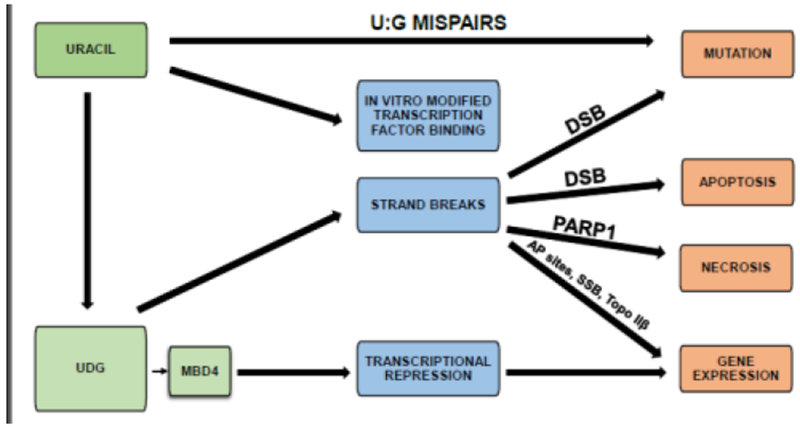
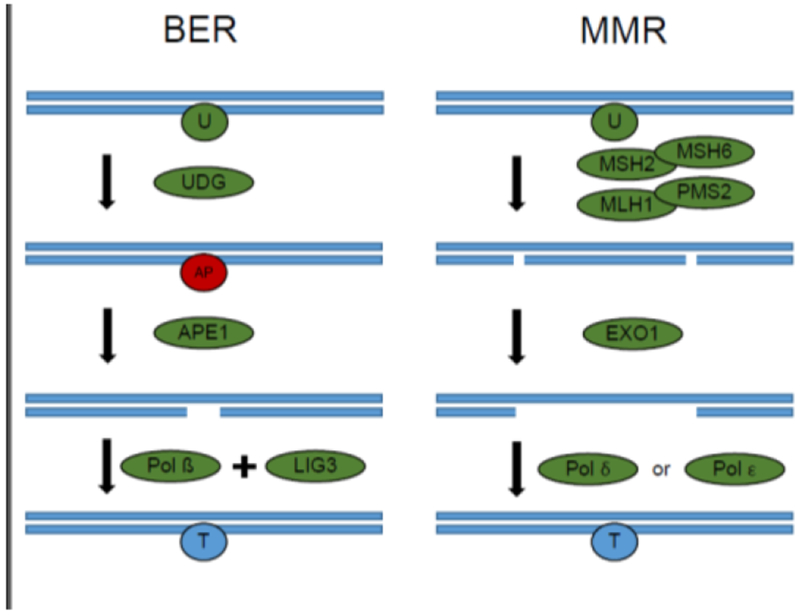
Genomic instability is implicated in the etiology of several deleterious health outcomes including megaloblastic anemia, neural tube defects, and neurodegeneration. Uracil misincorporation and its repair are known to cause genomic instability by inducing DNA strand breaks leading to apoptosis, but there is emerging evidence that uracil incorporation may also result in broader modifications of gene expression, including: changes in transcriptional stalling, strand break-mediated transcriptional upregulation, and direct promoter inhibition. The factors that influence uracil levels in DNA are cytosine deamination, de novo thymidylate (dTMP) biosynthesis, salvage dTMP biosynthesis, dUTPase, and DNA repair. There is evidence that the nuclear localization of the enzymes in these pathways in mammalian cells may modify and/or control the levels of uracil accumulation into nuclear DNA. Uracil sequencing technologies demonstrate that uracil in DNA is not distributed stochastically across the genome, but instead shows patterns of enrichment. Nuclear localization of the enzymes that modify uracil in DNA may serve to change these patterns of enrichment in a tissue-specific manner, and thereby signal the genome in response to metabolic and/or nutritional state of the cell.
基因组不稳定性与多种有害健康后果有关,包括巨幼细胞性贫血、神经管缺陷和神经退行性变。尿嘧啶掺入及其修复已知会通过诱导 DNA 链断裂导致细胞凋亡而引起基因组不稳定性,但有新的证据表明尿嘧啶掺入也可能导致基因表达的更广泛修饰,包括:转录停滞变化、链断裂介导的转录上调和直接启动子抑制。影响 DNA 中尿嘧啶水平的因素有胞嘧啶脱氨酶、从头胸苷酸(dTMP)生物合成、补救 dTMP 生物合成、dUTP 酶和 DNA 修复。有证据表明,哺乳动物细胞中这些途径中酶的核定位可能会修饰和/或控制核 DNA 中尿嘧啶积累的水平。尿嘧啶测序技术表明,DNA 中的尿嘧啶不是随机分布在基因组中,而是显示出富集的模式。DNA 中修饰尿嘧啶的酶的核定位可能以组织特异性的方式改变这些富集模式,并因此响应细胞的代谢和/或营养状态对基因组发出信号。