Choi Jongki, Park Jinse, Lee Byung Inn, Shin Kyoung Jin, Yoo Sunmi, Kim Hyoeun, Jang Wooyoung, Kim Ji Sun, Youn Jinyoung, Oh Engseok
Department of Family Medicine, Haeundae Paik Hospital, Busan, Korea.
Department of Neurology, Haeundae Paik Hospital, Busan, Korea.
J Clin Neurol. 2019 Apr;15(2):152-158. doi: 10.3988/jcn.2019.15.2.152. Epub 2019 Mar 11.
Gait impairment in patients with cognitive decline has received considerable attention over the past several decades. However, gait disturbance in dementia is often underdiagnosed. The Mini Mental State Examination (MMSE) is the most widely used screening test for dementia, and the Montreal Cognitive Assessment (MoCA) has been developed for more accurate assessments of mild cognitive impairment (MCI). The purpose of this study was to determine the correlation between gait status and the scores on these screening tests for dementia.
We recruited 18 patients with MCI and 19 patients with early-stage dementia. All of the participants were examined using the Korean versions of the MMSE and MoCA developed for screening dementia (MMSE-DS and MoCA-K, respectively) and a neuropsychological test to determine cognitive function. A three-dimensional motion-capture system was used to perform objective measurements of gait in all participants. We evaluated the correlation between the screening scores and gait parameters.
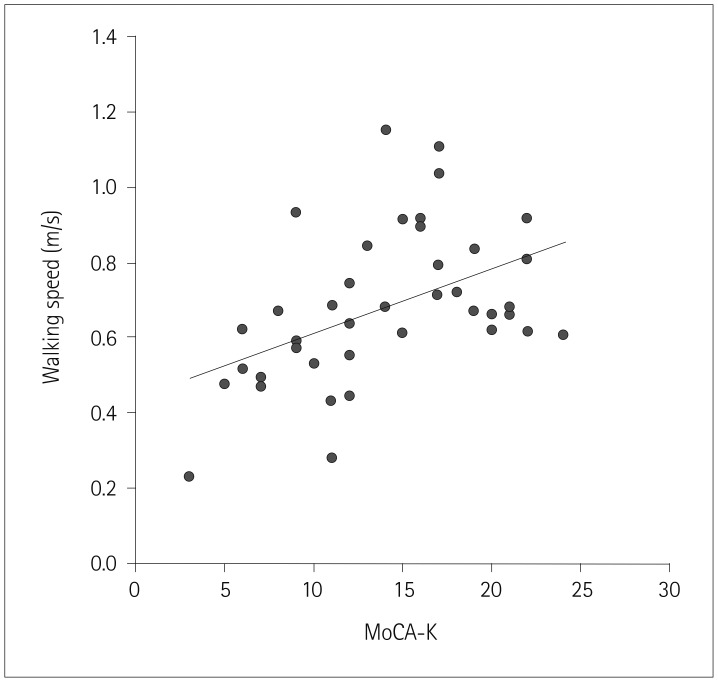
The MoCA-K score was significantly correlated with the walking speed (=0.408, <0.05) and stride length (=0.334, <0.05). After adjusting for age, the MoCA-K score remained correlated with the walking speed (=0.331, <0.05), whereas the MMSE-DS score (=0.264, =0.11) and stride length (=0.206, =0.22) were not. The neuropsychological test revealed that walking speed and stride length were significantly correlated with memory and frontal lobe function.
We found that the MoCA-K reflects the gait status in patients with cognitive decline more accurately than does the MMSE-DS. Our results suggest that the MoCA-K has more advantages than the MMSE-DS as a screening tool for dementia.
在过去几十年中,认知功能减退患者的步态障碍受到了广泛关注。然而,痴呆患者的步态障碍常常被漏诊。简易精神状态检查表(MMSE)是痴呆最常用的筛查测试,而蒙特利尔认知评估量表(MoCA)则用于更准确地评估轻度认知障碍(MCI)。本研究的目的是确定步态状态与这些痴呆筛查测试得分之间的相关性。
我们招募了18例MCI患者和19例早期痴呆患者。所有参与者均使用为痴呆筛查而开发的韩语版MMSE和MoCA(分别为MMSE-DS和MoCA-K)以及一项神经心理学测试来确定认知功能。使用三维运动捕捉系统对所有参与者的步态进行客观测量。我们评估了筛查得分与步态参数之间的相关性。
MoCA-K得分与步行速度(=0.408,<0.05)和步幅(=0.334,<0.05)显著相关。在调整年龄后,MoCA-K得分仍与步行速度相关(=0.331,<0.05),而MMSE-DS得分(=0.264,=0.11)和步幅(=0.206,=0.22)则无相关性。神经心理学测试显示,步行速度和步幅与记忆及额叶功能显著相关。
我们发现,MoCA-K比MMSE-DS更准确地反映了认知功能减退患者的步态状态。我们的结果表明,作为痴呆筛查工具,MoCA-K比MMSE-DS具有更多优势。