Asiri Safiyyah, Altwaijri Waleed A, Ba-Armah Duaa, Al Rumayyan Ahmed, Alrifai Muhammad T, Salam Mahmoud, Almutairi Adel F
Pediatric Neurology, Pediatric Department, King Abdullah Specialist Children's Hospital, Ministry of National Guard-Health Affairs (MNGHA), Riyadh, Saudi Arabia.
College of Medicine, King Saud Bin Abdulaziz University for Health Sciences, Riyadh, Saudi Arabia.
Neuropsychiatr Dis Treat. 2019 Mar 1;15:627-635. doi: 10.2147/NDT.S187994. eCollection 2019.
Guillain-Barré syndrome (GBS) is a progressive acute form of paralysis most probably secondary to an immune-mediated process. GBS among Saudis has been seldom investigated, which leaves both clinicians and researchers with scarcity in knowledge. Therefore, this study aims to assess the prevalence and clinical prognosis of GBS among pediatrics admitted with acute paralysis at a large healthcare facility in Riyadh, Saudi Arabia.
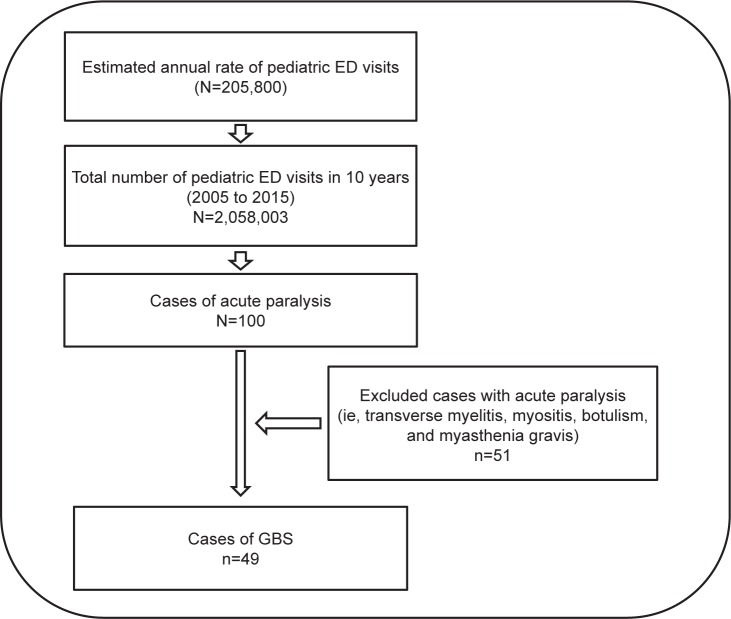
This retrospective study reviewed patients' medical records between 2005 and 2015. Eligible cases were children (<14 years old) admitted to the hospital complaining of acute paralysis and later diagnosed with one form or variant of GBS. Pearson's chi-square, Fisher's exact test, and binary logistic regression were employed to analyze the collected data.
The prevalence of GBS was 49%. The male-to-female ratio was 1.45:1. The mean ± standard deviation age was 7±3.7 years. There were 34 (69.4%) cases with progression to maximum paralysis in ≤2 weeks, while 15 (30.6%) cases occurred beyond 2 weeks. Males (n=24, 82.8%) were more likely to endure progression to maximum paralysis in ≤2 weeks after the disease onset, compared to females (n=10, 50%), =0.014. All cases complaining of respiratory problems exhibited a progression to maximum paralysis in ≤2 weeks, compared to those with no respiratory problems, =0.027. Residual paralysis at 60 days post disease onset was highly associated with GBS patients of age 8-14 years (n=15, 65.2%), compared to younger patients (n=8, 30.8%), =0.016. Patients admitted in colder seasons (n=14, 63.6%) were more likely to suffer residual paralysis too, compared to those in warmer seasons (n=9, 33.3%), =0.035. GBS cases who complained of facial weakness (n=9, 75%) and ocular abnormalities (n=10, 71.4%) were also more likely to endure residual paralysis at 60 days post disease onset, =0.025 and =0.03, respectively.
Male gender could be a determinant of rapid progression to maximum paralysis, while the older age group in pediatrics is expected to endure residual paralysis at 60 days post disease onset. GBS can be accounted as a rare disease, especially in pediatrics, so confirmed cases should be investigated comprehensively for research purposes.
吉兰-巴雷综合征(GBS)是一种进行性急性麻痹形式,很可能继发于免疫介导过程。沙特人中的GBS很少被研究,这使得临床医生和研究人员在这方面的知识都很匮乏。因此,本研究旨在评估沙特阿拉伯利雅得一家大型医疗机构中因急性麻痹入院的儿科患者中GBS的患病率和临床预后。
这项回顾性研究回顾了2005年至2015年期间患者的病历。符合条件的病例为年龄小于14岁、因急性麻痹入院且后来被诊断为GBS的一种形式或变体的儿童。采用Pearson卡方检验、Fisher精确检验和二元逻辑回归分析收集的数据。
GBS的患病率为49%。男女比例为1.45:1。平均年龄±标准差为7±3.7岁。在≤2周内进展至最大麻痹的病例有34例(69.4%),而15例(30.6%)病例在2周后出现。与女性(n = 10,50%)相比,男性(n = 24,82.8%)在疾病发作后≤2周内更有可能进展至最大麻痹,P = 0.014。与无呼吸问题的病例相比,所有抱怨有呼吸问题的病例在≤2周内均进展至最大麻痹,P = 0.027。与较年轻患者(n = 8,30.8%)相比,发病后60天仍有残留麻痹与8 - 14岁的GBS患者高度相关(n = 15,65.2%),P = 0.016。与温暖季节入院的患者(n = 9,33.3%)相比,寒冷季节入院的患者(n = 14,63.6%)也更有可能残留麻痹,P = 0.035。抱怨面部无力(n = 9,75%)和眼部异常(n = 10,71.4%)的GBS病例在发病后60天也更有可能残留麻痹,P分别为0.025和0.03。
男性可能是快速进展至最大麻痹的一个决定因素,而儿科中年龄较大的组预计在疾病发作后60天会残留麻痹。GBS可被视为一种罕见疾病,尤其是在儿科,因此为了研究目的,应对确诊病例进行全面调查。