Department of Epidemiology, School of Medicine, Jinan University, Guangzhou, China.
Department of Medical Statistics, School of Medicine, Jinan University, Guangzhou, China.
J Gynecol Oncol. 2019 May;30(3):e23. doi: 10.3802/jgo.2019.30.e23.
There has been growing body of literatures showing that chronic inflammation might play an important role in cancer development. This meta-analysis aimed to assess the association between the dietary inflammation index (DII) score and gynecological cancers.
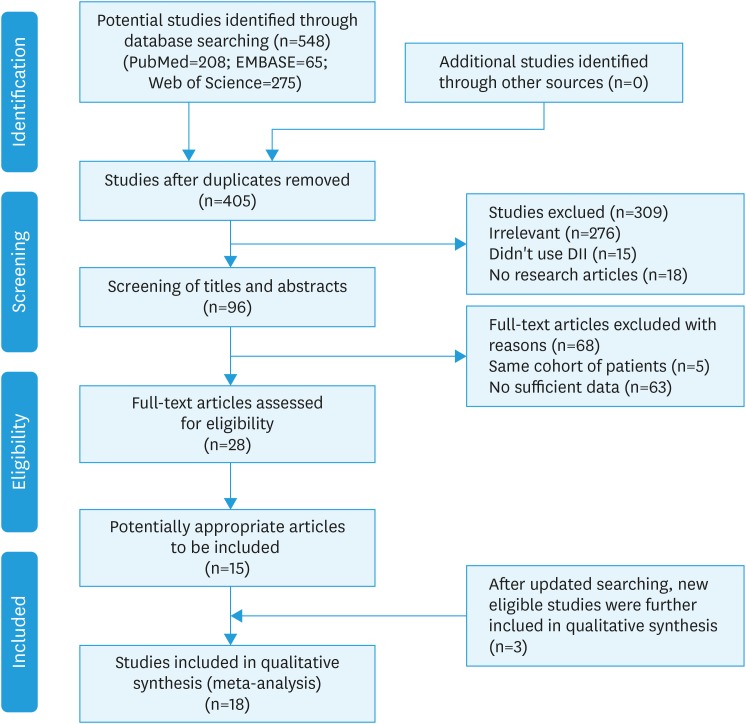
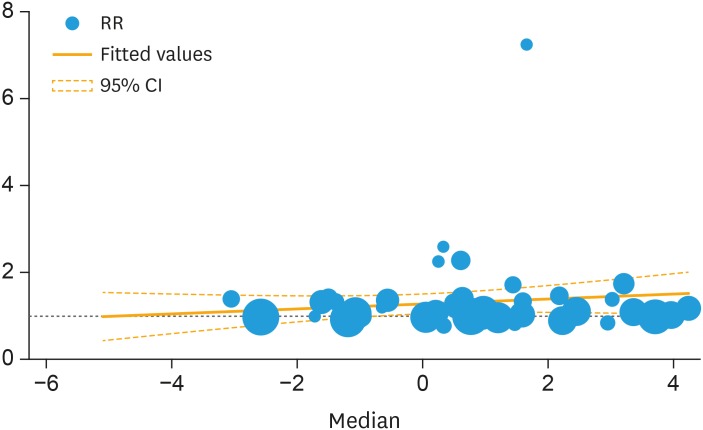
A systematic search of PubMed, EMBASE and Web of Science up until October 20, 2018 was carried out to retrieve all related cohort and case-control studies. The summary risk assessments were pooled using random-effects models. The dose-response relationship was estimated by linear relationship model.
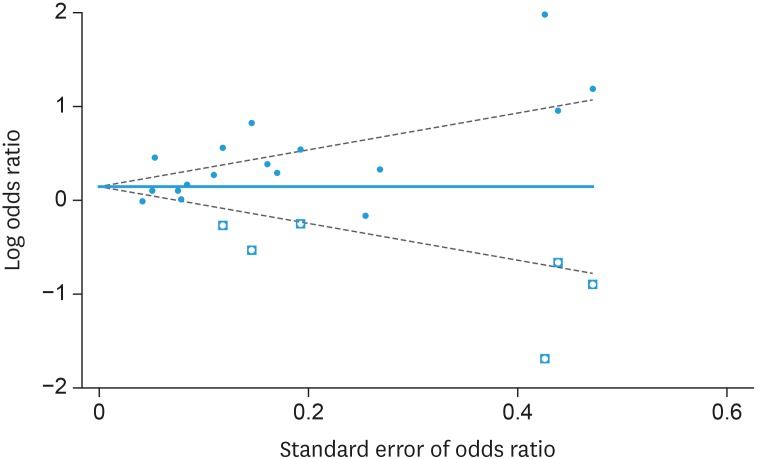
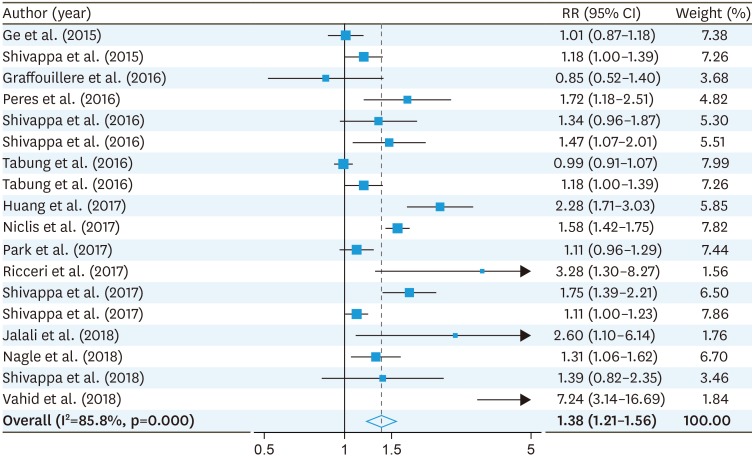
Twelve case-control studies (10,774 cases/15,958 controls) and six prospective cohort studies (330,363 participants/23,133 incident cases) were included in this meta-analysis. The pooled adjusted relative risk (RR) of gynecological cancers for the highest DII category compared to the lowest category was 1.38, (95% confidence intervals [CIs], 1.21-1.56, p<0.001]. A positive dose-response relationship was also noticed. Stratified by study design indicated that, the pooled RRs was significantly higher for case-control studies than cohort studies (p for interaction<0.001), for studies conducted among participants with body mass index (BMI) ≥25 kg/m² than participants with BMI <25 kg/m² (p for interaction=0.026), among participants with ovarian cancer and endometrial cancer than participants with breast cancer (p for interaction = 0.038). Meta-regression analysis further confirmed that study design significantly contributed to inter-study heterogeneity (p<0.001).
This meta-analysis suggests that elevated DII is independently associated with a higher risk of gynecological cancers, especially patients with ovarian cancer and endometrial cancer and among obese participants.
越来越多的文献表明,慢性炎症可能在癌症发展中起重要作用。本荟萃分析旨在评估饮食炎症指数(DII)评分与妇科癌症之间的关系。
系统检索了 PubMed、EMBASE 和 Web of Science,检索时间截至 2018 年 10 月 20 日,以检索所有相关的队列研究和病例对照研究。使用随机效应模型汇总汇总风险评估。通过线性关系模型估计剂量反应关系。
本荟萃分析共纳入 12 项病例对照研究(10774 例/15958 例对照)和 6 项前瞻性队列研究(330363 例参与者/23133 例病例)。与最低 DII 类别相比,最高 DII 类别妇科癌症的合并调整相对风险(RR)为 1.38(95%置信区间[CI],1.21-1.56,p<0.001)。还观察到阳性剂量反应关系。按研究设计分层表明,病例对照研究的合并 RR 明显高于队列研究(p 交互<0.001),BMI≥25 kg/m²的参与者高于 BMI<25 kg/m² 的参与者(p 交互=0.026),卵巢癌和子宫内膜癌患者高于乳腺癌患者(p 交互=0.038)。Meta 回归分析进一步证实,研究设计显著导致了研究间异质性(p<0.001)。
本荟萃分析表明,DII 升高与妇科癌症风险增加独立相关,尤其是卵巢癌和子宫内膜癌患者以及肥胖参与者。