Liu Fang-Hua, Liu Chuan, Gong Ting-Ting, Gao Song, Sun Hui, Jiang Yu-Ting, Zhang Jia-Yu, Zhang Meng, Gao Chang, Li Xin-Yu, Zhao Yu-Hong, Wu Qi-Jun
Department of Clinical Epidemiology, Shengjing Hospital of China Medical University, Shenyang, China.
Clinical Research Center, Shengjing Hospital of China Medical University, Shenyang, China.
Front Nutr. 2021 May 19;8:647122. doi: 10.3389/fnut.2021.647122. eCollection 2021.
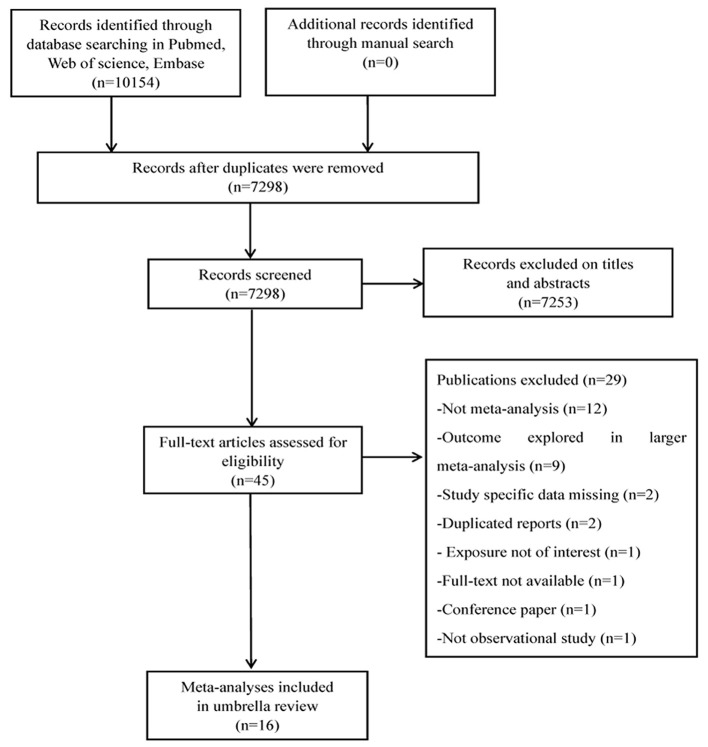
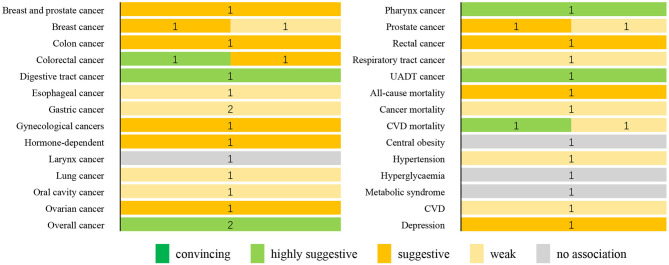
The dietary inflammatory index (DII) is associated with non-communicable disease. We conducted an umbrella review to systematically evaluate meta-analyses of observational studies on DII and diverse health outcomes. We comprehensively searched the PubMed, Web of Science, and Embase databases to identify related systematic reviews and meta-analyses of observational studies. Those investigating the association between DII and a wide range of health outcomes in humans were eligible for inclusion. For each meta-analysis, we estimated the summary effect size by using fixed and random effects models, the 95% confidence interval, and the 95% prediction interval. We assessed heterogeneity, evidence of small-study effects, and excess significance bias. The umbrella review identified 35 meta-analyses assessing associations between DII and various health outcomes: cancer ( = 24), mortality ( = 4), metabolic ( = 4), and other ( = 3). The methodological quality was high or moderate. Of the 35 meta-analyses, we observed highly suggestive evidence for harmful associations between digestive tract cancer, colorectal cancer, overall cancer, pharyngeal cancer, UADT cancer, and CVD mortality. Moreover, 11 harmful associations showed suggestive evidence: hormone-dependent cancer, rectal cancer, colon cancer, breast and prostate cancer, gynecological cancer, breast cancer, ovarian cancer, colorectal cancer, prostate cancer, all-cause mortality, and depression. DII is likely to be associated with harmful effects in multiple health outcomes. Robust randomized controlled trials are warranted to understand whether the observed results are causal. CRD42021218361.
饮食炎症指数(DII)与非传染性疾病相关。我们进行了一项综合评价,以系统评估关于DII与多种健康结局的观察性研究的荟萃分析。我们全面检索了PubMed、科学网和Embase数据库,以识别观察性研究的相关系统评价和荟萃分析。那些研究DII与人类广泛健康结局之间关联的研究符合纳入标准。对于每项荟萃分析,我们使用固定效应模型和随机效应模型估计汇总效应量、95%置信区间和95%预测区间。我们评估了异质性、小研究效应的证据和过度显著性偏差。该综合评价确定了35项评估DII与各种健康结局之间关联的荟萃分析:癌症(n = 24)、死亡率(n = 4)、代谢(n = 4)和其他(n = 3)。方法学质量为高或中等。在这35项荟萃分析中,我们观察到有高度提示性证据表明消化道癌、结直肠癌、总体癌症、咽喉癌、上呼吸道和消化道癌症以及心血管疾病死亡率之间存在有害关联。此外,11项有害关联显示有提示性证据:激素依赖性癌症、直肠癌、结肠癌、乳腺癌和前列腺癌、妇科癌症、乳腺癌、卵巢癌、结直肠癌、前列腺癌、全因死亡率和抑郁症。DII可能与多种健康结局的有害影响相关。有必要进行强有力的随机对照试验,以了解观察到的结果是否具有因果关系。CRD4202121836