
2003-2012 年因心血管疾病导致的亚裔美国人亚组潜在寿命损失年数。
Years of Potential Life Lost Because of Cardiovascular Disease in Asian-American Subgroups, 2003-2012.
机构信息
1 University of Connecticut School of Medicine Farmington CT.
2 Division of Primary Care and Population Health Stanford University School of Medicine Stanford CA.
出版信息
J Am Heart Assoc. 2019 Apr 2;8(7):e010744. doi: 10.1161/JAHA.118.010744.
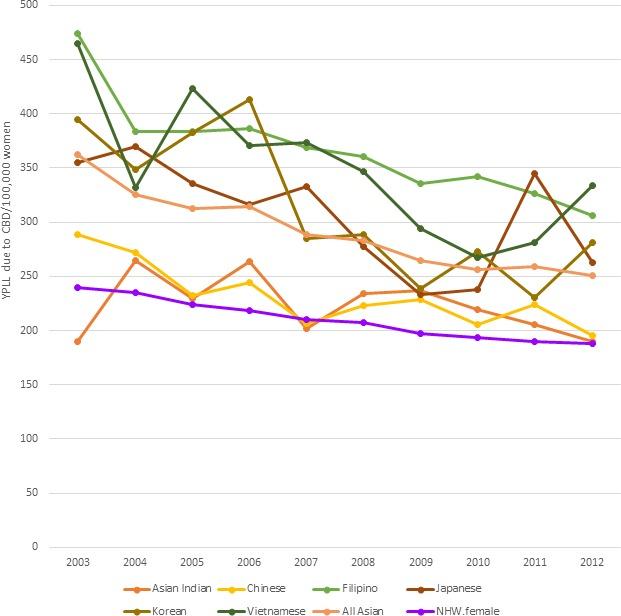
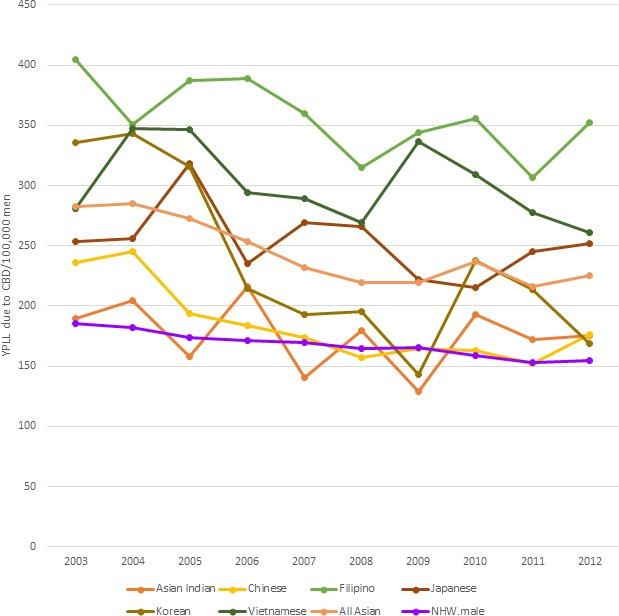
Background Asian-American subgroups (Asian-Indian, Chinese, Filipino, Korean, Japanese, and Vietnamese) display varied cardiovascular disease mortality patterns, especially at younger ages. This study aims to examine the years of potential life lost because of ischemic heart disease and cerebrovascular disease among the 6 largest Asian-American subgroups compared with non-Hispanic whites. Methods and Results We used National Center for Health Statistics Multiple Causes of Death mortality files from 2003 to 2012 to calculate race-specific life expectancy, mean years of potential life lost, and years of potential life lost per 100 000 population for each Asian subgroup and non-Hispanic whites. Asian-American subgroups display heterogeneity in cardiovascular disease burden. Asian-Indians had a high burden of ischemic heart disease; Asian-Indian men lost 724 years per 100 000 population in 2012 and a mean of 17 years to ischemic heart disease. Respectively, Vietnamese and Filipino men and women lost a mean of 17 and 16 years of life to cerebrovascular disease; Filipino men lost 352 years per 100 000 population in 2012. All Asian subgroups for both sexes had higher years of life lost to cerebrovascular disease compared with non-Hispanic whites. Conclusions Cardiovascular disease burden varies among Asian subgroups, and contributes to greater premature mortality in certain subgroups. Asian-Indian and Filipino populations have the highest years of life lost because of ischemic heart disease and Filipino and Vietnamese have the highest years of life lost because of cerebrovascular disease. Analysis of risk factors and development of subgroup-specific interventions are required to address these health disparities.
背景
亚裔美国人亚群(亚裔印度人、中国人、菲律宾人、韩国人、日本人、越南人)的心血管疾病死亡率模式存在差异,尤其是在较年轻时。本研究旨在比较 6 大亚裔美国人亚群与非西班牙裔白人之间因缺血性心脏病和脑血管病而丧失的潜在寿命年数。
方法和结果
我们使用国家卫生统计中心 2003 年至 2012 年的多死因死亡率档案,计算每个亚裔亚群和非西班牙裔白人的特定种族预期寿命、平均潜在寿命损失年数以及每 10 万人的潜在寿命损失年数。亚裔美国人亚群在心血管疾病负担方面存在异质性。亚裔印度人患有缺血性心脏病的负担较重;2012 年,亚裔印度男性每 10 万人丧失 724 年的潜在寿命,平均有 17 年因缺血性心脏病而丧失生命。相应地,越南和菲律宾男性和女性平均有 17 年和 16 年的生命因脑血管病而丧失;2012 年,菲律宾男性每 10 万人丧失 352 年的潜在寿命。与非西班牙裔白人相比,所有亚裔亚群的两性都有更高的因脑血管病而丧失的寿命年数。
结论
心血管疾病负担在亚裔亚群中存在差异,这导致某些亚群的过早死亡率更高。亚裔印度人和菲律宾人因缺血性心脏病而丧失的生命年数最多,而菲律宾人和越南人因脑血管病而丧失的生命年数最多。需要分析危险因素并制定针对特定亚群的干预措施,以解决这些健康差异。


 Zotero 插件