Department of Biochemistry and Molecular Genetics, University of Colorado Denver-Anschutz Medical Campus, Aurora, CO.
Division of Pulmonary Allergy and Critical Care Medicine, University of Pittsburgh and University of Pittsburgh Medical Center, Pittsburgh, PA.
Blood Adv. 2019 Mar 26;3(6):884-896. doi: 10.1182/bloodadvances.2018029629.
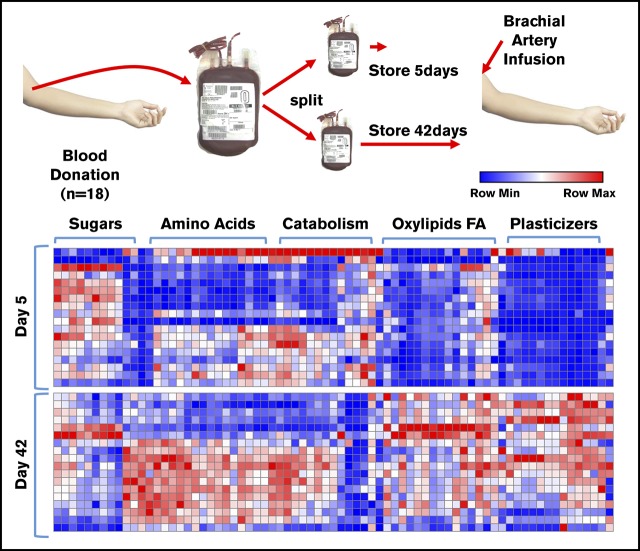
Cold storage of blood for 5 to 6 weeks has been shown to impair endothelial function after transfusion and has been associated with measures of end-organ dysfunction. Although the products of hemolysis, such as cell-free plasma hemoglobin, arginase, heme, and iron, in part mediate these effects, a complete analysis of transfused metabolites that may affect organ function has not been evaluated to date. Blood stored for either 5 or 42 days was collected from 18 healthy autologous volunteers, prior to and after autologous transfusion into the forearm circulation, followed by metabolomics analyses. Significant metabolic changes were observed in the plasma levels of hemolytic markers, oxidized purines, plasticizers, and oxidized lipids in recipients of blood stored for 42 days, compared with 5 days. Notably, transfusion of day 42 red blood cells (RBCs) increased circulating levels of plasticizers (diethylhexyl phthalate and derivatives) by up to 18-fold. Similarly, transfusion of day 42 blood significantly increased circulating levels of proinflammatory oxylipins, including prostaglandins, hydroxyeicosatrienoic acids (HETEs), and dihydroxyoctadecenoic acids. Oxylipins were the most significantly increasing metabolites (for 9-HETE: up to ∼41-fold, = 3.7e-06) in day 42 supernatants. Measurements of arginine metabolism confirmed an increase in arginase activity at the expense of nitric oxide synthesis capacity in the bloodstream of recipients of day 42 blood, which correlated with measurements of hemodynamics. Metabolic changes in stored RBC supernatants impact the plasma metabolome of healthy transfusion recipients, with observed increases in plasticizers, as well as vasoactive, pro-oxidative, proinflammatory, and immunomodulatory metabolites after 42 days of storage.
血液冷藏 5 至 6 周后会损害输血后的内皮功能,并与终末器官功能障碍的指标相关。尽管溶血产物(如无细胞血浆血红蛋白、精氨酸酶、血红素和铁)在一定程度上介导了这些作用,但迄今为止尚未对可能影响器官功能的输注代谢产物进行全面分析。在自体输血到前臂循环之前和之后,从 18 名健康的自体志愿者中采集了冷藏 5 天或 42 天的血液,随后进行代谢组学分析。与冷藏 5 天的血液相比,冷藏 42 天的血液在接受者的血浆中观察到溶血标志物、氧化嘌呤、增塑剂和氧化脂质的水平发生了显著变化。值得注意的是,输注冷藏 42 天的红细胞 (RBC) 可使循环中的增塑剂(邻苯二甲酸二乙酯及其衍生物)水平增加 18 倍。同样,输注冷藏 42 天的血液显著增加了循环中的促炎氧化脂质,包括前列腺素、羟二十碳三烯酸 (HETE) 和二羟基十八碳烯酸。氧化脂质是冷藏 42 天的上清液中增加最多的代谢物(对于 9-HETE:增加高达约 41 倍,=3.7e-06)。精氨酸代谢的测量结果证实,在接受冷藏 42 天的血液的受者的血液中,由于一氧化氮合成能力下降,精氨酸酶活性增加,这与血液动力学的测量结果相关。储存的 RBC 上清液中的代谢变化会影响健康输血受者的血浆代谢组,观察到增塑剂以及血管活性、促氧化、促炎和免疫调节代谢物的增加,这是在储存 42 天后发生的。