Institute of Life Sciences and Bioengineering, Graduate School of Life and Environmental Sciences, University of Tsukuba, Tsukuba, Ibaraki, 305-8572, Japan.
Faculty of Life and Environmental Sciences, University of Tsukuba, Tsukuba, Ibaraki, 305-8572, Japan.
Sci Rep. 2019 Mar 19;9(1):4879. doi: 10.1038/s41598-018-37752-8.
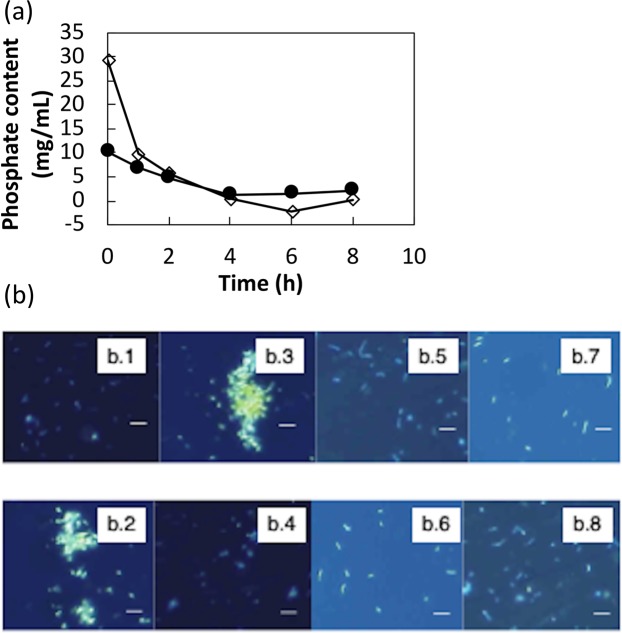
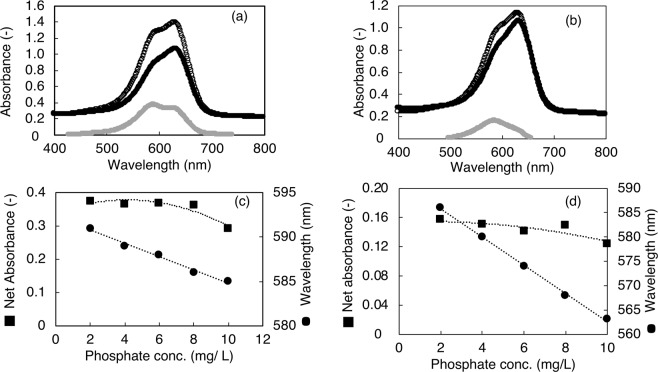
Phosphate binders and dialysis can have harmful side-effects during the treatments of hyperphosphatemia. Therefore, we evaluated the capability of intestinal bacteria (lactic acid bacteria and bifidobacteria) as phosphate-accumulating organisms (PAOs) for phosphate accumulation, with the aim of determining whether PAO-formulated food can prevent hyperphosphatemia in the early stages. However, methods for estimating microbial phosphate-accumulation capacities require significant improvements regarding specificity, cost, and simplicity. The presented method analyzed cell-free broth to assess the phosphate accumulation capability of cells. Active cells and the constructed phosphate-deficient cells were incubated in assay salt media. After incubation, phosphate-deficient cell-free broth was taken as sample and the blank was the active cell-free broth. Therefore, effects of interfering agents and other metabolites were avoided and enhanced the specificity remarkably. Phosphate contents were assessed by reactions with toluidine blue O. In contrast to the case in previous studies, the shift in the first absorbance peak was found to be inversely proportional to the phosphate concentration. The minimum detectable phosphate concentrations for the 11th isolate of Lactobacillus casei JCM 1134 and 8th isolate of Bifidobacterium adolescentis JCM 1275 were determined to be 1.24 and 0.4 mg/L, respectively. Further, the validation results were found to be significant (p-value < 0.05).
在治疗高磷血症的过程中,磷酸盐结合剂和透析可能会产生有害的副作用。因此,我们评估了肠道细菌(乳酸菌和双歧杆菌)作为聚磷菌(PAO)的能力,以确定 PAO 配方食品是否可以预防高磷血症的早期发生。然而,用于估计微生物聚磷能力的方法在特异性、成本和简单性方面需要显著改进。所提出的方法分析了无细胞培养液,以评估细胞的聚磷能力。将活性细胞和构建的缺磷细胞在盐培养基中孵育。孵育后,取缺磷无细胞培养液作为样品,空白为活性无细胞培养液。因此,避免了干扰剂和其他代谢物的影响,显著提高了特异性。通过与甲苯胺蓝 O 的反应来评估磷酸盐含量。与之前的研究不同,发现第一吸收峰的偏移与磷酸盐浓度成反比。Lactobacillus casei JCM 1134 的第 11 个分离株和 Bifidobacterium adolescentis JCM 1275 的第 8 个分离株的最低可检测磷酸盐浓度分别确定为 1.24 和 0.4mg/L。此外,验证结果具有统计学意义(p 值 < 0.05)。