Liu Zhicheng, Bingga Gali, Zhang Chunhong, Shao Junjie, Shen Haiyan, Sun Junying, Zhang Jianfeng
Scientific Observation and Experiment Station of Veterinary Drugs and Diagnostic Techniques of Guangdong Province, Ministry of Agriculture, Key Laboratory of Livestock Disease Prevention of Guangdong Province, Institute of Animal Health, Guangdong Academy of Agricultural Sciences, Guangzhou, China.
Vocational and Technical College of Inner Mongolia Agricultural University, Baotou, China.
Front Microbiol. 2019 Mar 5;10:419. doi: 10.3389/fmicb.2019.00419. eCollection 2019.
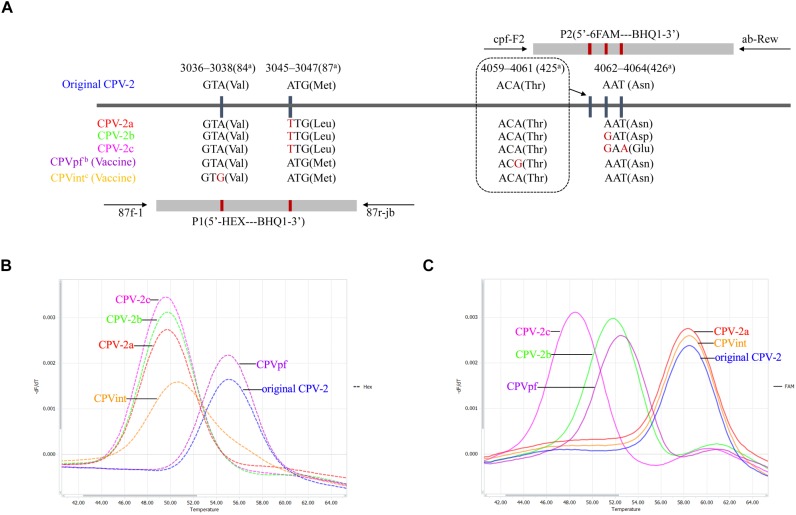
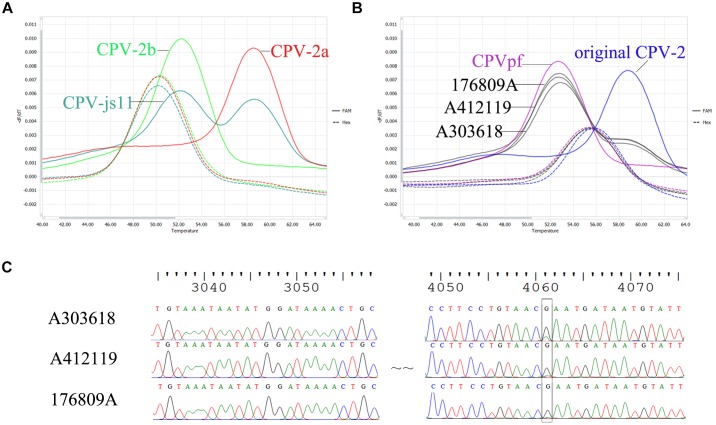
Canine parvovirus (CPV-2) is an enteric virus causing morbidity and mortality in dogs worldwide. Since CPV-2 emerged as canine pathogen, the original CPV-2 strain has constantly evolved, and its primary variants (CPV-2a, CPV-2b, and CPV-2c) co-circulate to varying extents in canine populations worldwide. Thus, rapid and accurate laboratory diagnoses of CPV-2 variants are crucial to monitor CPV-2 evolution. Conventional methods for CPV-2 genotyping are laborious, time consuming, and determining the genotype of a CPV-2 variant often requires two or more reaction tubes. The present study developed a probe-based fluorescence melting curve analysis (FMCA) for genotyping six different CPV-2 variants (original CPV-2, CPV-2a, CPV-2b, CPV-2c, and vaccine strains of CPVpf and CPVint) in a single reaction tube using only two TaqMan probes. One of the TaqMan probes (FAM labeled) was designed to perfectly match with the target sequence of CPV-2a, this probe allows a 1-bp mismatched hybridization with the CPV-2b VP2 gene region (A4062G), and a 2-bp mismatched hybridization for CPV-2c (A4062G and T4064A); Another TaqMan probe (HEX labeled) was produced to perfectly match with the target sequence of original CPV-2, this probe enables 1-bp mismatched hybridization with the other CPV-2 variants (A3045T). Using the two TaqMan probes, all six CPV-2 variants were readily distinguished by their respective melting temperature values in a single reaction tube. The detection limits of this assay were 1-10 copies per reaction for six CPV-2 construction plasmids and no cross reactions were observed with several other common canine viruses. In this assay, co-infected samples were also directly identified via probe-based FMCA without using a mixing control; only a pure control is required. The clinical evaluation of this assay was demonstrated by analyzing 83 clinical fecal samples, among which 41 (49.39%), 8 (9.63%), and 14 (16.87%) samples were found to be positive for CPV-2a, CPV-2b, and CPV-2c, respectively. The concordance rate between probe-based FMCA and Sanger sequencing was 100%. Thus, the duplex FMCA is effective, rapid, simple, high-throughput, and straightforward for genotyping CPV-2 variants, and is useful to effectively diagnose and monitor CPV-2 epidemiology.
犬细小病毒(CPV-2)是一种肠道病毒,在全球范围内导致犬类发病和死亡。自CPV-2作为犬类病原体出现以来,原始的CPV-2毒株不断进化,其主要变体(CPV-2a、CPV-2b和CPV-2c)在全球犬类群体中不同程度地共同流行。因此,快速准确地对CPV-2变体进行实验室诊断对于监测CPV-2的进化至关重要。传统的CPV-2基因分型方法费力、耗时,而且确定CPV-2变体的基因型通常需要两个或更多反应管。本研究开发了一种基于探针的荧光熔解曲线分析(FMCA)方法,用于在单个反应管中使用仅两种TaqMan探针对六种不同的CPV-2变体(原始CPV-2、CPV-2a、CPV-2b、CPV-2c以及CPVpf和CPVint疫苗株)进行基因分型。其中一种TaqMan探针(FAM标记)设计为与CPV-2a的靶序列完美匹配,该探针允许与CPV-2b VP2基因区域(A4062G)进行1个碱基错配杂交,与CPV-2c(A4062G和T4064A)进行2个碱基错配杂交;另一种TaqMan探针(HEX标记)用于与原始CPV-2的靶序列完美匹配,该探针能够与其他CPV-2变体(A3045T)进行1个碱基错配杂交。使用这两种TaqMan探针,在单个反应管中通过各自的熔解温度值很容易区分所有六种CPV-2变体。该检测方法对六种CPV-2构建质粒的检测限为每个反应1-10个拷贝,并且未观察到与其他几种常见犬病毒的交叉反应。在该检测方法中,无需使用混合对照,仅通过基于探针的FMCA即可直接鉴定共感染样本;仅需要一个纯对照。通过分析83份临床粪便样本对该检测方法进行了临床评估,其中分别有41份(49.39%)、8份(9.63%)和14份(16.87%)样本被检测出CPV-2a、CPV-2b和CPV-2c呈阳性。基于探针的FMCA与桑格测序之间的一致性率为100%。因此,双重FMCA对于CPV-2变体的基因分型有效、快速、简单、高通量且直接,并且对于有效诊断和监测CPV-2流行病学很有用。