La Jolla Institute for Immunology, La Jolla, CA, United States.
Indoor Biotechnologies, Inc., Charlottesville, VA, United States.
Front Immunol. 2019 Feb 27;10:313. doi: 10.3389/fimmu.2019.00313. eCollection 2019.
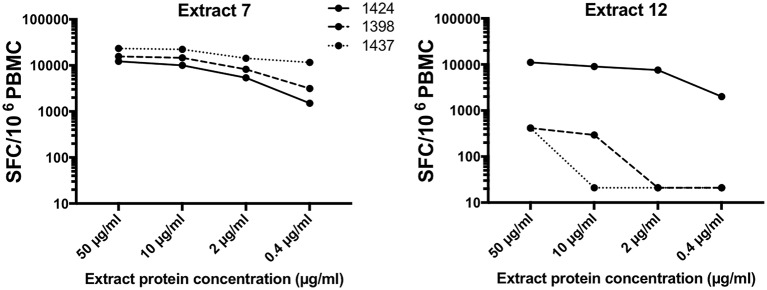
German cockroach extract is used clinically to evaluate allergen-specific sensitization and for subcutaneous allergen-specific immunotherapy, though there are no guidelines for standardization in its manufacture. We performed an immunological evaluation of 12 different cockroach extracts prepared from different sources and their potency to induce allergen-specific T cell reactivity. PBMC from 13 cockroach allergic donors were expanded with 12 different German cockroach extracts. After culture expansion, cells were re-stimulated with the different extracts and T cell responses were assessed by FluoroSpot (IL-5, IFNγ and IL-10 production). In parallel to the extracts, single allergen peptide pools for allergens from groups 1, 2, 4, 5, and 11 were tested to determine allergen immunodominance. Furthermore, to assess allergy specificity, PBMC from 13 non-allergic donors were also tested with the most potent extract and T cell responses were compared to the allergic cohort. Dramatic variations in T cell reactivity were observed to the different cockroach extract batches. Response magnitudes varied over 3 logs within a single donor. IL-5 production in the allergic cohort was significantly higher compared to the non-allergic cohort (p=0.004). Allergen content determination by ELISA detected much lower concentrations of Bla g 5 compared to Bla g 1 and 2. Mass spectrometric analysis revealed that Bla g 5 was present in similar amounts to Bla g 1 and 2 in extracts made from whole body, whereas it was not detected in extracts made from fecal matter, suggesting that Bla g 5 is not excreted into feces. Different donors exhibit different response patterns to different extracts, potentially dependent on the donor-specific T cell allergen immunodominance pattern and the allergen content of the extract tested. These findings have dramatic implications for the selection of potent extracts used for diagnostic purposes or allergen-specific immunotherapy.
德国蟑螂提取物临床上用于评估过敏原特异性致敏,并进行皮下过敏原特异性免疫治疗,尽管其制造没有标准化指南。我们对 12 种不同来源的蟑螂提取物进行了免疫评估,并评估了它们诱导过敏原特异性 T 细胞反应的效力。用 12 种不同的德国蟑螂提取物扩增了 13 例蟑螂过敏供体的 PBMC。培养扩增后,用不同的提取物再次刺激细胞,并通过 FluoroSpot(IL-5、IFNγ 和 IL-10 产生)评估 T 细胞反应。与提取物平行,还测试了组 1、2、4、5 和 11 的过敏原的单个过敏原肽池,以确定过敏原免疫优势。此外,为了评估过敏特异性,还使用最有效的提取物测试了 13 例非过敏供体的 PBMC,并将 T 细胞反应与过敏队列进行了比较。不同蟑螂提取物批次的 T 细胞反应差异很大。同一供体的反应幅度差异超过 3 个对数级。与非过敏队列相比,过敏队列的 IL-5 产生显著更高(p=0.004)。ELISA 测定过敏原含量检测到 Bla g 5 的浓度明显低于 Bla g 1 和 2。质谱分析表明,Bla g 5 在来自全虫和粪便的提取物中的含量与 Bla g 1 和 2 相似,而在来自粪便的提取物中未检测到,表明 Bla g 5 不排泄到粪便中。不同的供体对不同的提取物表现出不同的反应模式,这可能取决于供体特异性 T 细胞过敏原免疫优势模式和测试的提取物的过敏原含量。这些发现对用于诊断目的或过敏原特异性免疫治疗的有效提取物的选择具有重大影响。