Weng Ziqing, Wolc Anna, Su Hailin, Fernando Rohan L, Dekkers Jack C M, Arango Jesus, Settar Petek, Fulton Janet E, O'Sullivan Neil P, Garrick Dorian J
1Department of Animal Science, Iowa State University, Ames, IA 50010 USA.
2Hy-Line International, Dallas Center, IA 50063 USA.
J Anim Sci Biotechnol. 2019 Feb 26;10:20. doi: 10.1186/s40104-019-0332-y. eCollection 2019.
The frequency of recombination events varies across the genome and between individuals, which may be related to some genomic features. The objective of this study was to assess the frequency of recombination events and to identify QTL (quantitative trait loci) for recombination rate in two purebred layer chicken lines.
A total of 1200 white-egg layers (WL) were genotyped with 580 K SNPs and 5108 brown-egg layers (BL) were genotyped with 42 K SNPs (single nucleotide polymorphisms). Recombination events were identified within half-sib families and both the number of recombination events and the recombination rate was calculated within each 0.5 Mb window of the genome. The 10% of windows with the highest recombination rate on each chromosome were considered to be recombination hotspots. A BayesB model was used separately for each line to identify genomic regions associated with the genome-wide number of recombination event per meiosis. Regions that explained more than 0.8% of genetic variance of recombination rate were considered to harbor QTL.
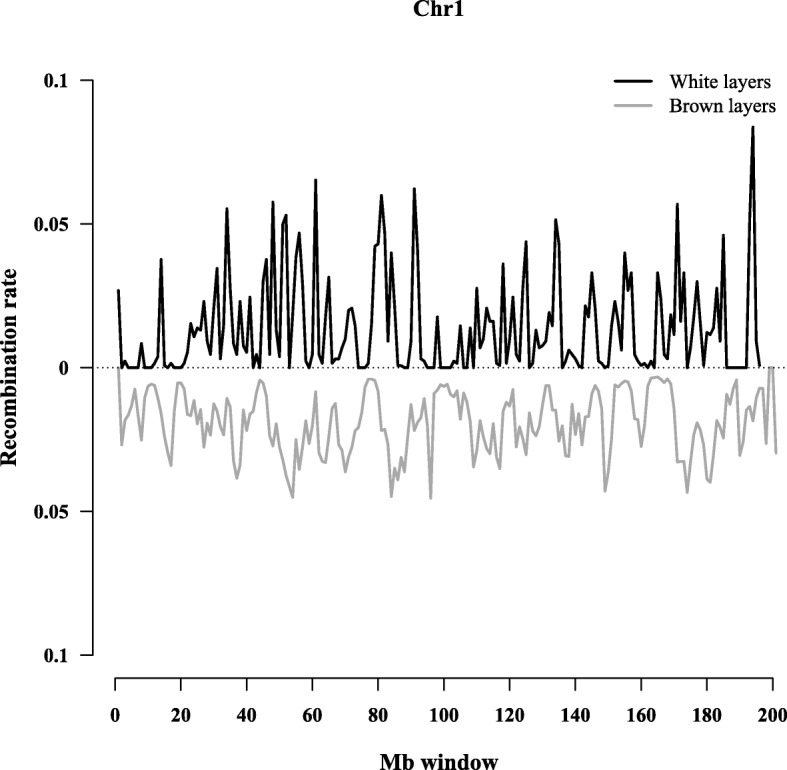
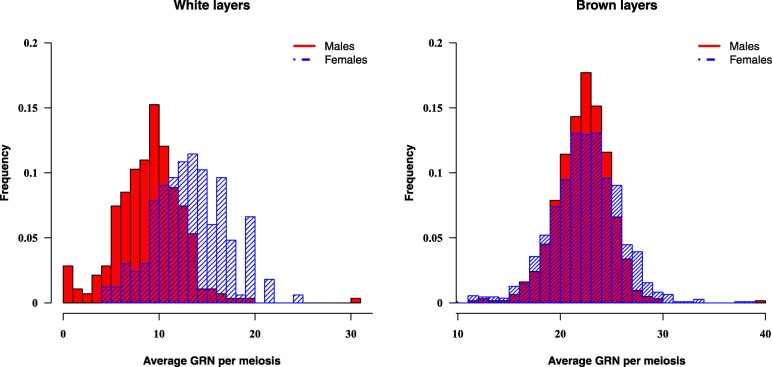
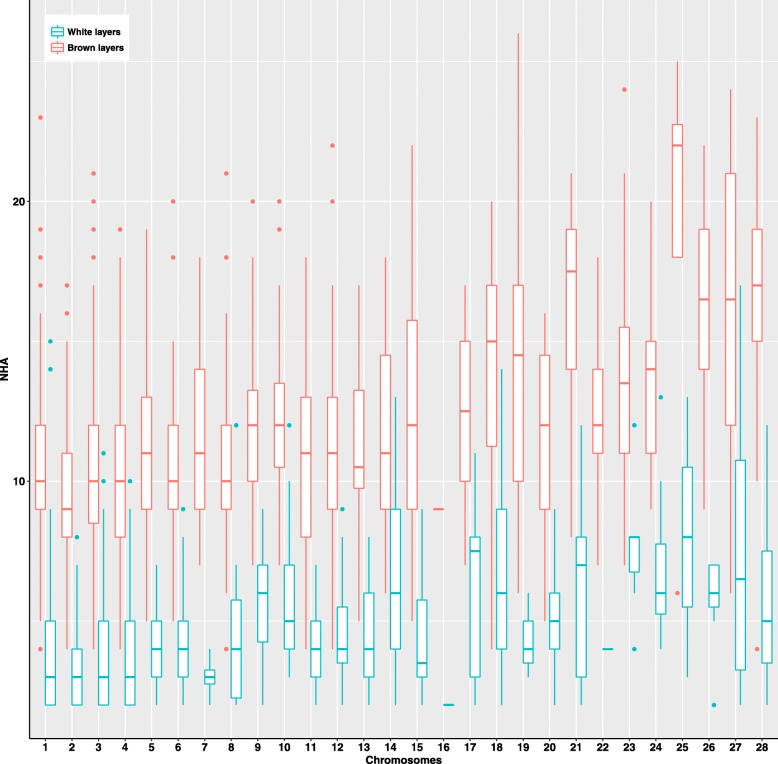
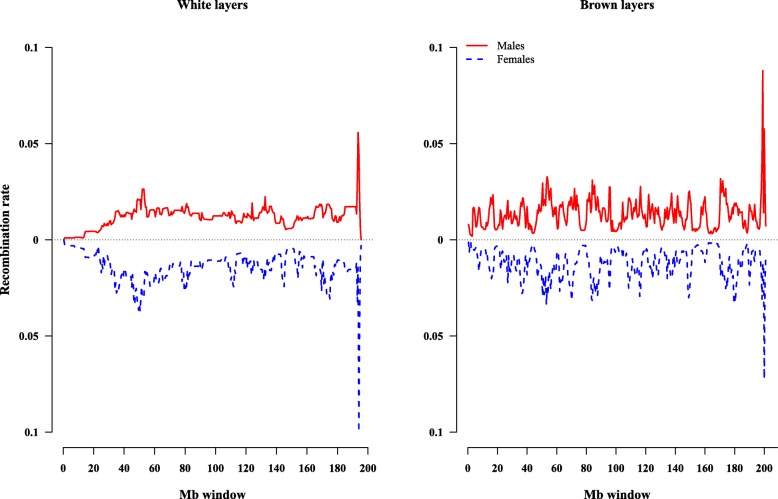
Heritability of recombination rate was estimated at 0.17 in WL and 0.16 in BL. On average, 11.3 and 23.2 recombination events were detected per individual across the genome in 1301 and 9292 meioses in the WL and BL, respectively. The estimated recombination rates differed significantly between the lines, which could be due to differences in inbreeding levels, and haplotype structures. Dams had about 5% to 20% higher recombination rates per meiosis than sires in both lines. Recombination rate per 0.5 Mb window had a strong negative correlation with chromosome size and a strong positive correlation with GC content and with CpG island density across the genome in both lines. Different QTL for recombination rate were identified in the two lines. There were 190 and 199 non-overlapping recombination hotspots detected in WL and BL respectively, 28 of which were common to both lines.
Differences in the recombination rates, hotspot locations, and QTL regions associated with genome-wide recombination were observed between lines, indicating the breed-specific feature of detected recombination events and the control of recombination events is a complex polygenic trait.
重组事件的频率在基因组中以及个体之间存在差异,这可能与某些基因组特征有关。本研究的目的是评估重组事件的频率,并鉴定两个纯种蛋鸡品系中重组率的数量性状位点(QTL)。
对1200只白壳蛋鸡(WL)进行了580K单核苷酸多态性(SNP)基因分型,对5108只褐壳蛋鸡(BL)进行了42K SNP基因分型。在半同胞家系中鉴定重组事件,并在基因组的每个0.5Mb窗口内计算重组事件的数量和重组率。每条染色体上重组率最高的10%的窗口被视为重组热点。对每个品系分别使用BayesB模型来鉴定与每个减数分裂中全基因组重组事件数量相关的基因组区域。解释重组率遗传变异超过0.8%的区域被认为含有QTL。
WL品系中重组率的遗传力估计为0.17,BL品系中为0.16。在WL和BL中,分别在1301次和9292次减数分裂中,全基因组每个个体平均检测到11.3次和