FG 16: Mycotic and Parasitic Agents and Mycobacteria, Robert Koch-Institute, Berlin, Germany.
Department of Veterinary Medicine, Institute of Immunology, Freie Universität Berlin, Berlin, Germany.
Front Cell Infect Microbiol. 2019 Mar 5;9:46. doi: 10.3389/fcimb.2019.00046. eCollection 2019.
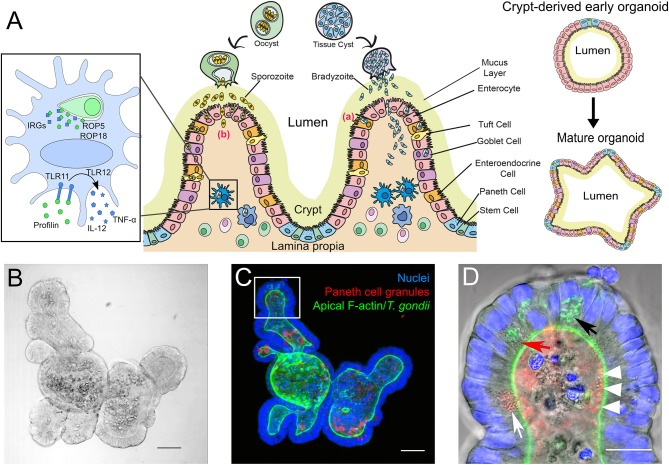
is a zoonotic intracellular parasite, able to infect any warm-blooded animal via ingestion of infective stages, either contained in tissue cysts or oocysts released into the environment. While immune responses during infection are well-studied, there is still limited knowledge about the very early infection events in the gut tissue after infection via the oral route. Here we briefly discuss differences in host-specific responses following infection with oocyst-derived sporozoites vs. tissue cyst-derived bradyzoites. A focus is given to innate intestinal defense mechanisms and early immune cell events that precede s dissemination in the host. We propose stem cell-derived intestinal organoids as a model to study early events of natural host-pathogen interaction. These offer several advantages such as live cell imaging and transcriptomic profiling of the earliest invasion processes. We additionally highlight the necessity of an appropriate large animal model reflecting human infection more closely than conventional infection models, to study the roles of dendritic cells and macrophages during early infection.
刚地弓形虫是一种动物细胞内寄生原虫,能够通过摄入包含在组织囊或释放到环境中的卵囊中的感染阶段来感染任何温血动物。虽然感染期间的免疫反应已经得到了很好的研究,但对于通过口服途径感染后肠道组织中的早期感染事件仍然知之甚少。在这里,我们简要讨论了感染来源于卵囊的孢子虫与来源于组织囊的缓殖子后,宿主特异性反应的差异。重点介绍了先天肠道防御机制和早期免疫细胞事件,这些事件先于在宿主中的传播。我们提出由干细胞衍生的肠道类器官作为研究天然宿主-病原体相互作用早期事件的模型。这些模型具有许多优势,例如对最早的入侵过程进行活细胞成像和转录组谱分析。我们还强调了需要一种更接近人类感染的合适的大动物模型来代替传统的感染模型,以研究树突状细胞和巨噬细胞在早期感染中的作用。