Centre de référence Adulte de la Mucoviscidose, Service de médecine interne, Hospices civils de Lyon, F-69495, Pierre Bénite, France.
Université de Lyon, Équipe d'Accueil Health Services and Performance Research (HESPER) 7425, F-69003, Lyon, France.
Sci Rep. 2019 Mar 18;9(1):4763. doi: 10.1038/s41598-019-40592-9.
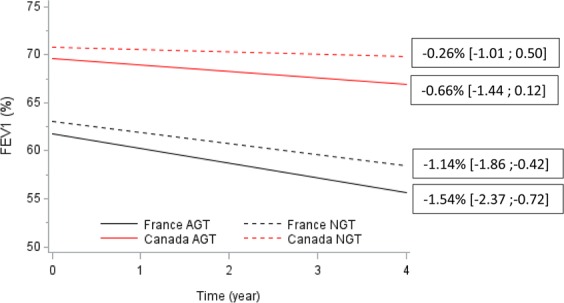
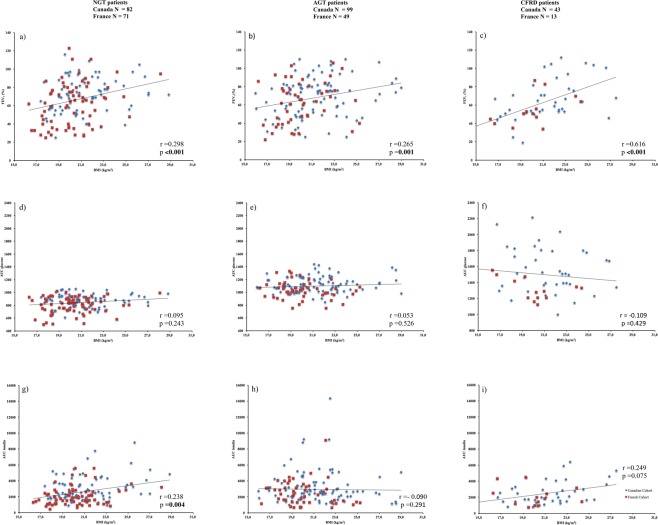
Cystic fibrosis (CF)-related diabetes is associated with increased mortality. We analysed the clinical and glycemic profiles of two cohorts of patients treated according to the same guidelines in France and Canada. To investigate incidence differences in phenotypic and glucose abnormalities and to explore the evolution over a 4-year follow-up period, two cohorts of 224 Canadian and 147 French adult CF patients (≥18 years) without treated CF-related diabetes (CFRD) were followed over a 4 year period. In each of these groups, we investigated the longitudinal relationship between glucose tolerance and pulmonary function. An annual 2-hour oral glucose tolerance test was performed: fasting blood glucose (G0) and 2-h blood glucose (G2) were measured. Patients were classified at inclusion according to their glucose tolerance status: Normal glucose tolerant, abnormal glucose tolerant or de novo CFRD. Age, sex ratio and proportion of F508del homozygous patients were not statistically different between both cohorts. Canadian patients had better pulmonary function (median %FEV1 (IQR): 71.0 (55.0-82.0) vs. 64.0 (40.0-78.0), p < 0.001) and greater body mass index (BMI; median BMI in kg/m) (IQR) 21.1 (19.5-22.8) vs. 19.9 (18.4-21.4), p < 0.001). Glucose values: G0 (5.4 (5.0-5.9) vs. 4.8 (4.5-5.1) mmol/L, p < 0.001) and G2 (7.6 (5.8-9.7) vs. 6.5 (5.2-8.5) mmol/L, p = 0.001) were higher in the Canadian cohort translating into a higher incidence of de novo CFRD diagnosis (19.2 vs. 9.8%, p = 0.003). Decline in FEV1 over time was not different between patients according to glucose tolerance groups. Despite higher glucose levels and incidence of de novo CFRD, Canadian CF patients have a better lung function and a higher BMI than French patients. In spite of these differences between the cohorts, the decline in FEV1 in patients with abnormal glucose tolerance is similar between these groups.
囊性纤维化(CF)相关糖尿病与死亡率增加有关。我们分析了根据相同指南在法国和加拿大治疗的两批患者的临床和血糖特征。为了研究表型和葡萄糖异常的发生率差异,并探索 4 年随访期间的演变,我们对 224 名加拿大和 147 名法国成年 CF 患者(≥18 岁)进行了两项研究,这些患者无治疗的 CF 相关糖尿病(CFRD),随访时间为 4 年。在这两组患者中,我们研究了葡萄糖耐量与肺功能之间的纵向关系。每年进行 2 小时口服葡萄糖耐量试验:测量空腹血糖(G0)和 2 小时血糖(G2)。根据葡萄糖耐量状态将患者在纳入时进行分类:正常葡萄糖耐量、异常葡萄糖耐量或新诊断的 CFRD。两组患者的年龄、性别比例和 F508del 纯合子患者的比例无统计学差异。加拿大患者的肺功能更好(中位 %FEV1(IQR):71.0(55.0-82.0)vs.64.0(40.0-78.0),p<0.001),体重指数(BMI)更高(中位 BMI in kg/m2,IQR)21.1(19.5-22.8)vs.19.9(18.4-21.4),p<0.001)。葡萄糖值:G0(5.4(5.0-5.9)vs.4.8(4.5-5.1)mmol/L,p<0.001)和 G2(7.6(5.8-9.7)vs.6.5(5.2-8.5)mmol/L,p=0.001)在加拿大队列中更高,导致新诊断的 CFRD 发生率更高(19.2% vs.9.8%,p=0.003)。根据葡萄糖耐量组,随时间推移,FEV1 的下降无差异。尽管加拿大 CF 患者的血糖水平更高且新诊断的 CFRD 发生率更高,但他们的肺功能和 BMI 均高于法国患者。尽管两组患者存在这些差异,但异常葡萄糖耐量患者的 FEV1 下降在这些组之间相似。