Faculty of Epidemiology & Population Health, London School of Hygiene and Tropical Medicine, London, WC1E 7HT, United Kingdom.
Division of Infection & Immunity, University College London, Gower Street, London, WC1E 6BT, United Kingdom.
Sci Rep. 2019 Mar 18;9(1):4743. doi: 10.1038/s41598-019-41218-w.
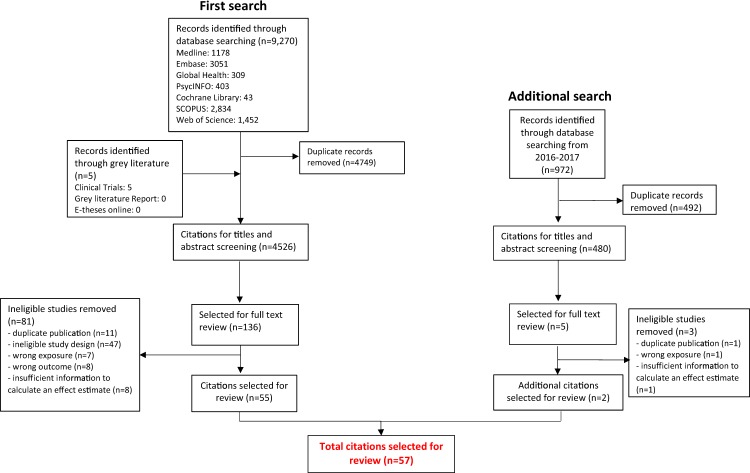
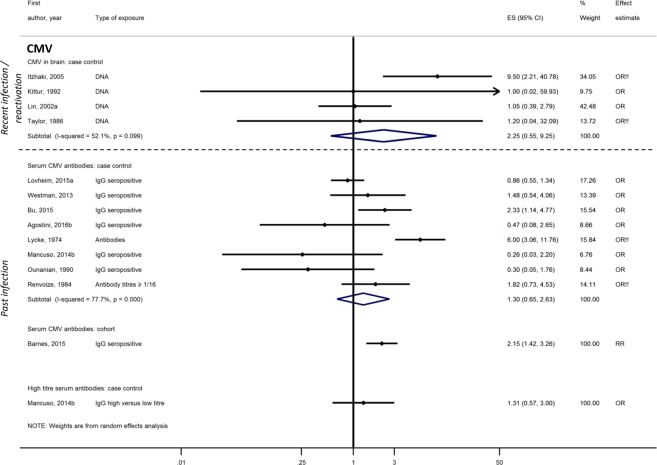
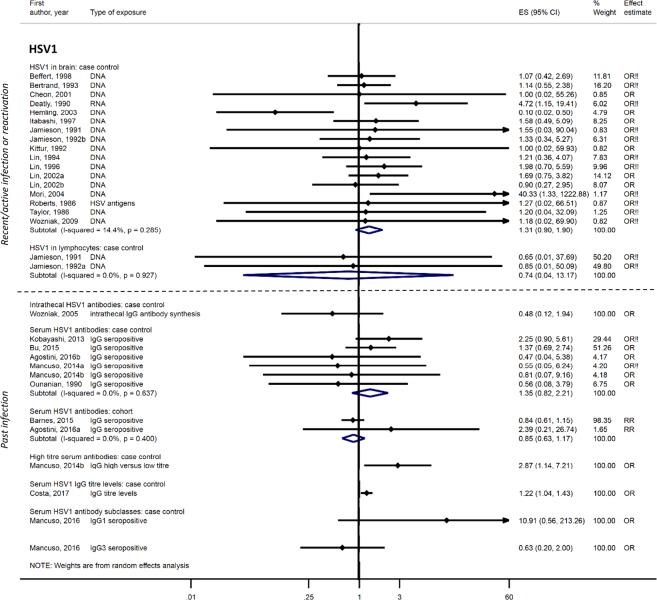
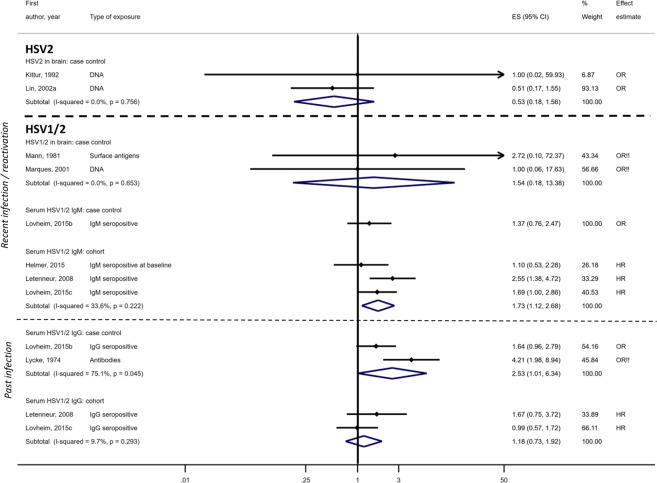
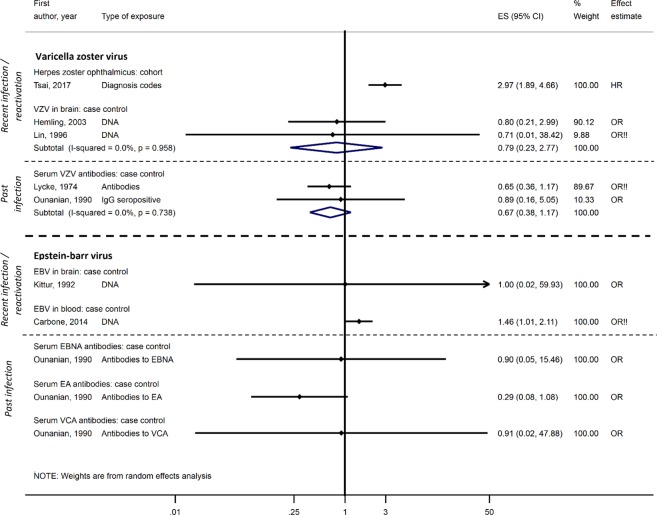
Interest is growing in the role of infectious agents in the pathogenesis of dementia, but current evidence is limited. We conducted a systematic review and meta-analysis to investigate the effect of any of eight human herpesviruses on development of dementia or mild cognitive impairment (MCI). We searched the Cochrane Library, Embase, Global Health, Medline, PsycINFO, Scopus, Web of Science, clinical trials registers and grey literature sources from inception to December 2017 for observational studies with cohort, case control or self-controlled designs, or randomised controlled trials of interventions against herpesviruses. Pooled effect estimates and 95% confidence intervals (CIs) were generated through random effects meta-analyses across studies with the same design, outcome, and virus type, method and site of measurement. We included 57 studies across various geographic settings. Past infection with herpesviruses, measured by IgG seropositivity, was generally not associated with dementia risk. A single cohort study rated moderate quality showed an association between varicella zoster virus reactivation (ophthalmic zoster) and incident dementia (HR 2.97; 95%CI, 1.89 to 4.66). Recent infection with, or reactivation of, herpes simplex virus type 1 or type 1/2 unspecified, cytomegalovirus and human herpes virus-6 measured by serum IgM, high titre IgG or clinical disease may be associated with dementia or MCI, though results were inconsistent across studies and overall evidence rated very low quality. Longitudinal population studies with robust repeated virus measurements taken sufficiently proximal to dementia onset are needed to establish whether, when and among whom herpesviruses affect dementia risk.
人们对感染因子在痴呆发病机制中的作用越来越感兴趣,但目前的证据有限。我们进行了一项系统评价和荟萃分析,以调查八种人类疱疹病毒中的任何一种对痴呆或轻度认知障碍(MCI)发展的影响。我们从建库开始至 2017 年 12 月,在 Cochrane 图书馆、Embase、全球健康、Medline、PsycINFO、Scopus、Web of Science、临床试验注册库和灰色文献来源中,对具有队列、病例对照或自身对照设计的观察性研究,或针对疱疹病毒的干预措施的随机对照试验进行了检索。通过对具有相同设计、结局和病毒类型、测量方法和部位的研究进行随机效应荟萃分析,生成了汇总效应估计值和 95%置信区间(CI)。我们纳入了来自不同地理环境的 57 项研究。既往疱疹病毒感染(通过 IgG 血清阳性来衡量)一般与痴呆风险无关。一项质量评为中等的单队列研究显示,水痘带状疱疹病毒再激活(眼带状疱疹)与新发痴呆之间存在关联(HR 2.97;95%CI,1.89 至 4.66)。最近感染或再激活单纯疱疹病毒 1 型或 1/2 型未特指、巨细胞病毒和人疱疹病毒 6,通过血清 IgM、高滴度 IgG 或临床疾病来衡量,可能与痴呆或 MCI 有关,但研究结果不一致,总体证据质量极低。需要进行具有稳健重复病毒测量的纵向人群研究,以确定疱疹病毒何时以及在哪些人群中影响痴呆风险。