Great North Children's Hospital, Queen Victoria Road, Newcastle upon Tyne, NE1 4LP, UK.
Pediatr Nephrol. 2019 Jul;34(7):1283-1288. doi: 10.1007/s00467-019-04226-6. Epub 2019 Mar 20.
This study aimed to determine whether nitrite sticks are as sensitive at detecting urinary tract infection (UTI) in children <2 years as they are in older children.
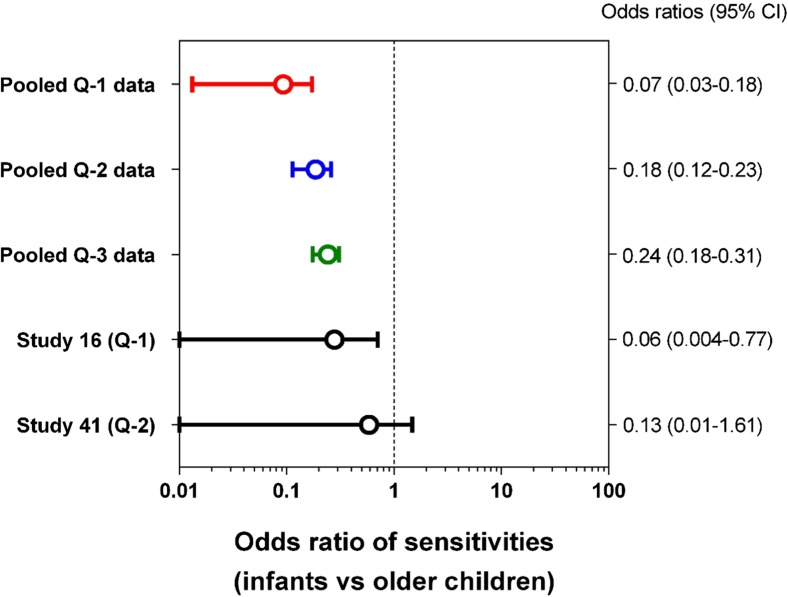
I reanalysed data on using nitrite sticks to detect UTIs for children aged either < 2 or 2-18 years. For sensitivity, evidence of a UTI was defined as level 1 when a single uropathogen grew ≥ 10 colony forming units/ml (cfu/ml) in two urine samples, level 2 when just one sample was cultured or a threshold of < 10 cfu/ml was used, and level 3 if mixed growths or Staphylococcus albus was considered to be positive. For specificity, children were defined as uninfected if they had 1 sterile urine culture. I also reanalysed our previously published data by age.
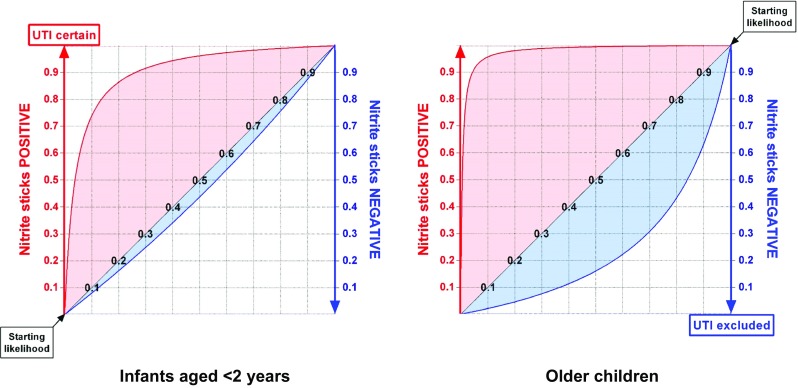
The sensitivity was lower for children aged < 2 years (11 studies, 1321 subjects) than for older children (9 studies, 295 subjects), whether the level-1 values or all the studies were analysed (Fisher's exact test, p < 0.0001 for both). The level-1 sensitivities were 0.23 in the infants and 0.81 among older children (odds ratio = 0.07, 95% confidence interval 0.03-0.18). The specificity was very high in infants (10 studies, 1783 cases) and older children (7 studies, 5952 cases), at 0.990 and 0.996.
Nitrite sticks only have a 23% sensitivity in children aged < 2 years, so cannot reliably rule out UTIs. A positive nitrite stick test is about 99% likely to indicate a UTI in children of any age.
本研究旨在确定亚硝酸盐试条在检测<2 岁儿童与检测较大儿童尿路感染(UTI)时的敏感性是否一致。
我重新分析了使用亚硝酸盐试条检测<2 岁和 2-18 岁儿童 UTI 的数据。为了评估敏感性,当单一尿路病原体在两份尿液样本中生长≥10 菌落形成单位/ml(cfu/ml)时定义为证据确凿的 UTI 1 级,当仅一份样本培养或使用<10 cfu/ml 作为阈值时定义为 2 级,如果考虑混合生长或表皮葡萄球菌为阳性则定义为 3 级。为了评估特异性,如果儿童有 1 份无菌尿液培养,则将其定义为未感染。我还根据年龄重新分析了我们之前发表的数据。
与较大儿童(9 项研究,295 例)相比,<2 岁儿童(11 项研究,1321 例)的敏感性较低,无论是分析 1 级值还是所有研究(Fisher 精确检验,p<0.0001)。婴儿的 1 级敏感性为 0.23,较大儿童为 0.81(比值比=0.07,95%置信区间 0.03-0.18)。婴儿(10 项研究,1783 例)和较大儿童(7 项研究,5952 例)的特异性非常高,分别为 0.990 和 0.996。
亚硝酸盐试条在<2 岁儿童中的敏感性仅为 23%,因此不能可靠地排除 UTI。任何年龄儿童的亚硝酸盐试条阳性几乎都表明存在 UTI。