Addiction Unit, Sørlandet Hospital HF, P.B. 416, 4604, Kristiansand, Norway.
Department of Veterans Affairs Health Care System, Stanford University Medical Center, Palo Alto, CA, USA.
Qual Life Res. 2019 Aug;28(8):2161-2170. doi: 10.1007/s11136-019-02169-x. Epub 2019 Mar 20.
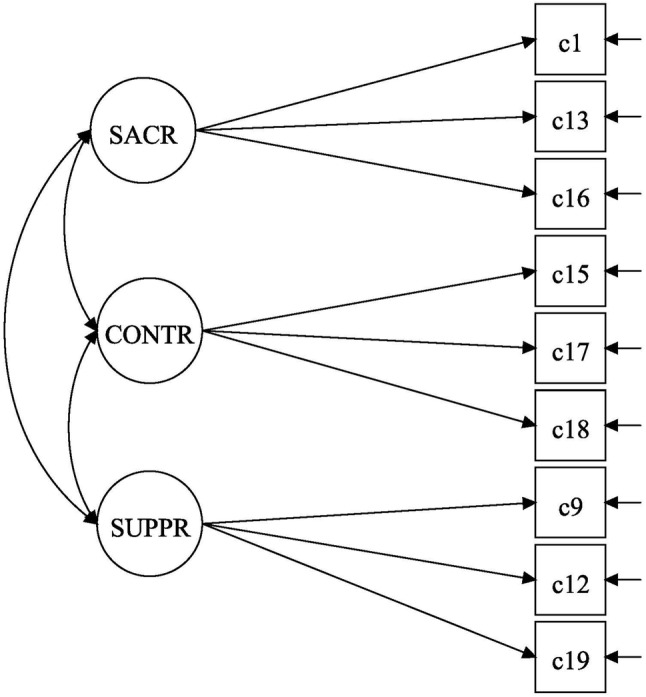
Addiction is a major health stressor for families, representing an under-researched area with important policy implications. The current aim was to validate the Composite Codependency Scale, which captures the psychological characteristics of affected family members, and assess quality of life as mediated by family functioning.
Close relatives (n = 271) of patients in treatment for substance use disorder (SUD) participated in a 4-day psychoeducational program. We also recruited a general population sample (n = 393) via an online social media site. Data were analyzed using multigroup confirmatory factor analysis (MGCFA) and a latent regression model. Differences in subscale latent means were applied to ascertain how the scale discriminated the two populations.
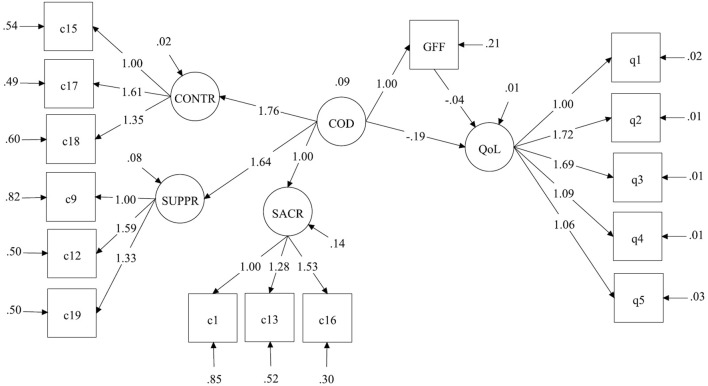
MGCFA yielded a shortened, nine-item partial scalar invariant scale (SCCS) that allowed comparison of latent means. The SCCS discriminated between family members and the general population, with family scoring higher on all three scale dimensions. By effect size, family had higher means (mean differences; 95% confidence intervals) for 'emotional suppression' (0.48; 0.36-0.59; p < 0.001; effect size, 0.92), 'interpersonal control' (0.47; 0.36-0.59; p < 0.001; effect size, 0.97), and 'self-sacrifice' (0.20; 0.10-0.29; p < 0.001; effect size, 0.43). Higher SCCS scores were associated with greater family dysfunction (β = 1.00, 95% CI 0.63-1.36; p < 0.001) and worse quality of life (β = - 0.23, 95% CI - 0.30 to - 0.16; p < 0.001), confirming the concurrent validity of the SCCS.
When family members of people with addictions had the psychological characteristics of suppressing their emotions, believing they could fix others' problems, and neglecting their own for others' needs, they also had more family dysfunction and poorer quality of life. The SCCS offers a valid instrument for addressing the life situation of affected families. This scale can help clinicians focus on family members within health services, especially within SUD treatment services.
成瘾是家庭的主要健康压力源,代表了一个研究不足但具有重要政策意义的领域。本研究旨在验证复合共病量表,该量表可反映受影响家庭成员的心理特征,并评估家庭功能中介的生活质量。
接受物质使用障碍(SUD)治疗的患者的近亲(n=271)参加了为期 4 天的心理教育计划。我们还通过在线社交媒体网站招募了一般人群样本(n=393)。使用多组验证性因子分析(MGCFA)和潜在回归模型对数据进行了分析。应用亚量表潜在均值差异来确定该量表如何区分这两个群体。
MGCFA 产生了一个缩短的、九个项目的部分标量不变量表(SCCS),允许比较潜在均值。SCCS 区分了家庭成员和一般人群,家庭在三个量表维度上的得分都更高。按效应量大小,家庭在“情绪压抑”(0.48;0.36-0.59;p<0.001;效应量,0.92)、“人际控制”(0.47;0.36-0.59;p<0.001;效应量,0.97)和“自我牺牲”(0.20;0.10-0.29;p<0.001;效应量,0.43)方面的得分更高。较高的 SCCS 得分与更大的家庭功能障碍(β=1.00,95%CI 0.63-1.36;p<0.001)和更差的生活质量(β=-0.23,95%CI -0.30 至-0.16;p<0.001)相关,证实了 SCCS 的同时效度。
当成瘾者的家庭成员表现出压抑情绪、认为自己可以解决他人问题以及忽视自己的需求以满足他人需求等心理特征时,他们也会出现更多的家庭功能障碍和更差的生活质量。SCCS 提供了一种评估受影响家庭生活状况的有效工具。该量表可帮助临床医生在卫生服务中关注家庭成员,尤其是在 SUD 治疗服务中。