Food, Nutrition, and Health Program, Faculty of Land and Food Systems, The University of British Columbia, 2205 East Mall, Vancouver, BC, V6T 1Z4, Canada.
Mol Cell Biochem. 2019 Jul;457(1-2):105-118. doi: 10.1007/s11010-019-03516-9. Epub 2019 Mar 20.
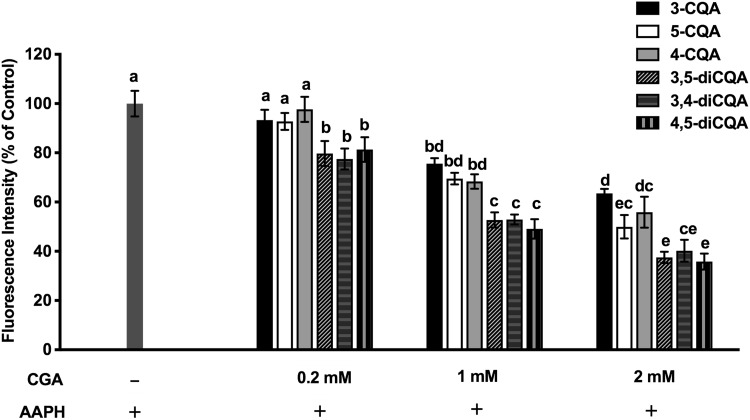
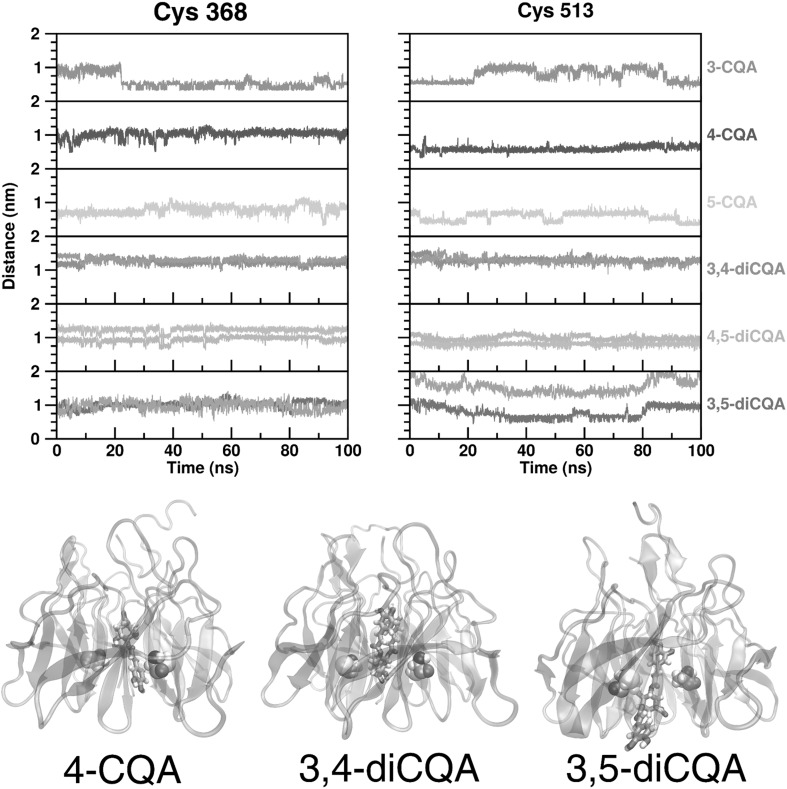
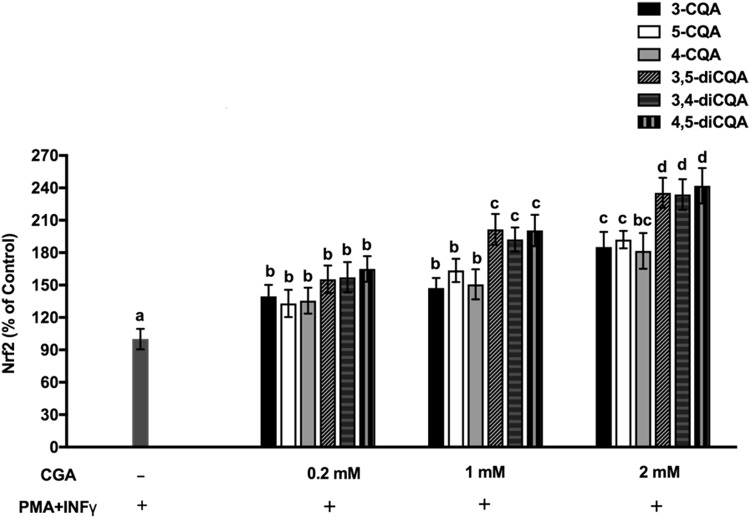
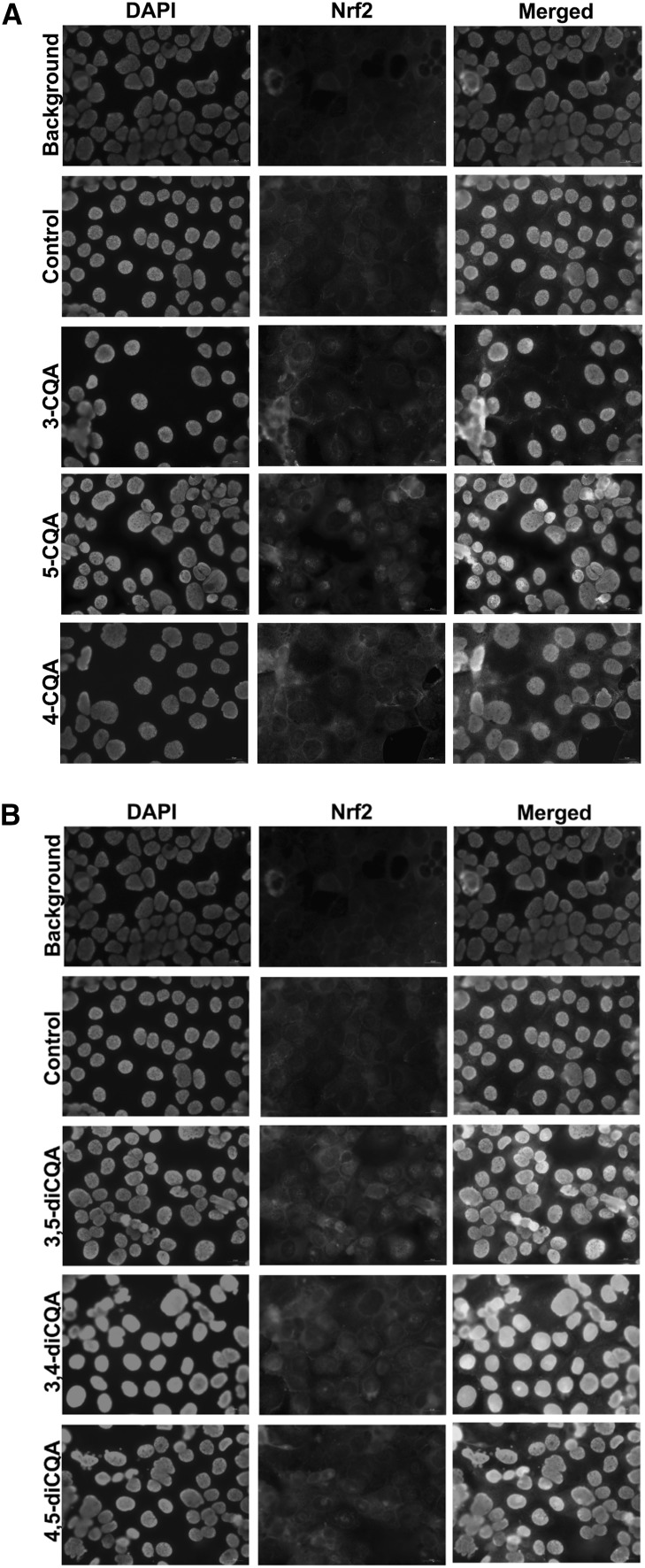
Chlorogenic acid (CGA) exists as multiple isomers (e.g., 3-CQA, 4-CQA, 5-CQA, 3,4-diCQA, 3,5-diCQA, and 4,5-diCQA) in foods such as coffee beverages, fruits and vegetables. This study aimed to investigate relative activities of these six different CGA isomers to modify redox biology in inflamed Caco-2 cells that involved Nrf2 signaling. Caco-2 cells were pre-treated with individual CGA isomers to assess the relative effectiveness to mitigate oxidative stress. Isomer-specific capacity of different CGA isomers for direct free radical scavenging activity and potential endogenous control of oxidative stress were determined using chemical assays and cell-based experiments, respectively. Molecular dynamics simulations of the CGA and Keap1-Nrf2 complex were performed to predict CGA structure-specific interactions. Results demonstrated that dicaffeoylquinic acid (diCQA including 3,4-diCQA, 3,5-diCQA, and 4,5-diCQA) isomers had greater (p < 0.05) affinity to ameliorate oxidative stress through direct free radical scavenging activity. This observation corresponded to greater (p < 0.05) capacity to activate Nrf2 signaling compared to caffeoylquinic acid (CQA including 3-CQA, 4-CQA, and 5-CQA) isomers in inflamed differentiated Caco-2 cells. Simulations revealed that differences between the ability of CQA and diCQA to interact with the Keap1-Nrf2 complex may be due to differences in relative orientation within this complex. The observed CGA isomer-specific affinity for CQA to activate Nrf2 signaling was confirmed by nuclear translocation of Nrf2 induced by CGA and greater (p < 0.05) upregulation of genes related to Nrf2 expression.
绿原酸 (CGA) 以多种异构体形式存在于咖啡饮料、水果和蔬菜等食物中(例如 3-CQA、4-CQA、5-CQA、3,4-二咖啡酰奎宁酸、3,5-二咖啡酰奎宁酸和 4,5-二咖啡酰奎宁酸)。本研究旨在研究这六种不同 CGA 异构体在涉及 Nrf2 信号通路的炎症 Caco-2 细胞中调节氧化还原生物学的相对活性。用各 CGA 异构体预处理 Caco-2 细胞,以评估减轻氧化应激的相对有效性。采用化学测定法和基于细胞的实验分别测定不同 CGA 异构体的直接清除自由基活性的异构体特异性能力和潜在的氧化应激内源性控制能力。采用分子动力学模拟方法对 CGA 和 Keap1-Nrf2 复合物进行了模拟,以预测 CGA 结构特异性相互作用。结果表明,二咖啡酰奎宁酸(包括 3,4-二咖啡酰奎宁酸、3,5-二咖啡酰奎宁酸和 4,5-二咖啡酰奎宁酸)异构体通过直接清除自由基活性具有更大(p < 0.05)的缓解氧化应激的亲和力。与咖啡酰奎宁酸(包括 3-CQA、4-CQA 和 5-CQA)异构体相比,这一观察结果对应于在炎症分化的 Caco-2 细胞中激活 Nrf2 信号通路的更大(p < 0.05)能力。模拟表明,CQA 和 diCQA 与 Keap1-Nrf2 复合物相互作用能力的差异可能是由于复合物内相对取向的差异所致。通过 CGA 诱导的 Nrf2 核易位和与 Nrf2 表达相关基因的更大(p < 0.05)上调证实了观察到的 CGA 异构体对 CQA 激活 Nrf2 信号通路的特异性亲和力。