Department of Orthopaedics, Third Hospital of Hebei Medical University, Shijiazhuang, China.
International Research Center for Implantable and Interventional Medical Devices, School of Biological Science and Medical Engineering, Beihang University, Beijing, China.
Orthop Surg. 2019 Apr;11(2):195-203. doi: 10.1111/os.12431. Epub 2019 Mar 21.
To compare the biomechanical stability and compatibility of two iliosacral screws (ISS), a tension band plate (TBP), and a minimally invasive adjustable plate (MIAP) for treating Tile C pelvic fractures.
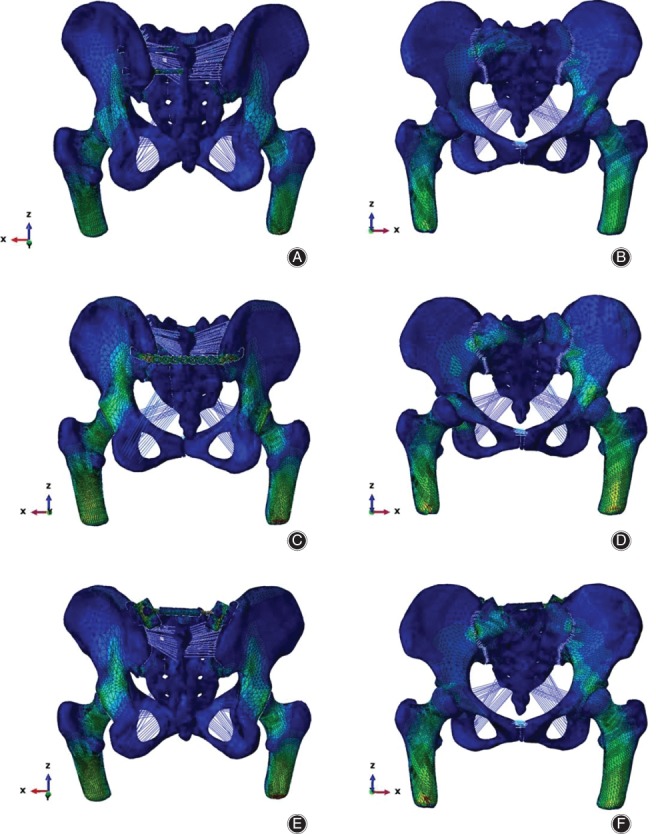
Three groups of finite element models of the intact pelvis, including the main ligament and the proximal one-third of both femurs, were developed to simulate vertical sacral fractures and treated with the three abovementioned internal fixation techniques. A 500 N vertical load, a 500 N vertical load plus a 10 Nm moment of forward sagittal direction, and 500 N vertical load plus a 10 Nm moment of right lateral direction were applied to the sacrum to simulate standing status, bending status, and flexion status, respectively. The maximum displacement value, the stress value, and the stress value of the fracture interface were compared among the three internal fixation techniques.
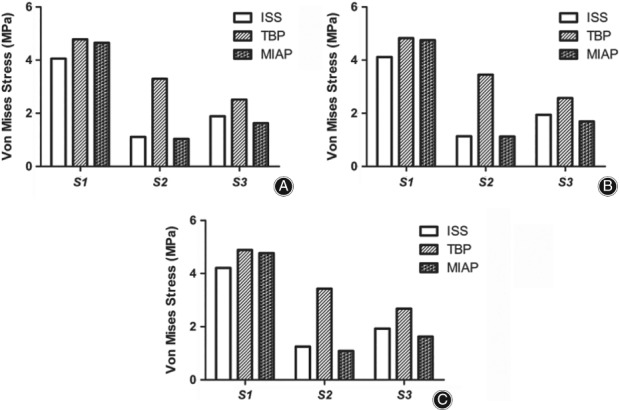
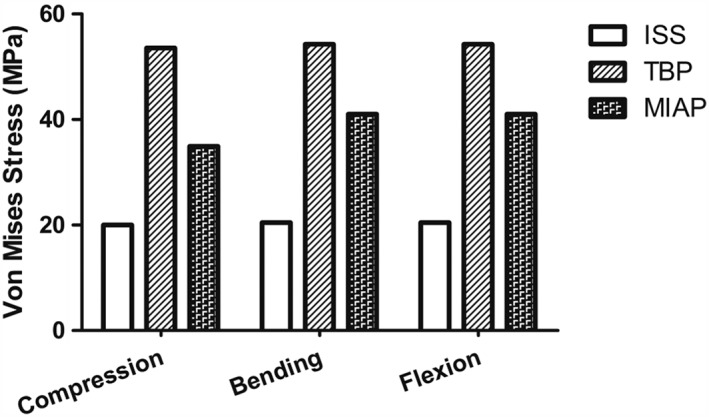
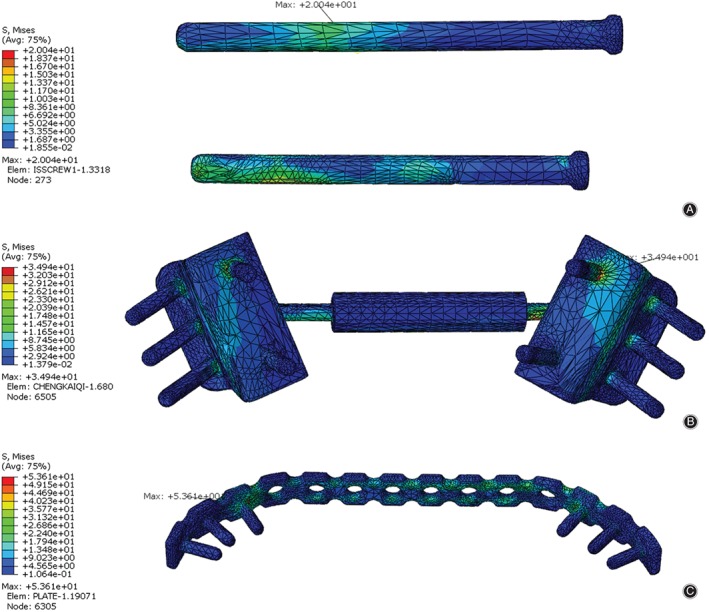
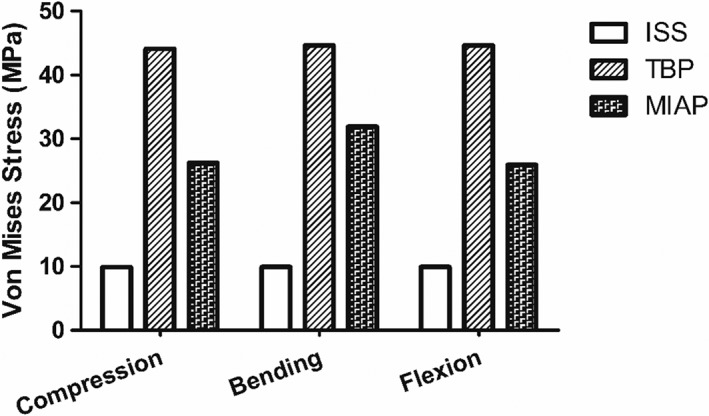
The results showed that all three internal fixation techniques effectively restored the biomechanical transmission of the injured pelvis. The stress on the implants in the TBP model was 167.47% and 53.41% higher than that in the ISS model and the MIAP model, respectively, and the stress shielding phenomenon of the TBP model was more obvious than in the other two models. Meanwhile, the stress between the fracture interfaces in the TBP fixation models was apparently higher than that in the other two models. However, the vertical displacement of the MIAP model was not significantly different from that in the ISS and TBP model; therefore, strong fixation could be obtained in all three models.
Based on our results, we believe that the stability of Tile C pelvic fracture fixed with MIAP was similar to that of fractures fixed with ISS and TBP, but the stress shielding phenomenon and safety of implants in the TBP models were inferior to those in the MIAP and ISS fixation models. Meanwhile, MIAP and ISS fixation were more helpful to the healing processing than was TBP fixation, especially at the fracture interface of the second and third vertebral body levels.
比较两种骶髂螺钉(ISS)、张力带钢板(TBP)和微创可调节钢板(MIAP)治疗 Tile C 型骨盆骨折的生物力学稳定性和相容性。
建立三组完整骨盆的有限元模型,包括主要韧带和股骨近端三分之一,模拟垂直骶骨骨折,并采用上述三种内固定技术进行治疗。在骶骨上施加 500 N 的垂直载荷、500 N 的垂直载荷加 10 Nm 的前矢状方向的弯矩和 500 N 的垂直载荷加 10 Nm 的右侧方向的弯矩,分别模拟站立状态、弯曲状态和屈曲状态。比较三种内固定技术的最大位移值、应力值和骨折界面的应力值。
结果表明,三种内固定技术均有效恢复了损伤骨盆的生物力学传递。TBP 模型中植入物的应力比 ISS 模型和 MIAP 模型分别高 167.47%和 53.41%,TBP 模型的应力屏蔽现象更为明显。同时,TBP 固定模型中骨折界面之间的应力明显高于其他两种模型。然而,MIAP 模型的垂直位移与 ISS 和 TBP 模型无显著差异;因此,三种模型均能获得牢固固定。
根据我们的结果,我们认为 MIAP 固定的 Tile C 型骨盆骨折的稳定性与 ISS 和 TBP 固定的骨折相似,但 TBP 模型中的应力屏蔽现象和植入物的安全性不如 MIAP 和 ISS 固定模型。同时,MIAP 和 ISS 固定比 TBP 固定更有助于骨折愈合过程,尤其是在第二和第三椎体水平的骨折界面。