School of Stomatology, Hospital of Stomatology, Tianjin Medical University, Tianjin, China.
Department of Endodontics, Shanghai Ninth People's Hospital, College of Stomatology, Shanghai Jiao Tong University School of Medicine, Shanghai, China.
Cell Prolif. 2019 May;52(3):e12601. doi: 10.1111/cpr.12601. Epub 2019 Mar 21.
Bone tissue engineering was introduced in 1995 and provides a new way to reconstruct bone and repair bone defects. However, the design and fabrication of suitable bionic bone scaffolds are still challenging, and the ideal scaffolds in bone tissue engineering should have a three-dimensional porous network, good biocompatibility, excellent biodegradability and so on. The purpose of our research was to investigate whether a bioplasticpoly3-hydroxybutyrate4-hydroxybutyrate (P34HB) electrospun fibre scaffold is conducive to the repair of bone defects, and whether it is a potential scaffold for bone tissue engineering.
The P34HB electrospun fibre scaffolds were prepared by electrospinning technology, and the surface morphology, hydrophilicity, mechanical properties and cytological behaviour of the scaffolds were tested. Furthermore, a calvarial defect model was created in rats, and through layer-by-layer paper-stacking technology, the P34HB electrospun fibre scaffolds were implanted into the calvarial defect area and their effect on bone repair was evaluated.
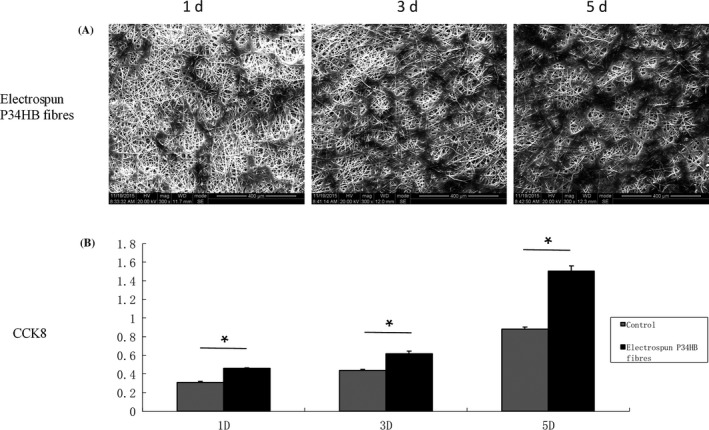
The results showed that the P34HB electrospun fibre scaffolds are interwoven with several fibres and have good porosity, physical properties and chemical properties and can promote cell adhesion and proliferation with no cytotoxicity in vitro. In addition, the P34HB electrospun fibre scaffolds can promote the repair of calvarial defects in vivo.
These results demonstrated that the P34HB electrospun fibre scaffold has a three-dimensional porous network with good biocompatibility, excellent biosafety and ability for bone regeneration and repair; thus, the P34HB electrospun fibre scaffold is a potential scaffold for bone tissue engineering.
骨组织工程于 1995 年问世,为重建骨骼和修复骨缺损提供了新方法。然而,设计和制造合适的仿生骨支架仍然具有挑战性,骨组织工程中理想的支架应具有三维多孔网络、良好的生物相容性、优异的生物降解性等。我们的研究目的是探讨聚 3-羟基丁酸酯 4-羟基丁酸酯(P34HB)电纺纤维支架是否有利于骨缺损的修复,以及它是否是一种有潜力的骨组织工程支架。
采用静电纺丝技术制备 P34HB 电纺纤维支架,测试支架的表面形态、亲水性、力学性能和细胞行为。此外,在大鼠颅骨创建缺损模型,通过层层叠纸技术将 P34HB 电纺纤维支架植入颅骨缺损区域,评估其对骨修复的影响。
结果表明,P34HB 电纺纤维支架由几根纤维交织而成,具有良好的孔隙率、物理性能和化学性能,在体外无细胞毒性,能促进细胞黏附和增殖。此外,P34HB 电纺纤维支架能促进体内颅骨缺损的修复。
这些结果表明,P34HB 电纺纤维支架具有良好的生物相容性、优异的生物安全性和骨再生修复能力的三维多孔网络;因此,P34HB 电纺纤维支架是一种有潜力的骨组织工程支架。