Division of Mental Health and Addiction, Oslo University Hospital, P.O. box 4959, N-0424, Nydalen, Oslo, Norway.
University of Oslo, Institute of Clinical Medicine, P.O. box 1171, 0318, Blindern, Oslo, Norway.
BMC Psychiatry. 2019 Mar 21;19(1):95. doi: 10.1186/s12888-019-2080-0.
There is emerging evidence for the effectiveness of psychodynamic psychotherapy for depressive disorders. However, we know less of how this relation-focused therapy mode is experienced and what the patients themselves identify as helpful. Hence, the purpose of this study is to explore adolescents' experiences of factors promoting improvement in psychodynamic therapy.
Eight female patients participating in a Norwegian study on psychodynamic therapy, the First Experimental Study of Transference Work - In Teenagers (FEST-IT), were included. The participants were offered a total number of 28 sessions. Semi-structured qualitative interviews about experiences with therapy were then conducted and analysed with systematic text condensation and hermeneutic interpretation.
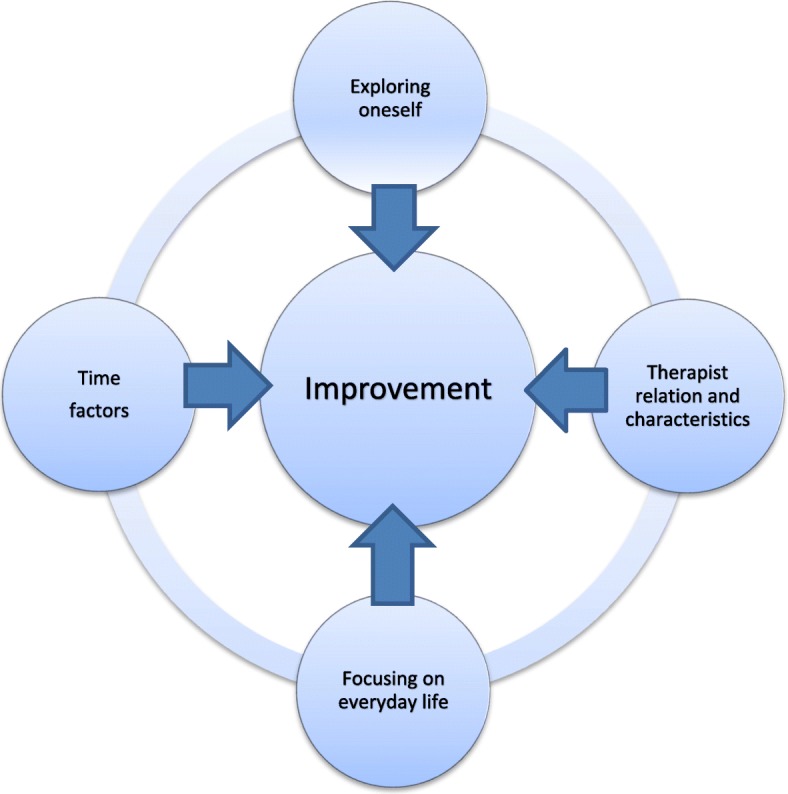
The analysis revealed four main themes. 'Exploring oneself' comprises autonomy and acknowledgment, openness, insight and acceptance of oneself. 'Therapist relation and characteristics' includes confidence and trust in and support from the therapist as well as having a trustworthy and experienced therapist. 'Focusing on everyday life' includes learning and practical orientation. 'Time factors' refers to duration and frequency.
Together with a supportive and listening therapist, the adolescents improve by exploring themselves within the frames of a time-limited treatment period. Improvement seems to be experienced through better relations to oneself and to others and by finding one's place in the family, or at school. Adolescents value problem solving and help with concrete challenges. Hence, therapy should be tailored to the needs of adolescents with depression and incorporate the challenges they face in their everyday life.
ClinicalTrials.gov . Id: NCT01531101. Date of registry: 8 February 2012, retrospectively registered.
动力心理疗法治疗抑郁症的有效性已初见端倪。然而,我们对这种以关系为导向的治疗模式的体验以及患者自身认为哪些方面有帮助了解较少。因此,本研究旨在探讨青少年在动力心理治疗中促进改善的因素的体验。
纳入了参加挪威动力心理治疗研究(FEST-IT)的 8 名女性患者。参与者共接受了 28 次治疗。然后对他们进行了关于治疗体验的半结构式定性访谈,并采用系统文本冷凝和解释学解释进行分析。
分析揭示了四个主要主题。“探索自我”包括自主性和认知、开放性、自我洞察力和接受度。“治疗师关系和特点”包括对治疗师的信任和支持,以及拥有值得信赖和经验丰富的治疗师。“关注日常生活”包括学习和实践导向。“时间因素”是指持续时间和频率。
青少年在有限的治疗时间内通过探索自我,在一个支持和倾听的治疗师的帮助下得到改善。通过更好地处理与自己和他人的关系,以及在家庭或学校中找到自己的位置,来体验改善。青少年重视解决问题和应对具体挑战。因此,治疗应该针对患有抑郁症的青少年的需求,并纳入他们在日常生活中面临的挑战。
ClinicalTrials.gov。标识符:NCT01531101。注册日期:2012 年 2 月 8 日,回溯注册。