Department of Molecular Sciences and ARC Centre of Excellence for Nanoscale Biophotonics, Macquarie University, North Ryde, NSW, 2109, Australia.
ARC Centre of Excellence for Nanoscale Biophotonics, University of Adelaide, Adelaide, South Australia, Australia.
J Neuroinflammation. 2019 Mar 21;16(1):65. doi: 10.1186/s12974-019-1451-2.
Neurokine signaling via the release of neurally active cytokines arises from glial reactivity and is mechanistically implicated in central nervous system (CNS) pathologies such as chronic pain, trauma, neurodegenerative diseases, and complex psychiatric illnesses. Despite significant advancements in the methodologies used to conjugate, incorporate, and visualize fluorescent molecules, imaging of rare yet high potency events within the CNS is restricted by the low signal to noise ratio experienced within the CNS. The brain and spinal cord have high cellular autofluorescence, making the imaging of critical neurokine signaling and permissive transcriptional cellular events unreliable and difficult in many cases.
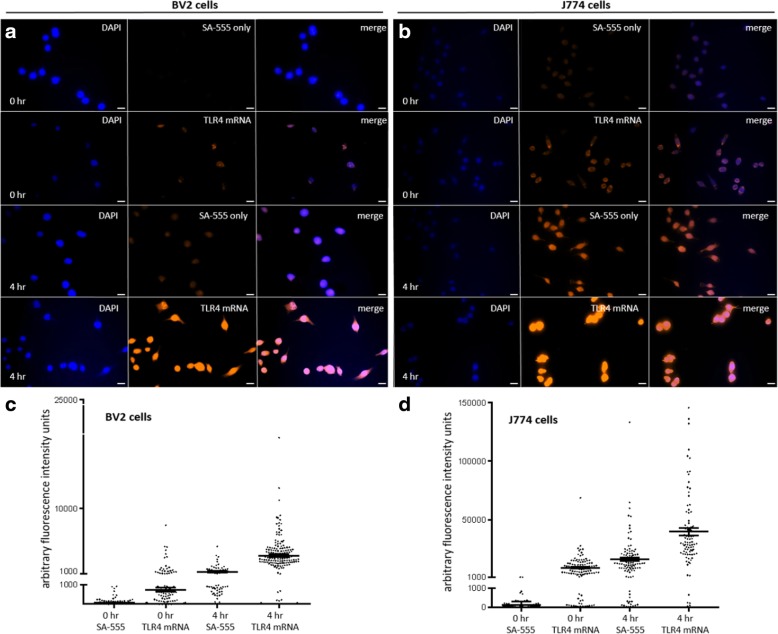
In this manuscript, we developed a method for background-free imaging of the transcriptional events that precede neurokine signaling using targeted mRNA transcripts labeled with luminescent lanthanide chelates and imaged via time-gated microscopy. To provide examples of the usefulness this method can offer to the field, the mRNA expression of toll-like receptor 4 (TLR4) was visualized with traditional fluorescent in situ hybridization (FISH) or luminescent lanthanide chelate-based in situ hybridization (LISH) in mouse BV2 microglia or J774 macrophage phenotype cells following lipopolysaccharide stimulation. TLR4 mRNA staining using LISH- and FISH-based methods was also visualized in fixed spinal cord tissues from BALB/c mice with a chronic constriction model of neuropathic pain or a surgical sham model in order to demonstrate the application of this new methodology in CNS tissue samples.
Significant increases in TLR4 mRNA expression and autofluorescence were visualized over time in mouse BV2 microglia or mouse J774 macrophage phenotype cells following lipopolysaccharide (LPS) stimulation. When imaged in a background-free environment with LISH-based detection and time-gated microscopy, increased TLR4 mRNA was observed in BV2 microglia cells 4 h following LPS stimulation, which returned to near baseline levels by 24 h. Background-free imaging of mouse spinal cord tissues with LISH-based detection and time-gated microscopy demonstrated a high degree of regional TLR4 mRNA expression in BALB/c mice with a chronic constriction model of neuropathic pain compared to the surgical sham model.
Advantages offered by adopting this novel methodology for visualizing neurokine signaling with time-gated microscopy compared to traditional fluorescent microscopy are provided.
通过神经营养因子释放产生的神经激酶信号来自于神经胶质细胞的反应,并且在中枢神经系统(CNS)病理学中具有机械相关性,例如慢性疼痛、创伤、神经退行性疾病和复杂的精神疾病。尽管在用于缀合、结合和可视化荧光分子的方法方面取得了重大进展,但由于 CNS 内的信噪比低,对 CNS 内罕见但高效力事件的成像受到限制。大脑和脊髓具有高细胞自发荧光,使得在许多情况下,对关键神经激酶信号和允许转录细胞事件的成像变得不可靠且困难。
在本手稿中,我们开发了一种方法,用于使用标记有发光镧系螯合物的靶向 mRNA 转录本进行无背景成像,以对神经激酶信号之前的转录事件进行成像,并通过时间门控显微镜进行成像。为了提供该方法对该领域有用性的示例,使用传统的荧光原位杂交(FISH)或基于发光镧系螯合物的原位杂交(LISH)可视化了 TLR4 的 mRNA 表达在脂多糖刺激后,在小鼠 BV2 小胶质细胞或 J774 巨噬细胞表型细胞中。还在 BALB/c 小鼠慢性缩窄性模型的神经病理性疼痛或手术假模型的固定脊髓组织中可视化了 TLR4 mRNA 染色,以证明该新方法在 CNS 组织样本中的应用。
在脂多糖(LPS)刺激后,在小鼠 BV2 小胶质细胞或小鼠 J774 巨噬细胞表型细胞中,TLR4 mRNA 表达和自发荧光随时间显著增加。在用基于 LISH 的检测和时间门控显微镜在无背景环境中成像时,在 LPS 刺激后 4 小时观察到 BV2 小胶质细胞中 TLR4 mRNA 的增加,该增加在 24 小时后接近基线水平。用基于 LISH 的检测和时间门控显微镜对小鼠脊髓组织进行无背景成像,与手术假模型相比,在慢性缩窄性模型的神经病理性疼痛的 BALB/c 小鼠中显示了 TLR4 mRNA 表达的高度区域性。
与传统荧光显微镜相比,采用这种新方法通过时间门控显微镜可视化神经激酶信号提供了优势。