Dziedzic Ewelina A, Gąsior Jakub S, Pawłowski Mariusz, Wodejko-Kucharska Beata, Saniewski Tomasz, Marcisz Anna, Dąbrowski Marek J
Department of Cardiology, Bielanski Hospital, Warsaw, Poland.
Faculty of Health Sciences and Physical Education, Kazimierz Pulaski University of Technology and Humanities, Radom, Poland.
Arch Med Sci. 2019 Mar;15(2):359-368. doi: 10.5114/aoms.2019.83291. Epub 2019 Mar 4.
Ischaemic heart disease is the main cause of death in developed countries. There are many modifiable risk factors associated with coronary heart disease (CAD). A growing number of studies point to vitamin D deficiency as a risk factor for heart attacks and the conditions associated with cardiovascular disease. This study aimed to analyse the relationship between the level of 25-hydroxyvitamin D (25(OH)D) and the severity of coronary artery atherosclerosis and to study 25(OH)D levels in non-diabetic patients hospitalised due to acute coronary syndrome and those diagnosed with stable CAD.
oronary angiography was performed prospectively in 410 successive cardiac patients. The severity of coronary artery atherosclerosis was assessed according to the Coronary Artery Surgery Study Score (CASSS). The plasma 25(OH)D level was assessed with the electrochemiluminescence method.
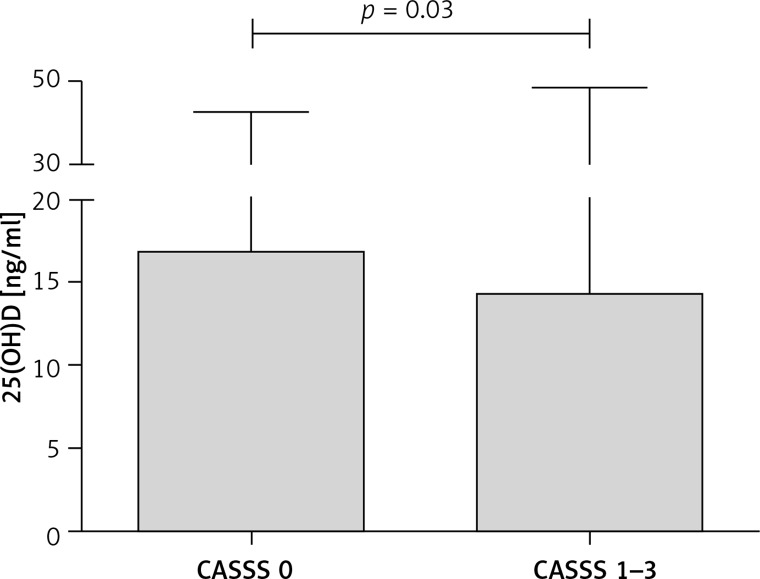
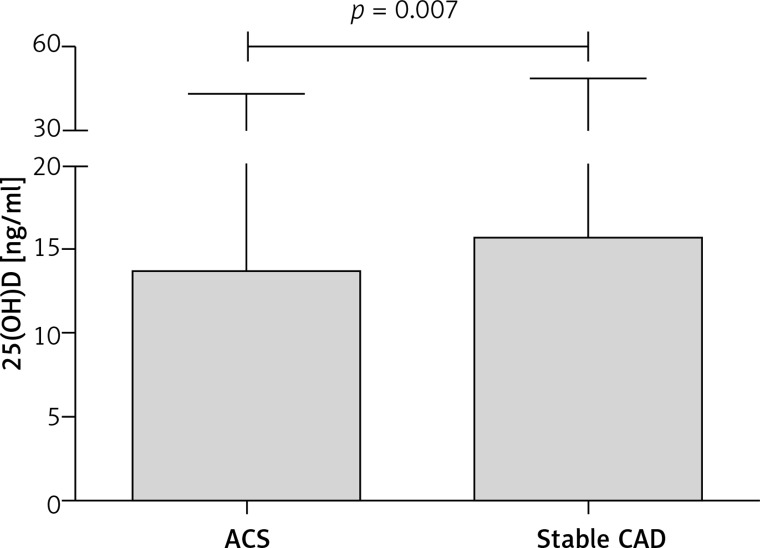
The 25(OH)D level proved to be one of the significant determinants of the CASSS ( < 0.05). In subjects without significant lesions in the coronary arteries the 25(OH)D level was significantly higher compared to patients with one- to three-vessel coronary atherosclerosis ( < 0.05). A significantly higher 25(OH)D level was noted in patients diagnosed with stable CAD compared to patients hospitalised due to acute coronary syndrome ( < 0.01).
Patients with one- to three-vessel atherosclerosis have a significantly lower 25(OH)D level compared to patients without significant lesions in the coronary arteries. A lower 25(OH)D level was observed in patients hospitalised due to acute coronary syndrome compared to patients diagnosed with stable CAD.
缺血性心脏病是发达国家的主要死因。与冠心病(CAD)相关的可改变风险因素众多。越来越多的研究指出维生素D缺乏是心脏病发作及心血管疾病相关病症的一个风险因素。本研究旨在分析25-羟维生素D(25(OH)D)水平与冠状动脉粥样硬化严重程度之间的关系,并研究因急性冠状动脉综合征住院的非糖尿病患者以及被诊断为稳定型CAD患者的25(OH)D水平。
对410例连续的心脏病患者进行前瞻性冠状动脉造影。根据冠状动脉外科研究评分(CASSS)评估冠状动脉粥样硬化的严重程度。采用电化学发光法评估血浆25(OH)D水平。
25(OH)D水平被证明是CASSS的重要决定因素之一(<0.05)。与患有单支至三支冠状动脉粥样硬化的患者相比,冠状动脉无明显病变的受试者25(OH)D水平显著更高(<0.05)。与因急性冠状动脉综合征住院的患者相比,被诊断为稳定型CAD的患者25(OH)D水平显著更高(<0.01)。
与冠状动脉无明显病变的患者相比,患有单支至三支动脉粥样硬化的患者25(OH)D水平显著更低。与被诊断为稳定型CAD的患者相比,因急性冠状动脉综合征住院的患者25(OH)D水平更低。