Beese Sophie Elizabeth, Harris Isobel Marion, Dretzke Janine, Moore David
Institute of Applied Health Research, University of Birmingham, Birmingham, UK.
BMJ Open Gastroenterol. 2019 Feb 16;6(1):e000255. doi: 10.1136/bmjgast-2018-000255. eCollection 2019.
Little is known about the relationship between inflammatory bowel disease (IBD) and body image. The aim of this systematic review was to summarise the evidence on body image dissatisfaction in patients with IBD across four areas: (1) body image tools, (2) prevalence, (3) factors associated with body image dissatisfaction in IBD and (4) association between IBD and quality of life.
Two reviewers screened, selected, quality assessed and extracted data from studies in duplicate. EMBASE, MEDLINE, PsycINFO and Cochrane CENTRAL were searched to April 2018. Study design-specific critical appraisal tools were used to assess risk of bias. Narrative analysis was undertaken due to heterogeneity.
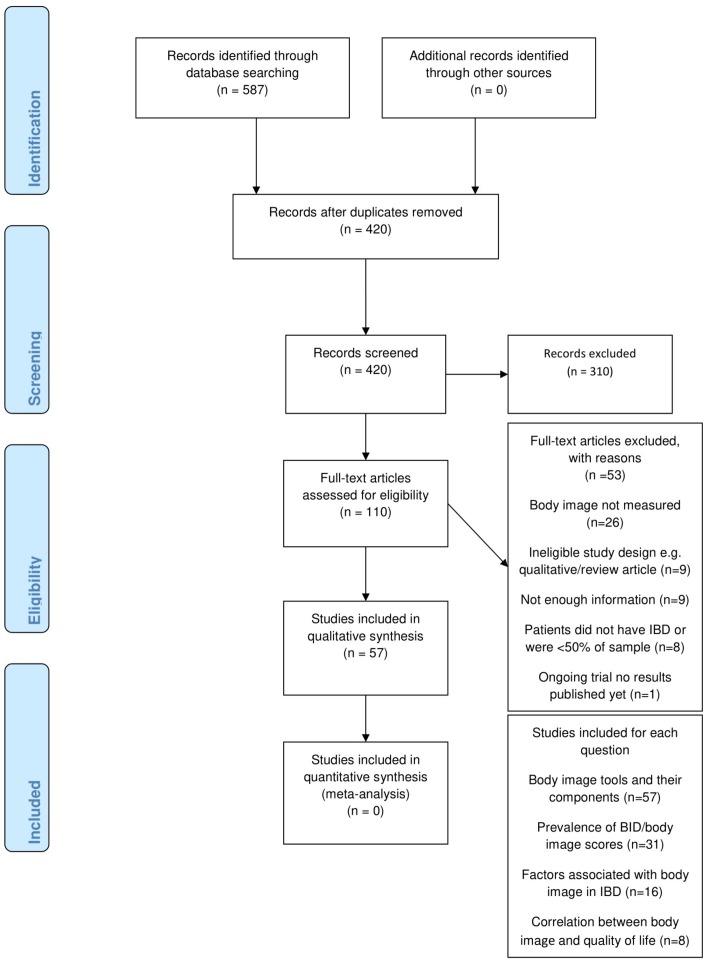
Fifty-seven studies using a body image tool were included; 31 for prevalence and 16 and 8 for associated factors and association with quality of life, respectively. Studies reported mainly mean or median scores. Evidence suggested female gender, age, fatigue, disease activity and steroid use were associated with increased body image dissatisfaction, which was also associated with decreased quality of life.
This is the first systematic review on body image in patients with IBD. The evidence suggests that body image dissatisfaction can negatively impact patients, and certain factors are associated with increased body image dissatisfaction. Greater body image dissatisfaction was also associated with poorer quality of life. However, the methodological and reporting quality of studies was in some cases poor with considerable heterogeneity. Future IBD research should incorporate measurement of body image dissatisfaction using validated tools.
关于炎症性肠病(IBD)与身体意象之间的关系,人们所知甚少。本系统评价的目的是总结IBD患者身体意象不满在四个方面的证据:(1)身体意象评估工具;(2)患病率;(3)IBD患者身体意象不满的相关因素;(4)IBD与生活质量之间的关联。
两名评价者对研究进行重复筛选、选择、质量评估和数据提取。检索EMBASE、MEDLINE、PsycINFO和Cochrane CENTRAL数据库至2018年4月。使用特定研究设计的关键评价工具评估偏倚风险。由于存在异质性,进行了叙述性分析。
纳入了57项使用身体意象评估工具的研究;分别有31项研究涉及患病率,16项和8项研究涉及相关因素以及与生活质量的关联。研究主要报告了均值或中位数得分。有证据表明,女性、年龄、疲劳、疾病活动度和使用类固醇与身体意象不满增加有关,而身体意象不满也与生活质量下降有关。
这是关于IBD患者身体意象的首次系统评价。有证据表明,身体意象不满会对患者产生负面影响,某些因素与身体意象不满增加有关。身体意象不满程度越高,生活质量也越差。然而,在某些情况下,研究的方法学和报告质量较差,且存在相当大的异质性。未来IBD研究应采用经过验证的工具纳入对身体意象不满的测量。