Simpkin Victoria, Namubiru-Mwaura Evelyn, Clarke Lorcan, Mossialos Elias
Department of Health Policy, London School of Economics and Political Science, London, UK.
Africa Centre, Stockholm Environment Institute, Nairobi, Kenya.
BMJ Glob Health. 2019 Mar 4;4(2):e001047. doi: 10.1136/bmjgh-2018-001047. eCollection 2019.
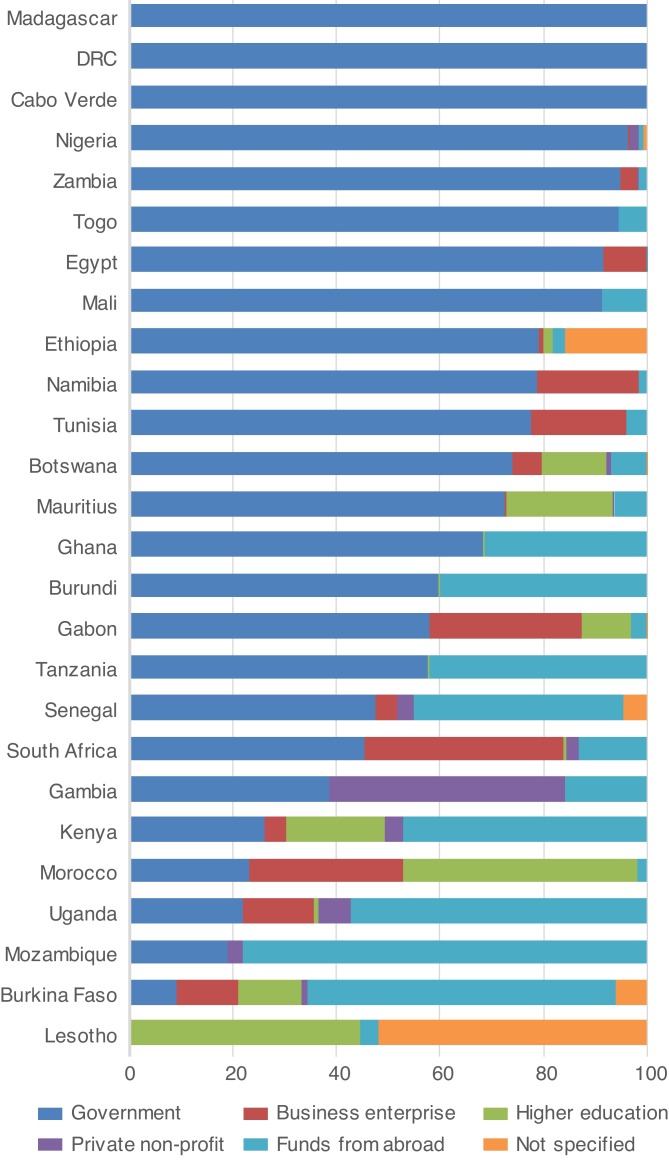
Global research and development (R&D) pipelines for diseases that disproportionately affect African countries appear to be inadequate, with governments struggling to prioritise investment in R&D. This article provides insights into the sources of investment in health science research, available research capacity and level of research output in Africa. The African region comprises 15% of the world's population, yet only accounted for 1.1% of global investments in R&D in 2016. There were substantial disparities within the continent, with Egypt, Nigeria and South Africa contributing 65.7% of the total R&D spending. In most countries of the Organisation for Economic Co-operation and Development, the largest source of R&D funding is the private sector. R&D in Africa is mainly funded by the public sector, with significant proportions of financing in many countries coming from international funding. Challenges that limit private sector investment include unstable political environments, poor governance and corruption. Evidence suggests various research output and research capacity limitations in Africa when considering a global context. Metrics that reflect this include university rankings, number of researchers, number of publications, clinical trials networks and pharmaceutical manufacturing capacity. Within the continent there are substantial regional disparities. Incentivising investment is crucial to foster current and future research output and research capacity. This paper outlines some of the many commendable initiatives under way. Innovative and collaborative financing mechanisms can stimulate further investment. Given the vast inequalities across Africa in R&D, strategies need to reflect the different capacities of countries to address this disparity.
对非洲国家影响尤为严重的疾病的全球研发(R&D)渠道似乎并不充足,各国政府难以确定研发投资的优先次序。本文深入探讨了非洲卫生科学研究的投资来源、现有的研究能力以及研究产出水平。非洲地区占世界人口的15%,但在2016年,其仅占全球研发投资的1.1%。非洲大陆内部存在巨大差异,埃及、尼日利亚和南非的研发支出占总支出的65.7%。在大多数经济合作与发展组织国家,研发资金的最大来源是私营部门。非洲的研发主要由公共部门资助,许多国家相当一部分资金来自国际资助。限制私营部门投资的挑战包括不稳定的政治环境、治理不善和腐败。有证据表明,在全球背景下,非洲在研究产出和研究能力方面存在各种限制。反映这一点的指标包括大学排名、研究人员数量、出版物数量、临床试验网络和制药生产能力。非洲大陆内部存在显著的地区差异。激励投资对于促进当前和未来的研究产出及研究能力至关重要。本文概述了正在开展的一些值得称赞的举措。创新和合作的融资机制可以刺激进一步投资。鉴于非洲在研发方面存在巨大不平等,战略需要反映各国解决这一差距的不同能力。