Cabel Luc, Decraene Charles, Bieche Ivan, Pierga Jean-Yves, Bennamoun Mostefa, Fuks David, Ferraz Jean-Marc, Lefevre Marine, Baulande Sylvain, Bernard Virginie, Vacher Sophie, Mariani Pascale, Proudhon Charlotte, Bidard Francois-Clement, Louvet Christophe
Department of Medical Oncology, Institut Curie, PSL Research University, 75005 Paris and 92210 Saint Cloud, France.
Versailles-Saint-Quentin University, Paris-Saclay University, 92210 Saint Cloud, France.
Cancers (Basel). 2019 Mar 21;11(3):396. doi: 10.3390/cancers11030396.
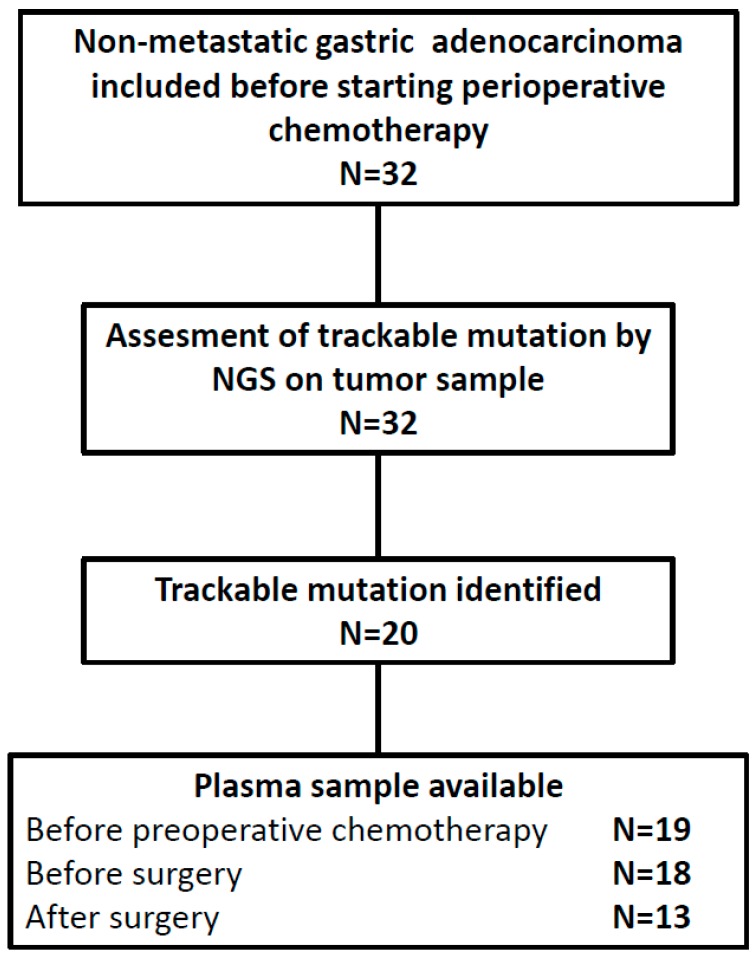
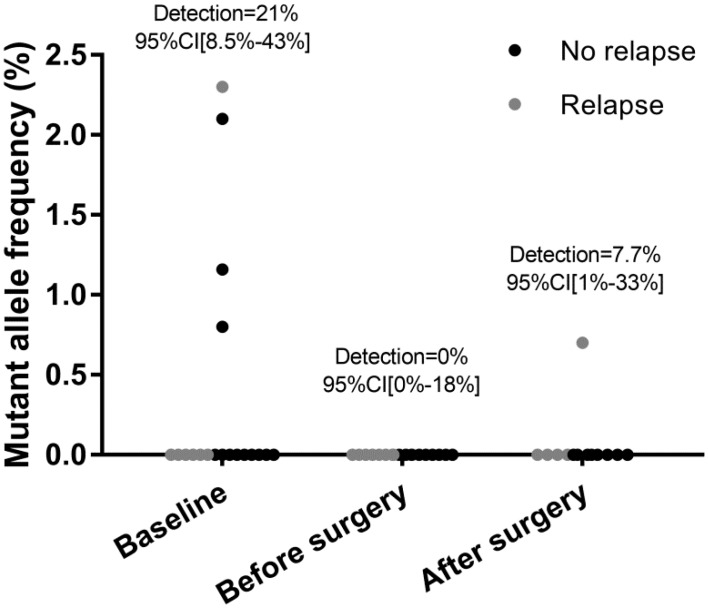
This study was designed to monitor circulating tumor DNA (ctDNA) levels during perioperative chemotherapy in patients with non-metastatic gastric adenocarcinoma. Plasma samples were prospectively collected in patients undergoing perioperative chemotherapy for non-metastatic gastric adenocarcinoma (excluding T1N0) prior to the initiation of perioperative chemotherapy, before and after surgery (NCT02220556). In each patient, mutations retrieved by targeted next-generation sequencing (NGS) on tumor samples were then tracked in circulating cell-free DNA from 4 mL of plasma by droplet digital PCR. Thirty-two patients with a diagnosis of non-metastatic gastric adenocarcinoma were included. A trackable mutation was identified in the tumor in 20 patients, seven of whom experienced relapse during follow-up. ctDNA was detectable in four patients ( = 4/19, sensitivity: 21%; 95% confidence interval CI = 8.5⁻43%, no baseline plasma sample was available for one patient), with a median allelic frequency (MAF) of 1.6% (range: 0.8⁻2.3%). No patient with available plasma samples ( = 0/18) had detectable ctDNA levels before surgery. After surgery, one of the 13 patients with available plasma samples had a detectable ctDNA level with a low allelic frequency (0.7%); this patient experienced a very short-term distant relapse only 3 months after surgery. No ctDNA was detected after surgery in the other four patients with available plasma samples who experienced a later relapse (median = 14.4, range: 9.3⁻26 months). ctDNA monitoring during preoperative chemotherapy and after surgery does not appear to be a useful tool in clinical practice for non-metastatic gastric cancer to predict the efficacy of chemotherapy and subsequent relapse, essentially due to the poor sensitivity of ctDNA detection.
本研究旨在监测非转移性胃腺癌患者围手术期化疗期间循环肿瘤DNA(ctDNA)水平。前瞻性收集了接受围手术期化疗的非转移性胃腺癌(不包括T1N0)患者在围手术期化疗开始前、手术前后的血浆样本(NCT02220556)。然后,通过液滴数字PCR在4 mL血浆的循环游离DNA中追踪每位患者肿瘤样本经靶向二代测序(NGS)获得的突变。纳入了32例诊断为非转移性胃腺癌的患者。20例患者的肿瘤中鉴定出可追踪的突变,其中7例在随访期间复发。4例患者可检测到ctDNA(=4/19,敏感性:21%;95%置信区间CI=8.5⁻43%,1例患者无基线血浆样本),中位等位基因频率(MAF)为1.6%(范围:0.8⁻2.3%)。没有可获得血浆样本的患者(=0/18)在手术前可检测到ctDNA水平。手术后,13例可获得血浆样本的患者中有1例ctDNA水平可检测到,等位基因频率较低(0.7%);该患者仅在术后3个月就出现了非常短期的远处复发。另外4例可获得血浆样本且后来复发的患者(中位时间=14.4,范围:9.3⁻26个月)术后未检测到ctDNA。术前化疗和术后的ctDNA监测在临床实践中似乎并非预测非转移性胃癌化疗疗效和后续复发的有用工具,主要是因为ctDNA检测的敏感性较差。