Oncode Institute, Hubrecht Institute⁻KNAW and University Medical Center Utrecht, Utrecht, The Netherlands.
Cells. 2019 Mar 21;8(3):271. doi: 10.3390/cells8030271.
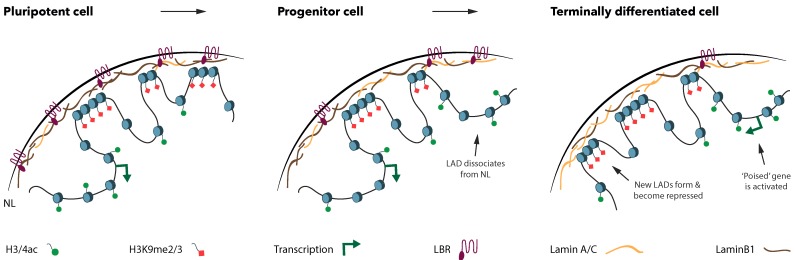
The nuclear lamina (NL) is a thin meshwork of filaments that lines the inner nuclear membrane, thereby providing a platform for chromatin binding and supporting genome organization. Genomic regions contacting the NL are lamina associated domains (LADs), which contain thousands of genes that are lowly transcribed, and enriched for repressive histone modifications. LADs are dynamic structures that shift spatial positioning in accordance with cell-type specific gene expression changes during differentiation and development. Furthermore, recent studies have linked the disruption of LADs and alterations in the epigenome with the onset of diseases such as cancer. Here we focus on the role of LADs and the NL in gene regulation during development and cancer.
核层(NL)是一种排列在内核膜上的薄丝状网络,为染色质结合提供了一个平台,并支持基因组的组织。与 NL 接触的基因组区域是核层相关结构域(LAD),其中包含数千个转录水平低的基因,并富含抑制性组蛋白修饰。LAD 是动态结构,在分化和发育过程中随着细胞类型特异性基因表达变化而改变空间定位。此外,最近的研究将 LAD 的破坏和表观基因组的改变与癌症等疾病的发生联系起来。在这里,我们重点介绍 LAD 和 NL 在发育和癌症过程中的基因调控中的作用。