Saliba Najat A, El Hellani Ahmad, Honein Edward, Salman Rola, Talih Soha, Zeaiter Joseph, Shihadeh Alan
Department of Chemistry, Faculty of Arts and Science, American University of Beirut.
Center for the Study of Tobacco Products, Virginia Commonwealth University, Richmond, Virginia, USA.
J Anal Appl Pyrolysis. 2018 Sep;134:520-525. doi: 10.1016/j.jaap.2018.07.019. Epub 2018 Jul 26.
Carbonyls, a class of compounds strongly linked to pulmonary disease in smokers, are probably the most reported non-nicotine toxicants found aerosols. Reported emissions vary from negligible quantities to those far exceeding combustible cigarettes. Observations of high emissions are commonly attributed to "dry puffing", whereby the ECIG heating filament runs dry of liquid and reaches temperatures that induce thermal degradation of the ECIG vapor components at the filament's metal surface. Using a pyrolysis flow reactor, in this study we examined the potential role of surface chemistry in the formation of carbonyl compounds in ECIGs, and whether the different commercially available filament materials could potentially impact their toxicant emissions through catalysis. This information could inform nascent efforts to regulate the design of ECIGs for public health ends.
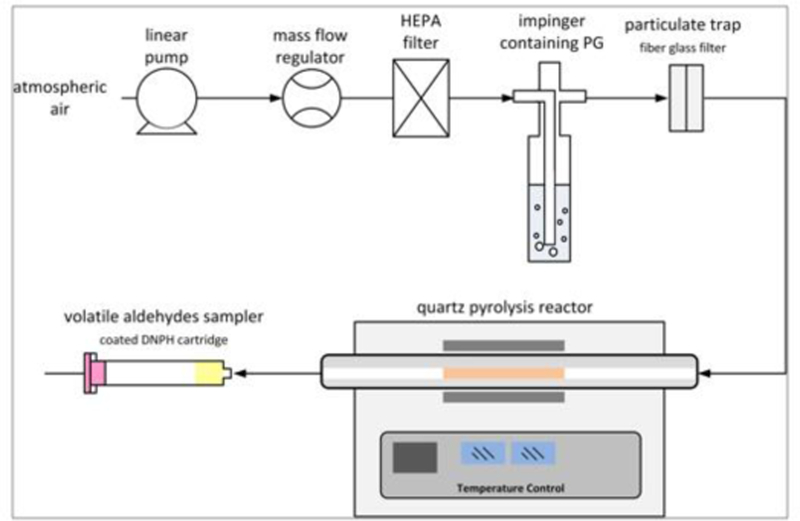
Nitrogen or air saturated with propylene glycol vapor was drawn through a temperature and residence time controlled tubular quartz pyrolysis flow reactor in which nichrome, Kanthal, or stainless steel ECIG heating filament wires were inserted. A control condition with no inserted wire was also included. Concentrations of carbonyl products at the reactor outlet were measured as a function of temperature, heating filament wire material, and carrier gas composition (N2 vs air). Carbonyls were sampled using DNPH cartridges and analyzed by HPLC.
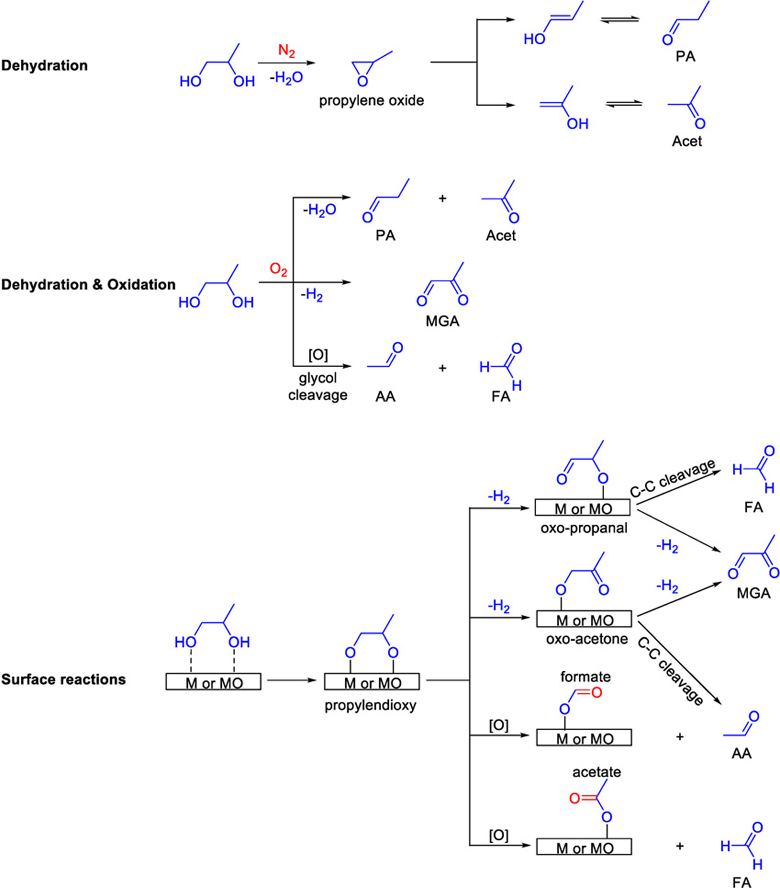
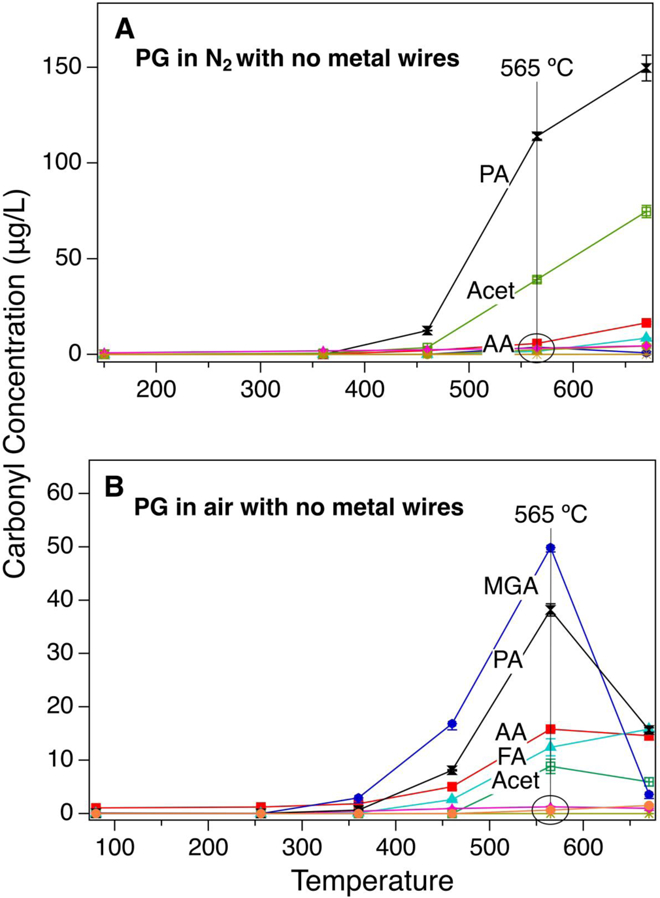
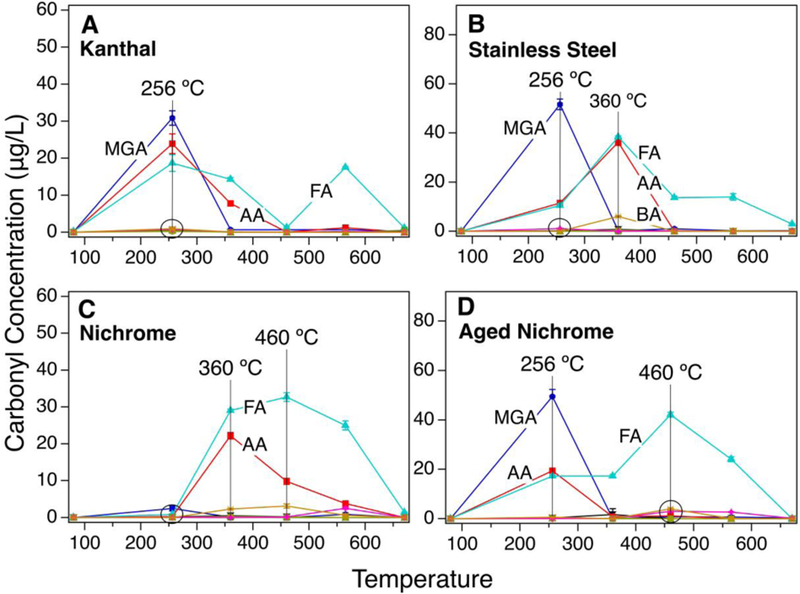
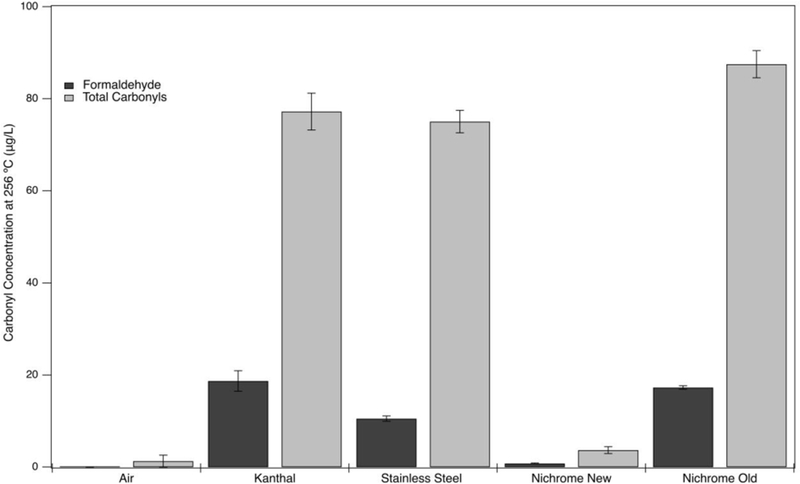
ECIG heating filament wires were found to have a strong catalytic effect. Carbonyl formation initiated at temperatures lower than 250°C in the presence of the metallic wires, compared to 460°C without them. Carbonyl formation was found to be a function of the material of construction, and whether the wire was new or aged. New nichrome wires were the least reactive, but when aged they exhibited the highest reactivity. Carbonyls were formed via dehydration or oxidation reactions of PG.
Carbonyl formation chemistry is catalyzed by commonly used ECIG heating filament materials, at temperatures that are well below those expected during "dry puffing". The variability in the distribution and yield of carbonyl compounds across ECIG filament materials suggests that this heretofore unaccounted variable may partially explain the wide ranges reported in the literature to date. More importantly, it suggests that ECIG construction materials may be an important variable for regulations designed to protect public health.
羰基化合物是一类与吸烟者肺部疾病密切相关的化合物,可能是雾化物中报道最多的非尼古丁毒物。报道的排放量从可忽略不计到远远超过可燃香烟的排放量不等。高排放量的观察结果通常归因于“干抽”,即电子烟加热丝干涸,达到能在金属丝表面引发电子烟蒸汽成分热降解的温度。在本研究中,我们使用热解流动反应器,研究了表面化学在电子烟羰基化合物形成中的潜在作用,以及不同市售的加热丝材料是否可能通过催化作用影响其毒物排放。这些信息可为当前为公共卫生目的规范电子烟设计的努力提供参考。
将饱和丙二醇蒸汽的氮气或空气通过一个温度和停留时间可控的管式石英热解流动反应器,其中插入了镍铬合金、康泰尔或不锈钢电子烟加热丝。还包括一个未插入金属丝的对照条件。测量反应器出口处羰基产物的浓度,作为温度、加热丝材料和载气组成(氮气与空气)的函数。使用2,4-二硝基苯肼(DNPH)柱采样羰基化合物,并通过高效液相色谱(HPLC)进行分析。
发现电子烟加热丝具有很强的催化作用。与没有金属丝时460°C相比,在有金属丝存在的情况下,羰基形成在低于250°C的温度下就开始了。发现羰基形成是结构材料以及金属丝是新的还是老化的函数。新的镍铬合金丝反应性最低,但老化后反应性最高。羰基化合物是通过丙二醇的脱水或氧化反应形成的。
常用的电子烟加热丝材料在远低于“干抽”预期温度的条件下催化羰基形成化学反应。电子烟丝材料中羰基化合物分布和产率的变异性表明,这个迄今为止未被考虑的变量可能部分解释了迄今为止文献中报道的广泛范围。更重要的是,这表明电子烟结构材料可能是旨在保护公众健康的法规中的一个重要变量。