Yang Mingxiao, Lao Lixing
School of Chinese Medicine, LKS Faculty of Medicine, The University of Hong Kong, Hong Kong, China.
Department of Chinese Medicine, The University of Hong Kong-Shenzhen Hospital, Shenzhen, China.
Front Pharmacol. 2019 Mar 8;10:158. doi: 10.3389/fphar.2019.00158. eCollection 2019.
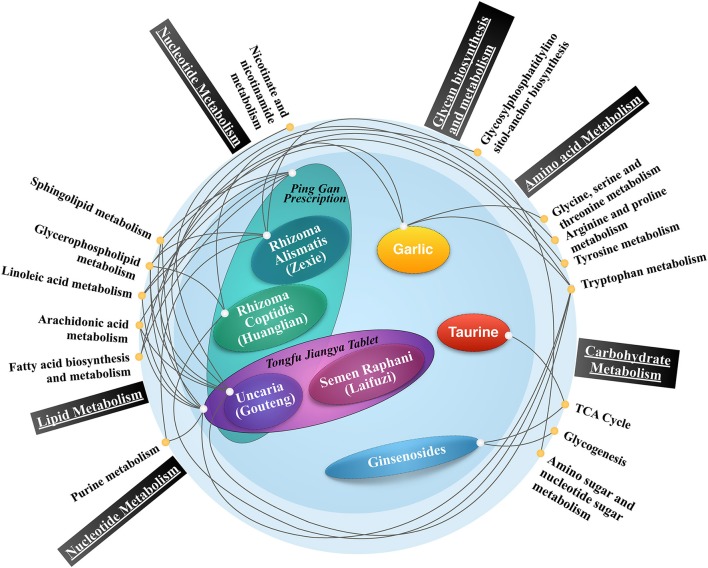
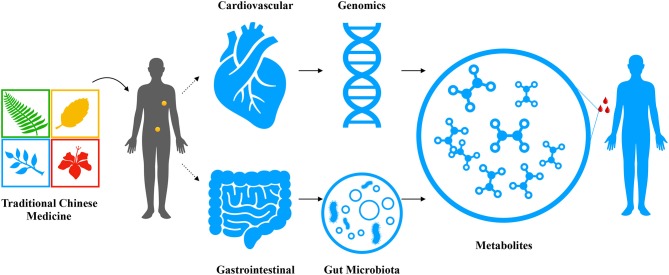
Hypertension is a prevalent, complex, and polygenic cardiovascular disease, which is associated with increased mortality and morbidity. Across the world, traditional Chinese medicine (TCM) constituted by herbal medicine and non-pharmacological therapies is used to assist blood pressure management. Though widely accepted in daily practice, its mechanism remains largely unknown. Recent years saw a number of studies utilizing metabolomics technologies to elucidate the biological foundation of the antihypertensive effect of TCM. Metabolomics is a relatively "young" omics approach that has gained enormous attention recently in cardiovascular drug discovery and pharmacology studies of natural products. In this review, we described the use of metabolomics in deciphering TCM diagnostic codes for hypertension and in revealing molecular events that drive the antihypertensive effect. By corroborating the diagnostic rules, there's accumulating evidence showing that metabolic profile could be the signature of different syndromes/patterns of hypertension, which offers new perspectives for disease diagnosis and efficacy optimization. Moreover, TCM treatment significantly altered the metabolic perturbations associated with hypertension, which could be a crucial mechanism of the therapeutic effect of TCM. Not only significantly rebalances the dynamics of metabolic flux, TCM but also elicits metabolic network reorganization through restoring the functions of key metabolites, and metabolic pathways. The role of TCM in regulating metabolic perturbations will be informative to researchers seeking new leads for drug discovery. This review further envisioned the promises of employing metabolomics to explore network pharmacology, host-gut microbiota interactions and metabolic reprogramming in TCM, and possible herb-drug interactions in this field in future.
高血压是一种常见、复杂的多基因心血管疾病,与死亡率和发病率的增加相关。在全球范围内,由草药和非药物疗法构成的传统中医被用于辅助血压管理。尽管在日常实践中被广泛接受,但其机制在很大程度上仍不为人知。近年来,一些研究利用代谢组学技术来阐明中药降压作用的生物学基础。代谢组学是一种相对“年轻”的组学方法,最近在心血管药物发现和天然产物的药理学研究中受到了极大关注。在这篇综述中,我们描述了代谢组学在解读高血压的中医诊断编码以及揭示驱动降压作用的分子事件方面的应用。通过确证诊断规则,越来越多的证据表明代谢谱可能是高血压不同证型的特征,这为疾病诊断和疗效优化提供了新的视角。此外,中药治疗显著改变了与高血压相关的代谢紊乱,这可能是中药治疗作用的关键机制。中药不仅能显著重新平衡代谢通量的动态变化,还能通过恢复关键代谢物和代谢途径的功能引发代谢网络重组。中药在调节代谢紊乱方面的作用将为寻求新药研发新线索的研究人员提供信息。这篇综述进一步展望了利用代谢组学探索中药网络药理学、宿主 - 肠道微生物群相互作用和代谢重编程以及该领域未来可能的药 - 药相互作用的前景。