Takase Hideto, Sakane Naoki, Morimoto Toshihisa, Uchida Takanobu, Mori Kenta, Katashima Mitsuhiro, Katsuragi Yoshihisa
Biological Science Research, Kao Corporation, 2-1-3, Bunka, Sumida-ku, Tokyo 131-8501, Japan.
Division of Preventive Medicine, Clinical Research Institute, National Hospital Organization Kyoto Medical Center, 1-1, Fukakusamukaihata-cho, Fushimi-ku, Kyoto 612-8555, Japan.
J Obes. 2019 Feb 13;2019:9497861. doi: 10.1155/2019/9497861. eCollection 2019.
The increased prevalence of metabolic syndrome necessitates the establishment of tools for evaluating dietary factors associated with visceral fat accumulation and preventing visceral fat obesity. Here, we aimed to develop a dietary factor assessment tool for evaluating visceral fat accumulation.
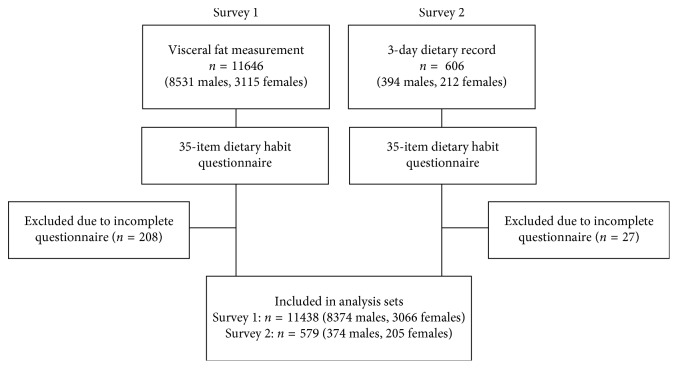
We conducted a dietary habit questionnaire survey and visceral fat measurement by bioelectrical impedance analysis in 11,438 adults (Survey 1) and a dietary habit questionnaire survey and dietary assessment based on 3-day meal records in 579 adults (Survey 2). Dietary habit factors were identified by factor analysis with varimax rotation, and their relationship with visceral fat accumulation and major nutrients were analyzed.
Factor analysis of the dietary habit questionnaire revealed the following five main dietary factors: "Appetite (15 questions)," "Healthy food choice (5 questions)," "Sedentary behavior (6 questions)," "Calorie restriction (5 questions)," and "Irregular mealtime (4 questions)." "Appetite" correlated positively with visceral fat accumulation and energy intake mainly from carbohydrate. "Healthy food choice" correlated negatively with visceral fat accumulation and positively with the protein/fat ratio, dietary fiber/carbohydrate ratio, and N-3 fatty acid/fat ratio. Dietary guidance to modify excess energy intake and increase nutritional balance might be effective toward preventing visceral fat accumulation.
The dietary factor assessment tool developed in this study can be used to diagnose problems related to dietary habits and provide guidance for dietary modifications aimed at preventing visceral fat accumulation.
代谢综合征患病率的上升使得有必要建立评估与内脏脂肪堆积相关的饮食因素以及预防内脏脂肪型肥胖的工具。在此,我们旨在开发一种用于评估内脏脂肪堆积的饮食因素评估工具。
我们对11438名成年人进行了饮食习惯问卷调查,并通过生物电阻抗分析测量了内脏脂肪(调查1),还对579名成年人进行了饮食习惯问卷调查以及基于3天饮食记录的饮食评估(调查2)。通过最大方差旋转因子分析确定饮食习惯因素,并分析其与内脏脂肪堆积及主要营养素的关系。
饮食习惯问卷的因子分析揭示了以下五个主要饮食因素:“食欲(15个问题)”、“健康食物选择(5个问题)”、“久坐行为(6个问题)”、“热量限制(5个问题)”和“用餐时间不规律(4个问题)”。“食欲”与内脏脂肪堆积以及主要来自碳水化合物的能量摄入呈正相关。“健康食物选择”与内脏脂肪堆积呈负相关,与蛋白质/脂肪比、膳食纤维/碳水化合物比以及N-3脂肪酸/脂肪比呈正相关。调整过量能量摄入并增加营养平衡的饮食指导可能对预防内脏脂肪堆积有效。
本研究开发的饮食因素评估工具可用于诊断与饮食习惯相关的问题,并为旨在预防内脏脂肪堆积的饮食调整提供指导。