Nuffield Centre for International Health and Development, Leeds Institute of Health Sciences, University of Leeds, Leeds, United Kingdom.
HERD International, Prasuti Griha Marg, Kathmandu, Nepal.
PLoS One. 2019 Mar 25;14(3):e0214142. doi: 10.1371/journal.pone.0214142. eCollection 2019.
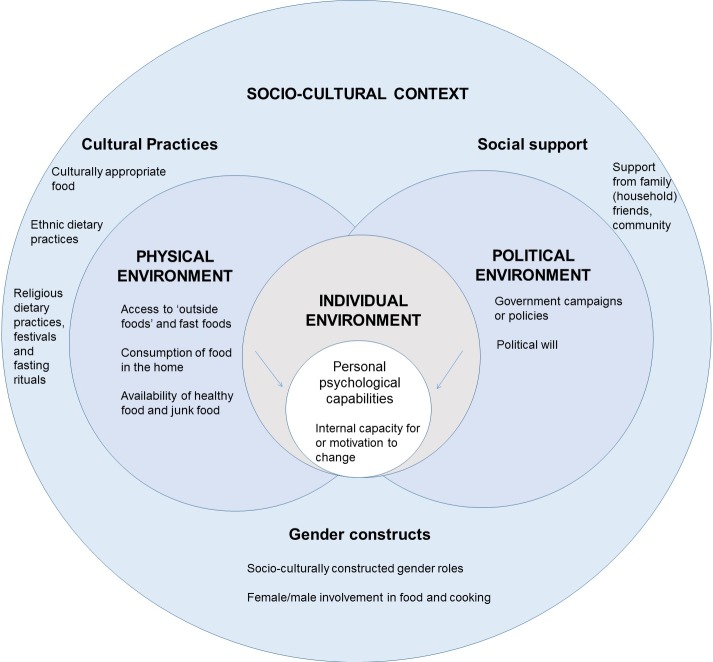
Instances of non-communicable diseases such as diabetes are on the rise globally leading to greater morbidity and mortality, with the greatest burden in low and middle income countries [LMIC]. A major contributing factor to diabetes is unhealthy dietary behaviour. We conducted 38 semi structured interviews with patients, health professionals, policy-makers and researchers in Kathmandu, Nepal, to better understand the determinants of dietary behaviour amongst patients with diabetes and high blood glucose levels. We created a social ecological model which is specific to socio-cultural context with our findings with the aim of informing culturally appropriate dietary behaviour interventions for improving dietary behaviour. Our findings show that the most influential determinants of dietary behaviour include cultural practices (gender roles relating to cooking), social support (from family and friends), the political and physical environment (political will, healthy food availability) and individuals' motivations and capabilities. Using these most influential determinants, we suggest potentially effective dietary interventions that could be implemented by policy makers. Our findings emphasise the importance of considering socio-cultural context in developing interventions and challenges one-size-fits-all approaches which are often encouraged by global guidelines. We demonstrate how multifaceted and multi layered models of behavioural influence can be used to develop policy and practice with the aim of reducing mortality and morbidity from diabetes.
在全球范围内,糖尿病等非传染性疾病的发病率不断上升,导致发病率和死亡率上升,中低收入国家的负担最大[LMIC]。不健康的饮食行为是导致糖尿病的一个主要因素。我们在尼泊尔加德满都对患者、卫生专业人员、政策制定者和研究人员进行了 38 次半结构化访谈,以更好地了解糖尿病和高血糖患者饮食行为的决定因素。我们根据研究结果创建了一个特定于社会文化背景的社会生态模型,旨在为改善饮食行为提供文化上适当的饮食行为干预措施。我们的研究结果表明,饮食行为最具影响力的决定因素包括文化习俗(与烹饪有关的性别角色)、社会支持(来自家庭和朋友)、政治和物理环境(政治意愿、健康食品供应)以及个人的动机和能力。利用这些最具影响力的决定因素,我们提出了一些可能有效的饮食干预措施,这些措施可以由政策制定者实施。我们的研究结果强调了在制定干预措施时考虑社会文化背景的重要性,挑战了全球指南经常鼓励的一刀切的方法。我们展示了如何使用多方面和多层次的行为影响模型来制定政策和实践,以降低糖尿病的死亡率和发病率。